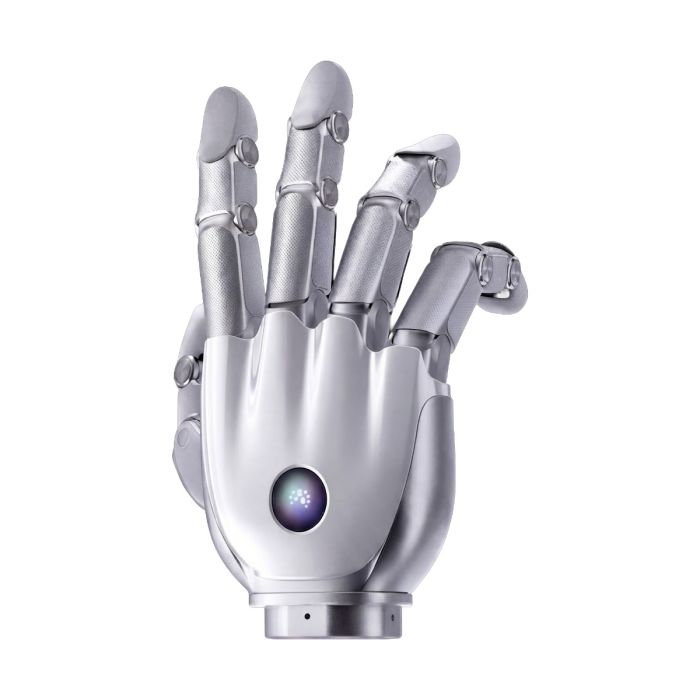
BrainCo Revo 3-21 V-Touch Robot Hand
In stock
- MARKA:
- BRAINCO
- MODEL:
- REVO 3-21 V-TOUCH
- ORIGIN:
- Kina
- Warranty:
- 12 MJESECI
- AVAILABILITY:
- SUBJECT TO AVAILABILITY
- SKU:
- BrainCo-Revo-3-V-Touch
BrainCo Revo 3-21 V-Touch Robot Hand
BrainCo Revo 3-21 V-Touch Robot Hand: Complete Overview, Specifications, and Applications
The defining characteristics of the Revo 3 are its 21 degrees of freedom, its fully direct-drive backdrivable joint architecture, and its dual-layer tactile sensing system that integrates full-palm sensing with fingertip visuotactile sensing. The "V-Touch" designation reflects this visuotactile capability, which allows the hand to detect object deformation at approximately 130 micrometers while simultaneously using visual input to understand the geometry and surface properties of objects it contacts. This combination of touch and vision at the fingertip level enables a class of in-hand manipulation that goes well beyond simple grasping, making the Revo 3 relevant to humanoid robot deployment, academic research in embodied AI, and precision automation tasks. BrainCo, formally known as Zhejiang BrainCo Technology Co., Ltd. or 强脑科技 in Chinese, was founded in 2015 by Han Bicheng while he was pursuing doctoral research at Harvard University's Center for Brain Science. The company was incubated in the Harvard Innovation Lab and has grown into one of the most prominent non-invasive brain-computer interface companies in the world, being named one of Hangzhou's "Six Little Dragons" alongside AI company DeepSeek and robotics leader Unitree. The company's prosthetic hand line received FDA clearance as a Class II medical device in November 2022, and it has accumulated more than 360 patents in the brain-computer interface and related fields.
Design and Features
Architecture: Direct Drive and Backdrivability
The most fundamental design decision in the Revo 3 is its fully direct-drive joint architecture. In most robotic hands, including many high-end research platforms, motors connect to finger joints through transmission elements such as tendons, gears, or linkages. These transmissions introduce mechanical compliance, backlash, and friction, which degrade precision and make it difficult for the hand to sense forces through its joints. A direct-drive design eliminates the intermediary transmission, coupling each motor output directly to its joint. This produces several meaningful advantages: lower mechanical latency, finer force resolution, the ability to detect external forces through motor current without dedicated force sensors at every joint, and improved reliability in the absence of wear-prone transmission components.
Backdrivability refers to how easily an external force can move the joint when the motor is not actively resisting it. A backdrivable joint can be pushed by a human or an object it contacts, and the motor can sense this interaction through back-EMF or current feedback. For contact-rich manipulation, backdrivability is essential: it allows the hand to comply gracefully with objects, register contact events, and perform dexterous adjustments without breaking or jamming against the object. The Revo 3's fully backdrivable design, applied across all 21 degrees of freedom, gives it the ability to feel objects through its joints rather than relying exclusively on dedicated tactile sensors.
21 Degrees of Freedom
The Revo 3's 21 degrees of freedom represent a substantial increase over the 11 DoF of the Revo 2. For context, the human hand possesses approximately 27 degrees of freedom, encompassing all finger joints, the wrist, and the palm arch. The Revo 3's 21 DoF places it closer to the human hand's functional range than most competing platforms, enabling movement patterns that simpler hands cannot replicate, including in-hand object rotation, finger gaiting, and tool manipulation.
Modular Design and Finger Configurations
The Revo 3 supports a modular design that accommodates different finger configurations, giving deployers flexibility to adapt the hand to specific task requirements. This modularity is particularly valuable in research contexts where investigators may want to study specific subsets of hand kinematics or integrate the hand with different robotic arm platforms.
Technology and Specifications
Visuotactile Sensing: The V-Touch System
The "V-Touch" designation distinguishes the Revo 3's fingertip sensing from conventional tactile sensors. Standard tactile sensors measure mechanical contact forces across an array of pressure-sensitive elements. The Revo 3's fingertip visuotactile system adds a visual component: a small embedded camera behind a translucent elastic fingertip membrane captures deformation patterns as the finger contacts an object. By analyzing how the membrane deforms, the system extracts geometric information about the contact surface, including curvature, edge orientation, and local texture, at a spatial resolution finer than typical pressure arrays. The system can detect surface deformation at approximately 130 micrometers, a level of sensitivity that enables the hand to distinguish fine surface features that would be imperceptible to standard tactile sensors.
At the palm level, the Revo 3 integrates full-palm tactile sensing at a force resolution of 0.01 Newtons, which is fine enough to detect extremely light contacts across the broad surface area of the hand. When combined with the fingertip visuotactile layer, the hand can build a rich, real-time map of its contact state with objects it holds, which is the foundational capability needed for stable in-hand manipulation, rather than simple pick-and-place grasping.
Control Frequency and Control Modes
The Revo 3 operates at a control frequency of 500 Hz, meaning its control loop runs 500 times per second. This rate is well above the threshold needed for stable impedance control and responsive force regulation in contact-rich tasks. The hand supports four control modes: position control, impedance control, MIT force-position control, and zero-torque mode. The availability of zero-torque mode is particularly significant for safety-critical applications, allowing the hand to go limp and exert negligible force when needed, such as during unexpected contact with a person or a delicate object.
Grasp Types and Range of Motion
The Revo 3 supports 33 distinct grasp types, covering the functional grasp taxonomy used in occupational therapy and robotics manipulation research. This includes precision pinch grasps, lateral grasps, power grasps, hook grasps, and specialized configurations for tools, containers, and irregular objects. In Kapandji testing, a clinical assessment standard used to evaluate the range and opposition capability of the thumb, the Revo 3 exceeds the typical range of the human hand. This means the robot hand can achieve thumb-to-finger oppositions that a human hand cannot, which is advantageous for manipulating small objects in constrained spaces.
The pinch force reaches 20 Newtons, sufficient for picking up small to medium weight objects and for applying controlled force during assembly tasks. The 3 Hz open-close cycle rate indicates how quickly the hand can transition between fully open and fully closed states, relevant to throughput in tasks requiring repetitive grasping.
Communication Interfaces and Power
The Revo 3 supports three communication protocols: EtherCAT, CAN FD, and RS-485. EtherCAT is the highest-bandwidth option and is the standard choice for industrial automation systems requiring high-rate synchronized control. CAN FD offers a good balance of bandwidth and robustness for robotics integration. RS-485 provides a simpler, cost-effective option for less demanding control scenarios. The hand operates across a wide power input range of 12 to 80 volts, accommodating a broad range of robot platform power systems and laboratory supply configurations without requiring dedicated power conversion.
Key Technical Specifications
| Specification | Detail |
|---|---|
| Degrees of Freedom | 21 |
| Joint Architecture | Direct-drive, fully backdrivable |
| Palm Tactile Sensing Resolution | 0.01 N |
| Fingertip Sensing Type | Visuotactile (V-Touch), ~130 μm deformation detection |
| Control Frequency | 500 Hz |
| Control Modes | Position, impedance, MIT force-position, zero-torque |
| Pinch Force | 20 N |
| Grasp Types | 33 |
| Kapandji Range | Exceeds typical human range |
| Open-Close Cycle Rate | 3 Hz |
| Communication Protocols | EtherCAT, CAN FD, RS-485 |
| Operating Voltage | 12 to 80 V |
| Ecosystem | Open ecosystem, sim2real support, one-click deployment |
Applications and Use Cases
Humanoid Robotics
The Revo 3 is positioned first and foremost as an end-effector for full-size humanoid robot platforms. The 2025 and 2026 generation of humanoid robots has brought hand dexterity into sharp focus: many bipedal platforms now have robust locomotion but struggle with the fine manipulation tasks required in real industrial and domestic environments. The Revo 3's 21 DoF, direct-drive architecture, and rich tactile sensing directly address this gap. Its predecessor, the Revo 2, was already integrated into production configurations of humanoid platforms including variants of the Unitree R1, where five-finger BrainCo hands appeared in the Pro C and Pro D configurations. The Revo 3 is expected to serve similar integration roles as it moves toward commercial availability.
Embodied AI Research
Universities and industrial research labs working on grasp learning, tactile policy learning, and foundation model fine-tuning for physical AI benefit from the Revo 3's high-resolution sensing output. Training manipulation policies on real hardware has historically been limited by the sparsity of tactile feedback available in most hands. The Revo 3's palm-level and visuotactile fingertip data provide a richer signal that can improve the generalization of learned grasping and manipulation policies across object geometries and surface textures.
The hand's sim2real support, meaning the compatibility between its simulated model and its physical behavior, is particularly relevant for researchers using simulation environments to generate large-scale training data before transfer to physical hardware. One-click deployment tooling reduces the engineering overhead required to get simulation-trained policies running on real hardware.
Industrial Assembly and Precision Automation
Industrial automation applications that require anthropomorphic end-effectors benefit from the Revo 3's combination of precision and force range. Electronics assembly tasks such as connector insertion, cable routing, and component placement require fine positional control and contact sensing to succeed reliably without damaging fragile parts. The Revo 3's 500 Hz control rate and 0.01 N tactile resolution provide the sensing and actuation bandwidth needed for these tasks. Its multi-protocol industrial bus support facilitates integration with existing industrial automation controllers and test-cell environments.
Prosthetics Research and Rehabilitation Engineering
While the Revo 3 is not itself a prosthetic device, BrainCo's deep background in prosthetics means that insights from its clinical prosthetic hand research continue to influence the Revo 3's design. Rehabilitation engineering research that studies hand kinematics, grasp strategies, or assistive technology for individuals with upper limb differences can leverage the Revo 3 as a high-fidelity research tool. The hand's 21 DoF and human-range motion profile make it a useful proxy for studying human hand function.
Advantages and Benefits
Full direct-drive backdrivability across all 21 DoF. The absence of transmission elements improves sensing fidelity through joint current feedback, reduces mechanical failure modes, lowers latency in force control, and makes the hand's feel and compliance more natural in contact with objects and people.
Dual-layer tactile sensing. The combination of full-palm sensing at 0.01 N resolution with V-Touch visuotactile fingertip sensing at 130 micrometer deformation detection provides one of the richest contact feedback systems in any commercially-oriented robotic hand. This enables genuine in-hand manipulation rather than requiring every task to be solved through top-down grasping alone.
500 Hz control with four modes. High-rate control with switchable position, impedance, force-position, and zero-torque modes gives integrators and researchers the flexibility to implement a wide range of manipulation strategies without requiring custom hardware modifications.
33 grasp types with supra-human Kapandji range. Coverage of the full functional grasp taxonomy, combined with a thumb opposition range that exceeds the typical human hand, makes the Revo 3 capable of tasks that human hands find difficult or impossible, including manipulation in constrained spaces and with very small objects.
Open ecosystem with sim2real and one-click deployment. For research teams and integrators, the availability of simulation models and streamlined deployment tooling significantly reduces the time between algorithm development and real-hardware validation, a historically significant bottleneck in manipulation research.
Manufacturer credibility from prosthetics and neurotechnology. BrainCo's decade-long track record in FDA-cleared prosthetic hands, its more than 360 BCI-related patents, and its position as one of China's most recognized neurotechnology companies provide institutional confidence in the engineering quality and long-term support commitment behind the Revo 3.
Frequently Asked Questions
What is the BrainCo Revo 3-21 V-Touch robot hand?
The BrainCo Revo 3-21 V-Touch is a dexterous robotic hand with 21 degrees of freedom, built on fully direct-drive backdrivable joints. It integrates full-palm tactile sensing at 0.01 N resolution and fingertip visuotactile sensing capable of detecting approximately 130 micrometers of surface deformation. Designed for humanoid robots, embodied AI research, and precision automation, it runs at 500 Hz control frequency across four control modes and supports 33 grasp types.
How does the BrainCo Revo 3 V-Touch sensing work?
The V-Touch system uses a small embedded camera positioned behind a translucent, elastic fingertip membrane. When the fingertip contacts an object, the membrane deforms in ways that correspond to the geometry and texture of the contact surface. The camera captures these deformation patterns, and image-processing algorithms extract contact information including shape, curvature, edge orientation, and surface texture at a resolution of approximately 130 micrometers. This is combined with full-palm pressure sensing that operates at 0.01 N force resolution, giving the hand a comprehensive tactile picture of its contact state with any object it holds.
Why is the direct-drive backdrivable design important in the Revo 3?
Direct-drive joints remove the mechanical transmission elements that typically connect motors to finger joints in robotic hands. Without gears, tendons, or linkages in the transmission path, the system benefits from lower latency, improved force sensing through motor current feedback, reduced backlash, and fewer components subject to mechanical wear. Backdrivability means the joints can be moved by external contact forces, allowing the hand to comply gracefully with objects and detect contact interactions through the joints themselves. Together, these properties make the Revo 3 much more capable at contact-rich in-hand manipulation tasks than transmission-based hand designs.
What makes the Revo 3 better suited for humanoid robots than simpler robot grippers?
Standard robotic grippers with two or three fingers can grasp objects reliably but cannot perform the in-hand dexterity tasks that emerge in human environments: reorienting a screwdriver, turning a doorknob, threading cable, or adjusting an object's grip position without setting it down. The Revo 3's 21 DoF, 33 grasp types, and visuotactile sensing give it the kinematic range and perceptual richness to perform these contact-rich tasks. Its compatibility with EtherCAT and CAN FD communication, combined with its open software ecosystem, also makes integration with humanoid platforms straightforward compared to research-only prototype hands.
What is the difference between the BrainCo Revo 2 and Revo 3?
The Revo 2 has 11 degrees of freedom, weighs approximately 383 grams, and delivers 50 N grip force with a payload of up to 20 kilograms. It focuses on minimal mass with high grip strength, making it ideal for humanoid platforms where end-effector weight affects locomotion. The Revo 3 has 21 degrees of freedom, uses fully direct-drive backdrivable joints, and adds visuotactile fingertip sensing and full-palm tactile sensing at 0.01 N resolution, running at 500 Hz with four control modes. The Revo 3 prioritizes rich manipulation capability and perceptual depth over minimal mass, making it better suited for tasks requiring in-hand dexterity and precise force control.
Is the BrainCo Revo 3 compatible with ROS?
BrainCo's hand platforms, including the Revo 2, are supported by SDKs that include ROS compatibility alongside Linux and Windows support. The Revo 3 is described as having an open ecosystem with sim2real integration and one-click deployment support, which implies ROS compatibility consistent with the company's existing software stack. Prospective integrators should verify specific SDK details with BrainCo or authorized distributors for confirmation of their target ROS version and communication setup.
Summary
The BrainCo Revo 3-21 V-Touch robot hand is one of the most technically capable dexterous end-effectors to enter the robotics market in 2026. Its combination of 21 direct-drive backdrivable degrees of freedom, dual-layer visuotactile sensing at the palm and fingertip levels, 500 Hz multi-mode control, and broad industrial protocol support addresses the manipulation gap that has limited humanoid robot deployment in real-world environments. Backed by BrainCo's decade-long expertise in neural-controlled prosthetics, more than 360 patents in brain-computer interface and related technology, and FDA-cleared prosthetic hand credentials, the Revo 3 carries institutional credibility beyond what many purely robotics-focused developers can offer. As the humanoid robot industry accelerates toward genuine manipulation capability in 2026 and beyond, the Revo 3 stands as a significant contribution to the field and a strong candidate for integration into the next generation of research and commercial platforms.