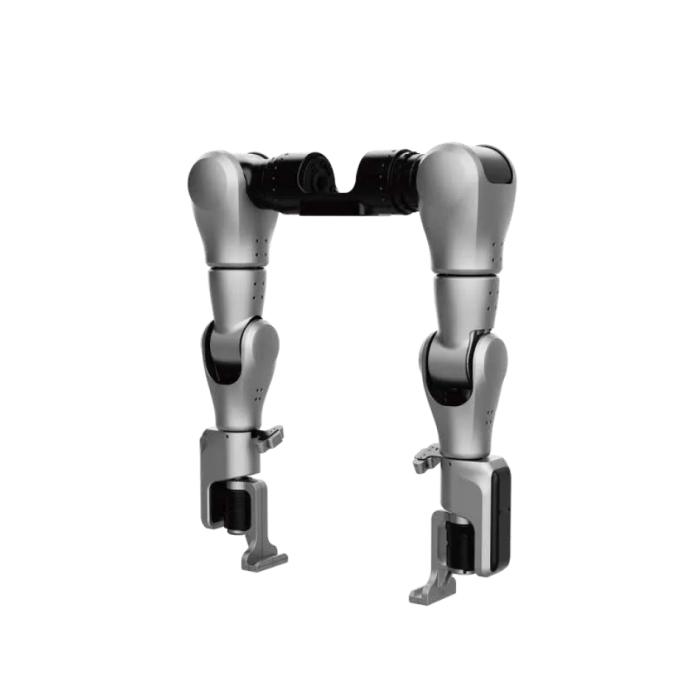
Ti5 Robotics A10-1 Dual-Arm System
In stock
- BRANDA:
- TI5 ROBOTICS
- MÚNLA:
- A10-1
- ORIGIN:
- China
- Warranty:
- 12 MONTHS
- AVAILABILITY:
- SUBJECT TO AVAILABILITY
- SKU:
- Ti5-Robotics-A10-1
Ti5 Robotics A10-1 Dual-Arm System
Ti5 Robotics A10-1 Dual-Arm System is a standard dual-arm robotic platform from Ti5 Robotics, a developer and manufacturer of intelligent robotic products and core components for humanoid robots. The system pairs two seven-degree-of-freedom arms into a single fourteen-degree-of-freedom assembly with a documented single-arm payload of 10 kg, an arm span of 2013 mm and a gross weight of 32 kg. It is offered as an integration-ready upper-body manipulation platform, with optional perception, computing, force sensing and power modules that let integrators scale the configuration to their project.
Background
Ti5 Robotics specializes in the research, development and manufacturing of intelligent robotic products and intelligent manufacturing services, with product lines covering lightweight joint modules, intelligent bionic hands, collaborative robot arms and humanoid robot actuators. Although the vendor lists the A10-1 within its humanoid robot actuator category, the product documented here is a complete dual-arm system built around those joint technologies, not a single motor or actuator module.
Joint architecture and drive technology
The A10-1 uses fourteen joint motors, one per degree of freedom, each built around a harmonic reducer and an 18-bit joint encoder. The vendor states a maximum single-joint torque of 411 Nm, which describes the strongest joint in the chain rather than a uniform rating across all fourteen axes. Joint actuators communicate over CAN or EtherCAT, giving integrators a choice between a widely supported fieldbus and a deterministic, high-rate industrial Ethernet protocol. The arrangement is based on internal structural components, with a maximum arm circumference of 160 mm.
A modular, integration-first configuration
Beyond the core arms, the A10-1 is defined by its optional modules. End-of-arm force sensing is available as a pair of six-dimensional force sensors (model M3552D1 with an M8123B2.232 communication interface). Visual perception can be added through two Intel RealSense D405 wrist depth cameras. Onboard computing is offered as one Jetson Orin Nano 8G, upgradeable to a Jetson AGX Orin 64G Developer Kit, and an optional 48 V 10 Ah battery supports a stated 3-hour battery life. A URDF standard-format structural document is output after contract signing and before complete machine delivery, supporting simulation and motion-planning workflows.
Technical Specifications
The following tables preserve the published configuration distinctions. Blank, malformed, or ambiguous source values are not confirmation of a capability; confirm the selected configuration during quotation.
Ti5 Robotics A10-1 Dual-Arm System
| Model | Ti5-A10-1 Dual-arm Standard Product |
| Maximum arm circumference | 160mm |
| Arm span | 2013mm |
| gross weight | 32kg |
| Arrangement | Internal structural components |
| Single-arm load | 10kg |
| Total number of degrees of freedom | 14 |
| Single-arm degree of freedom | 7 |
| Hand clamps | Universal ball clamp/hook clamp |
| Number of joint motors | 14 |
| Maximum torque of joint | Maximum single joint: 411 Nm |
| Joint actuator type | CAN/EtherCAT |
| Joint reducer type | harmonic |
| Joint encoder resolution | 18bit |
| Dual-arm end effector (optional) | Six-dimensional force *2 Model: M3552D1 with M8123B2.232 communication interface |
| Battery capacity (optional) | 48V 10Ah |
| Battery life | 3h |
| Visual perception (optional) | IntelRealsense D405*2 wrist depth camera |
| Communication Protocol | Joint CAN/EC, Hand 485/CAN |
| Communication interface | Ethernet |
| (Optional) Control and computing power | Jeston Orin Nano 8G*1 (upgradeable to Jeston AGX Orin 64G Developer Kit, optional) |
| Structural materials | Aluminum alloy, stainless steel, etc. |
| Shell material | Aluminum alloy, ABS+glass fiber, rubber, etc. |
| Structural related | URDF standard format document (output after contract signing and before complete machine delivery) |
How does the A10-1 handle communication and computing?
Communication is layered by subsystem: joints run on CAN or EtherCAT, hands communicate over RS-485 or CAN, and an Ethernet interface is available as an option for host connectivity. Computing is likewise optional and tiered, starting with a Jetson Orin Nano 8G and scaling to a Jetson AGX Orin 64G Developer Kit for heavier perception or learning workloads. This separation lets teams run their own external controllers or adopt the vendor-supplied onboard compute, depending on the software stack they already maintain.
Who is the Ti5 Robotics A10-1 Dual-Arm System for?
The A10-1 is aimed at robotics research groups, university laboratories, humanoid-platform developers and industrial R&D teams that need a bimanual manipulation platform without designing fourteen actuated joints from scratch. Teams working on dual-arm coordination, teleoperation, imitation learning or manipulation benchmarking benefit from the 7-DOF-per-arm kinematics, optional wrist depth cameras and six-dimensional force sensors. It also suits integrators building larger humanoid or mobile systems who want a documented upper body with URDF support.
What is the Ti5 Robotics A10-1 Dual-Arm System used for?
- Research and prototyping in industrial production scenarios, such as bimanual handling and assembly studies.
- Scientific research and education, including coursework and experiments in dual-arm kinematics and control.
- Research platforms in medical and rehabilitation robotics programs.
- Prototyping service and commercial-scenario applications involving two-handed manipulation.
- Development and testing of dual-arm motion-planning, grasping and force-control algorithms using the optional sensing packages.
- Upper-body integration into custom humanoid or mobile robot platforms, supported by the URDF structural documentation.
Pricing and Availability
The A10-1 is a configurable system, and final cost depends on the selected options, including force sensors, wrist depth cameras, battery and the computing tier. Pricing is therefore provided on a quotation basis rather than as a fixed list price. To obtain current pricing, lead time and configuration guidance, submit a request for quote through this listing with a short description of your intended application and required options.
Frequently Asked Questions
How many degrees of freedom does the A10-1 have?
The system provides 14 degrees of freedom in total, with 7 degrees of freedom per arm, driven by 14 joint motors with harmonic reducers and 18-bit encoders.
What payload can each arm handle?
The documented single-arm load is 10 kg. The vendor also states a maximum single-joint torque of 411 Nm for the strongest joint.
Which communication protocols are supported?
Joints communicate over CAN or EtherCAT, hands over RS-485 or CAN, and an Ethernet communication interface is available as an option.
Are cameras, computing and batteries included?
They are optional. Dual Intel RealSense D405 wrist depth cameras, a Jetson Orin Nano 8G (upgradeable to AGX Orin 64G) and a 48 V 10 Ah battery with a stated 3-hour battery life are offered as configurable options.
What end effectors and force sensing are available?
The standard hand clamps are a universal ball clamp and a hook clamp. An optional pair of six-dimensional force sensors (M3552D1 with M8123B2.232 interface) supports force-controlled tasks.
Does the A10-1 come with simulation files?
Yes. A URDF standard-format structural document is output after contract signing and before complete machine delivery, enabling simulation and motion-planning work.
Where can I buy the Ti5 Robotics A10-1 Dual-Arm System and what does it cost?
You can purchase the A10-1 through this listing. Because the final configuration determines cost, pricing is quoted individually; request a quote on this page to receive current pricing and availability.
Summary
The Ti5 Robotics A10-1 Dual-Arm System is a 14-DOF, 10 kg-per-arm bimanual platform built on harmonic-drive joints with CAN/EtherCAT control and a modular set of optional sensing, computing and power components. For teams evaluating a documented, integration-ready dual-arm system for research, education or product development, this page is the starting point.