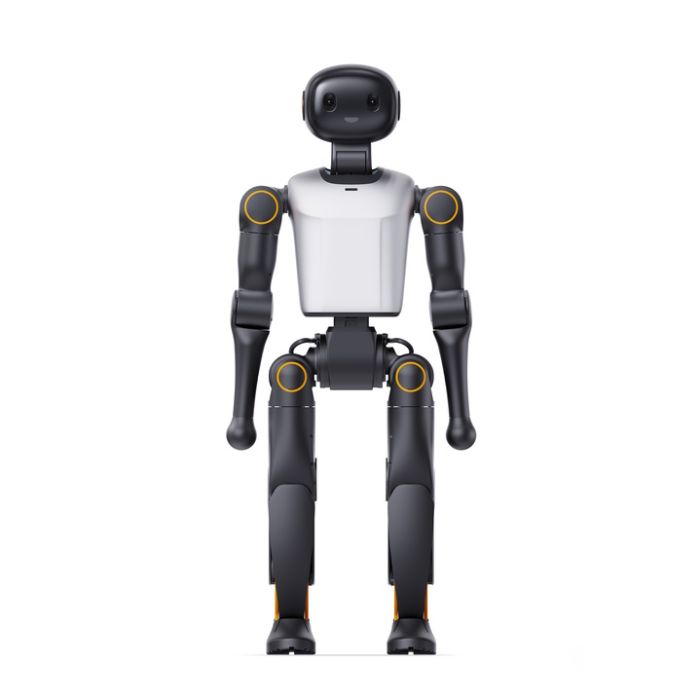
Booster K1 Professional Humanoid Robot
В наличии
- БРЕНД:
- BOOSTER ROBOTICS
- МОДЕЛЬ:
- BOOSTER K1
- ORIGIN:
- Китай
- Warranty:
- 12 МЕСЯЦЕВ
- AVAILABILITY:
- SUBJECT TO AVAILABILITY
- SKU:
- Booster-K1-Professional
- Buy 2 for 11 124,35 € 11 124,35 € each and save 3%
- Buy 5 for 10 894,98 € 10 894,98 € each and save 5%
- Buy 10 for 10 665,62 € 10 665,62 € each and save 7%
Booster K1 Professional Humanoid Robot
Booster K1 Humanoid Robot
Booster K1 is a revolutionary robotic system designed to enhance productivity and streamline operations across various industries. With state-of-the-art features and advanced AI integration, the Booster K1 delivers unparalleled precision, speed, and efficiency. Whether for manufacturing, logistics, or automated tasks, Booster K1 provides scalable solutions that empower businesses to stay ahead of the competition. Experience the next level of automation with Booster K1.
Compact humanoid architecture
A defining feature of the Booster K1 Professional is its small, classroom-friendly form factor. Booster’s official K1 page says the robot is about 95 cm tall and weighs only 19.5 kg, and those figures are repeated across reseller and distributor pages. This places K1 Professional in a much more portable category than many research humanoids, making it easier to move between labs, classrooms, workshops, and demo spaces.
That compactness is not just a convenience detail. In education and research, portability can affect how often a robot is actually used. A 95 cm, sub-20 kg humanoid is far easier to store, transport, and reset after testing than a larger 40–80 kg machine. This is an inference based on the published size and on distributor descriptions emphasizing the K1’s suitability for classrooms, labs, and demonstrations.
22-degree-of-freedom body structure
The Booster K1 Professional uses the same 22 DoF architecture as the rest of the K1 family. Booster’s Chinese-language comparison page breaks this down as 6 DoF per leg, 4 DoF per arm, and 2 DoF in the head. The same page also lists shared motion ranges across K1 variants, confirming that the Professional model keeps the same body structure while changing the compute tier.
This 22-DoF structure makes the K1 Professional much more than a simple educational toy. It supports humanoid gait, balance experiments, arm movement, head tracking, and expressive whole-body motion. Booster’s official product page reinforces that idea by marketing the robot around dynamic motion and “Booster GYM 2.0,” presenting the K1 as an active embodied-development platform rather than a static teaching prop.
Professional-tier compute configuration
What distinguishes the Professional model from the EDU and Geek variants is its compute package. Booster’s official page lists 48 / 117 / 200 TOPS compute options for K1, and Generation Robots maps those tiers to Geek, Educative, and Pro. That makes the Professional version the highest publicly listed compute configuration in the K1 family.
For advanced users, this matters because AI inference, visual perception, policy execution, and simulation-linked robotics workflows can be compute-intensive. The Professional version is therefore best suited to teams that want to go beyond introductory programming and use K1 in more advanced robotics experiments. This is an inference from the published compute hierarchy and K1’s developer-oriented positioning.
Technology and Specifications
Physical and mechanical specifications
The core published physical specifications for Booster K1 Professional are consistent across sources: approximately 95 cm height and 19.5 kg weight. Booster’s official product page and Chinese comparison page both confirm those figures for the K1 family, including the Professional version.
The same official comparison page also publishes the robot’s lower-body motion ranges, including hip pitch from -171° to 126°, hip roll from -22° to 89°, hip yaw ±59°, knee from 0° to 127°, and ankle pitch from -50° to 20° with ankle roll ±20°. These are meaningful ranges for a robot of this size and show that the K1 Professional is built for real humanoid locomotion and posture control, not only for simple scripted demonstrations.
Actuators and joint performance
Booster’s Chinese K1 comparison page lists a maximum peak torque of 60 N·m and dual encoders for the K1 line. Because this table applies across the K1 family, it is reasonable to attribute those same actuator fundamentals to the Professional version. These figures suggest a platform with enough mechanical authority for balancing, dynamic movement, and classroom-scale humanoid robotics research.
Sensors and perception hardware
Public reseller descriptions of the K1 family consistently mention onboard sensing, including a 3D or binocular camera, 9-axis IMU, microphones, and speaker. Generation Robots’ Booster Robotics family page specifically describes the K1 as having onboard sensors such as a 3D/binocular camera, 9-axis IMU, microphones, and speaker. This sensor stack gives the K1 Professional enough perception for visual robotics experiments, balance control, and interactive demos.
Software and development ecosystem
Booster Robotics positions the K1 as a development platform. Its official open-source page publishes a K1 manual, and the same site frames Booster robots broadly as humanoid development platforms for developers and general users. Generation Robots also notes Python / ROS compatibility depending on the stack, reinforcing that K1 is meant to be programmed and integrated into robotics workflows rather than used only through a closed app layer.
This is one of the Professional model’s strongest selling points. A high-compute compact humanoid becomes much more valuable when paired with accessible documentation and familiar robotics software environments. That is especially relevant in university labs and developer teams that want to prototype embodied-AI behaviors, robot soccer strategies, or perception-and-control pipelines. This is an inference supported by the official documentation availability and ROS/Python compatibility descriptions.
Runtime and power
Public K1 runtime figures vary somewhat by battery option and use intensity, but the family is consistently presented as suitable for class sessions, demo cycles, and laboratory use. Generation Robots’ K1 listing emphasizes the platform’s compact, ready-to-use educational role rather than all-day continuous operation, and secondary references commonly place K1-class operation in the roughly hour-scale range depending on battery and motion load. Because the official Booster snippets retrieved here do not show a single Professional-only runtime value, it is safest to state that runtime is configuration-dependent and geared to classroom, lab, and demo sessions rather than full-shift deployment.
Applications and Use Cases
Advanced education and STEM programs
The clearest use case for the Booster K1 Professional is advanced education. Booster’s official site places K1 under Education solutions, and its product page presents the platform as an introductory embodied development system. The Professional version builds on that foundation by offering the highest K1 compute tier, which makes it especially well suited to advanced STEM courses, robotics labs, and AI-focused project work.
Research and embodied-AI development
Because the Professional variant offers 200 TOPS, it is the K1 configuration best suited to more demanding research tasks. These can include visual perception, locomotion control, multimodal interaction, reinforcement-learning-related experiments, or compact embodied-AI prototyping. This is an inference, but it follows directly from the fact that Booster offers multiple compute tiers and reserves the top tier for the Pro version.
RoboCup and robot-soccer training
Booster Robotics strongly links its product ecosystem to RoboCup. Its RoboCup solution page says students can build toward 3v3 soccer gameplay in just 3 days with intensive training, and the official site highlights Booster’s role in champion-edition competition solutions. For teams that want the most capable K1 variant for competitions, the Professional model is the logical fit because it combines portability with the strongest K1 compute option.
Demonstrations and public-facing robotics
The K1 Professional is also a good fit for demonstrations, events, and outreach. A compact humanoid with integrated sensors, speaker, microphones, and dynamic movement is useful not only in labs but also in public innovation showcases and technology exhibitions. This is not the primary official positioning, but it follows naturally from the published hardware and distributor descriptions of classroom, lab, and demonstration use.
Advantages / Benefits
Highest K1 compute tier
The most obvious advantage of the Booster K1 Professional is that it gives buyers the highest compute tier in the K1 lineup. With 200 TOPS, it offers more headroom for AI inference and advanced robotics workflows than the Geek or EDU versions.
Compact, portable humanoid format
A second major benefit is portability. At 95 cm and 19.5 kg, the K1 Professional is much easier to transport and deploy than larger humanoid robots. This lowers the operational barrier for schools, labs, and small research teams.
Consistent body platform across variants
Because all K1 variants share the same 22-DoF body and actuator fundamentals, the Professional model does not require users to move to a completely different hardware architecture in order to gain more compute. That makes the K1 lineup relatively easy to understand: same robot body, different onboard capability tiers.
Developer-friendly ecosystem
Booster’s official documentation, open-source page, and broad developer positioning are also important advantages. The K1 Professional is not just higher-spec hardware; it sits inside a platform intended for real development work.
FAQ Section
What is the Booster K1 Professional Humanoid Robot?
The Booster K1 Professional is the highest-compute version of Booster Robotics’ K1 humanoid robot family. It is a compact 22-DoF humanoid platform intended for advanced education, research, AI development, and competition-oriented robotics.
How does the Booster K1 Professional work?
It combines a compact humanoid body, dual-encoder actuators, onboard perception hardware such as a 3D/binocular camera and IMU, and the K1 family’s top 200 TOPS compute tier to support locomotion, perception, and advanced robotics development.
Why is the Booster K1 Professional important?
It is important because it offers a relatively accessible, portable humanoid platform with enough onboard compute for more advanced AI and robotics work, making it a strong option for labs, educators, and competition teams that do not want a much larger humanoid robot.
What are the benefits of the Booster K1 Professional?
Its main benefits are the highest K1 compute tier, compact 95 cm / 19.5 kg format, 22-DoF humanoid architecture, developer-friendly tooling, and strong suitability for education, research, and RoboCup-style use.
How is the Booster K1 Professional different from the K1 EDU?
The main difference is compute. Public listings show the K1 EDU at 117 TOPS and the K1 Professional at 200 TOPS, while both share the same basic K1 body structure and form factor.
Summary
The Booster K1 Professional Humanoid Robot is the most capable version of Booster’s compact K1 family, combining a 95 cm, 19.5 kg, 22-DoF humanoid platform with the line’s top 200 TOPS compute tier. Public sources show it as a strong fit for advanced education, research, embodied-AI development, and competition robotics. For users who want a portable humanoid robot with more onboard capability than the K1 EDU or Geek versions, but without stepping up to a larger platform like the T1, the K1 Professional stands out as Booster’s top K1 option.
Hardware Parameters:
1. Dimensions: Approximately 0.9m.
2. Degrees of Freedom: 22 (Legs: 6 DoF * 2; Arms: 4 DoF * 2; Head: 2 DoF).
3. Large Joint Movement Space: Hip joint: P -170° to 100°, R -23° to +90°, Y ± 60°; Knee joint: -0° to 130°; Ankle joint: P -50° to 20°, R ± 20°.
4. Processor:NVIDIA Jetson Orin Nx 8GB, providing 117TOPS AI computing power.
5. Sensors: RGBD Camera, Microphone Array, Speaker, 9-axis IMU.
6. Joints: Full-force-controlled joints, supporting mixed control of torque, velocity, and position, with dual-encoder joint modules.
7. Battery Life: 40min
Software System:
1. Supports secondary development, providing interfaces for low-level joints and sensors as well as high-level motion interfaces, and is compatible with the ROS2 communication protocol.
2. Provides robot model and simulation interfaces, supporting simulation environments such as Issac sim.
3. Provides a mobile phone APP, supporting robot network configuration and remote control of the robot.
Specifications
General
Physical
Mobility
Shipping
What's included
- Booster K1 Pro
- Remote Control
- Charger
- Robot Transport Case