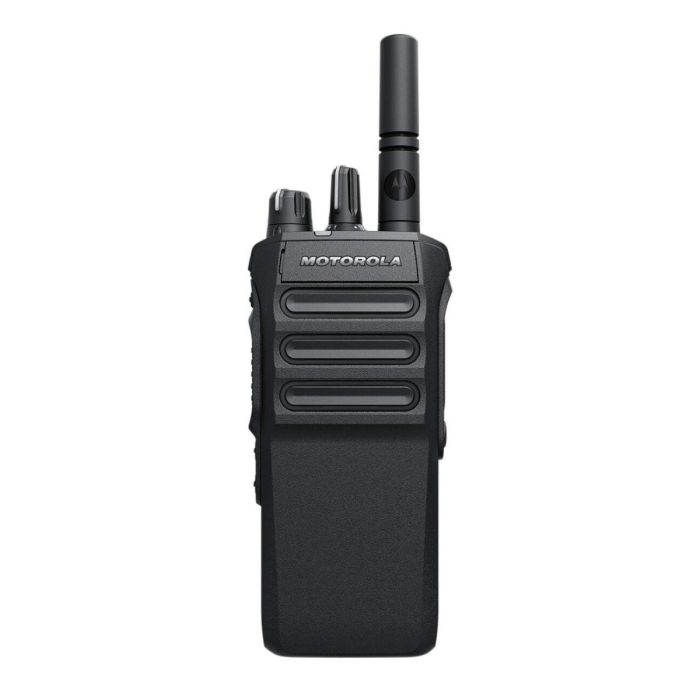
MOTOROLA MOTOTRBO R7 UHF TIA NKP BT WIFI GNSS CAPABLE PRA502CEG (MDH06RDC9WA1AN)
В наличии
- БРЕНД:
- MOTOROLA
- ЧАСТЬ №:
- MDH06RDC9WA1AN
- AVAILABILITY:
- USUALLY SHIPS IN 7-14 BUSINESS DAYS
- SKU:
- MOTOROLA-MDH06RDC9WA1AN
MOTOROLA MOTOTRBO R7 UHF TIA NKP BT WIFI GNSS CAPABLE PRA502CEG (MDH06RDC9WA1AN)
Within the broader MOTOTRBO ecosystem, the R7 is intended for use with digital and analog signaling, MOTOTRBO systems, accessories, and fleet-management workflows. Motorola also lists features such as WAVE PTX Backup Client with Seamless Voice Handover on current R7 datasheets in some regions, showing that the platform is designed not just as a standalone handheld radio, but as part of a larger communications environment that can span radio and broadband workflows.
Design and Features
Rugged Industrial Construction
A defining characteristic of the MOTOTRBO R7 family is durability. Motorola specifies IP68 protection for water immersion, IP66 resistance to concentrated water jets, and compliance with MIL-STD-810 ruggedness standards. The housing is also described as resistant to disinfectant and decontamination substances, which is relevant in healthcare, transportation, hospitality, industrial maintenance, and public-sector settings where devices may be sanitized frequently.
Non-Keypad Simplicity
Because MDH06RDC9WA1AN is an NKP model, it is aimed at users who benefit from simplified operation and fewer exposed interface elements. Motorola’s datasheet shows that R7 full-keypad models include a 2.4-inch QVGA display, while NKP models do not. This makes the non-keypad version attractive for organizations that want to standardize on a straightforward push-to-talk workflow with minimal training overhead.
Advanced Audio Engineering
Motorola’s strongest marketing and technical emphasis for the R7 is audio. Official materials cite wideband speaker and microphones, adaptive dual-microphone noise suppression, AI-trained noise suppression on current North American materials, automatic acoustic feedback suppression, Intelligent Audio, and programmable loudness up to 107 phons. In practical terms, these features are designed to improve intelligibility in environments such as manufacturing floors, warehouses, airports, security operations, utilities, and construction sites.
Modern Connectivity
The exact model name explicitly includes BT WiFi GNSS Capable, and Motorola’s R7 documentation confirms support for Bluetooth 5.2, Wi-Fi 2.4/5.0 GHz, and multi-constellation GNSS. Those features matter because modern enterprise radio fleets often depend on over-the-air programming, wireless accessory integration, location services, and interoperability with broader software ecosystems.
Technology and Specifications
Core Radio Specifications
For the UHF variant, Motorola lists the R7 operating band as 400–527 MHz with 4 watts high power output and 1 watt low power output. Channel spacing is listed as 12.5 kHz, 20 kHz, and 25 kHz, and Motorola supports digital protocol ETSI TS 102 361-1, -2, -3, -4, including DMR Tier II and Tier III.
Sensitivity and RF Performance
Official Motorola specifications cite analog sensitivity of 0.16 μV typical (12 dB SINAD) and digital sensitivity of 0.14 μV typical (5% BER), with 70 dB intermodulation and 70 dB spurious rejection. These figures place the R7 in the class of modern professional DMR portables engineered for reliable operation in congested RF environments.
GNSS Capability
Motorola lists support for GPS, GLONASS, BeiDou, and Galileo. The datasheet specifies cold start time to first fix of 60 seconds or less, hot start of 10 seconds or less, and horizontal accuracy under 5 meters. For organizations that use workforce visibility, dispatch mapping, or lone-worker workflows, that broad constellation support is a meaningful advantage.
Wi-Fi and Security
The R7 supports Wi-Fi 5 / IEEE 802.11 a/b/g/n/ac with WPA3 and WPA2 security support, depending on region and documentation set. That matters for secure provisioning, over-the-air updates, and enterprise wireless deployments where radios need to be treated as managed endpoints rather than isolated field devices.
Battery Life and Physical Profile
Motorola publishes several battery options for the R7 family. For the NKP UHF model, battery life reaches approximately 19 hours digital / 14.5 hours analog with a 2200 mAh slim battery, 25 hours digital / 19 hours analog with a 2850 mAh IMPRES battery, and 28 hours digital / 21.5 hours analog with a 3200 mAh HazLoc IMPRES battery. For the NKP unit, listed depth ranges from roughly 31 mm to 37 mm, depending on battery, and listed weight ranges from 289 g to 339 g.
Applications and Use Cases
The Motorola MOTOTRBO R7 UHF non-keypad model is well suited to organizations that need rugged business radio communications with strong audio performance and modern fleet features. Common fit scenarios include:
Manufacturing and Warehousing
In factories, logistics hubs, and fulfillment centers, the R7’s loud audio, noise suppression, and robust build help workers communicate near conveyors, forklifts, motors, and packaging equipment. Its UHF band is often preferred indoors where penetration through structures and dense facilities is important. This use case is an inference based on Motorola’s documented feature set and common UHF deployment patterns.
Security and Facility Operations
Security officers, property teams, and campus operations personnel often need radios that are easy to use, location-capable, and durable enough for all-weather service. The R7’s GNSS, Bluetooth, Wi-Fi, and accessory ecosystem make it suitable for that environment.
Oil, Gas, Utilities, and Hazardous Areas
Motorola explicitly positions TIA-4950-certified R7 configurations for hazardous environments when properly equipped. That makes the broader R7 TIA family relevant to fuel handling, utilities, industrial processing, and field maintenance where intrinsically safe equipment may be required. Buyers should always confirm the exact approved battery, accessory, and regional certification combination before deployment.
Transportation, Airports, and Maritime Workflows
Motorola’s materials note maritime-related certification paths for certain regional variants, and the R7 is marketed broadly for harsh, noisy, high-mobility operations. Transportation hubs, airport ground teams, and vessel-support operations are therefore natural use cases for the UHF R7 family, subject to the specific regulatory variant being purchased.
Advantages / Benefits
Exceptional Speech Clarity
The biggest benefit of the R7 is not just loudness, but usable loudness. The combination of noise suppression, feedback suppression, wideband audio, and Intelligent Audio is designed to reduce missed transmissions and listener fatigue in loud workplaces.
Strong Long-Term Platform Value
With Bluetooth 5.2, dual-band Wi-Fi, GNSS support, and compatibility with the larger MOTOTRBO systems ecosystem, the R7 is more future-ready than older voice-only business handhelds.
Ruggedness Without Excess Complexity
The NKP version removes some complexity while retaining the R7 family’s premium durability and connectivity. That is attractive for fleets where simplicity, training speed, and uptime matter more than display-driven workflows.
Broad Accessory Ecosystem
Motorola offers the R7 with a wide accessory range including remote speaker microphones, surveillance kits, batteries, chargers, and contactless RFID/NFC options, helping organizations tailor the radio to different user roles.
Within the broader MOTOTRBO ecosystem, the R7 is intended for use with digital and analog signaling, MOTOTRBO systems, accessories, and fleet-management workflows. Motorola also lists features such as WAVE PTX Backup Client with Seamless Voice Handover on current R7 datasheets in some regions, showing that the platform is designed not just as a standalone handheld radio, but as part of a larger communications environment that can span radio and broadband workflows.
Design and Features
Rugged Industrial Construction
A defining characteristic of the MOTOTRBO R7 family is durability. Motorola specifies IP68 protection for water immersion, IP66 resistance to concentrated water jets, and compliance with MIL-STD-810 ruggedness standards. The housing is also described as resistant to disinfectant and decontamination substances, which is relevant in healthcare, transportation, hospitality, industrial maintenance, and public-sector settings where devices may be sanitized frequently.
Non-Keypad Simplicity
Because MDH06RDC9WA1AN is an NKP model, it is aimed at users who benefit from simplified operation and fewer exposed interface elements. Motorola’s datasheet shows that R7 full-keypad models include a 2.4-inch QVGA display, while NKP models do not. This makes the non-keypad version attractive for organizations that want to standardize on a straightforward push-to-talk workflow with minimal training overhead.
Advanced Audio Engineering
Motorola’s strongest marketing and technical emphasis for the R7 is audio. Official materials cite wideband speaker and microphones, adaptive dual-microphone noise suppression, AI-trained noise suppression on current North American materials, automatic acoustic feedback suppression, Intelligent Audio, and programmable loudness up to 107 phons. In practical terms, these features are designed to improve intelligibility in environments such as manufacturing floors, warehouses, airports, security operations, utilities, and construction sites.
Modern Connectivity
The exact model name explicitly includes BT WiFi GNSS Capable, and Motorola’s R7 documentation confirms support for Bluetooth 5.2, Wi-Fi 2.4/5.0 GHz, and multi-constellation GNSS. Those features matter because modern enterprise radio fleets often depend on over-the-air programming, wireless accessory integration, location services, and interoperability with broader software ecosystems.
Technology and Specifications
Core Radio Specifications
For the UHF variant, Motorola lists the R7 operating band as 400–527 MHz with 4 watts high power output and 1 watt low power output. Channel spacing is listed as 12.5 kHz, 20 kHz, and 25 kHz, and Motorola supports digital protocol ETSI TS 102 361-1, -2, -3, -4, including DMR Tier II and Tier III.
Sensitivity and RF Performance
Official Motorola specifications cite analog sensitivity of 0.16 μV typical (12 dB SINAD) and digital sensitivity of 0.14 μV typical (5% BER), with 70 dB intermodulation and 70 dB spurious rejection. These figures place the R7 in the class of modern professional DMR portables engineered for reliable operation in congested RF environments.
GNSS Capability
Motorola lists support for GPS, GLONASS, BeiDou, and Galileo. The datasheet specifies cold start time to first fix of 60 seconds or less, hot start of 10 seconds or less, and horizontal accuracy under 5 meters. For organizations that use workforce visibility, dispatch mapping, or lone-worker workflows, that broad constellation support is a meaningful advantage.
Wi-Fi and Security
The R7 supports Wi-Fi 5 / IEEE 802.11 a/b/g/n/ac with WPA3 and WPA2 security support, depending on region and documentation set. That matters for secure provisioning, over-the-air updates, and enterprise wireless deployments where radios need to be treated as managed endpoints rather than isolated field devices.
Battery Life and Physical Profile
Motorola publishes several battery options for the R7 family. For the NKP UHF model, battery life reaches approximately 19 hours digital / 14.5 hours analog with a 2200 mAh slim battery, 25 hours digital / 19 hours analog with a 2850 mAh IMPRES battery, and 28 hours digital / 21.5 hours analog with a 3200 mAh HazLoc IMPRES battery. For the NKP unit, listed depth ranges from roughly 31 mm to 37 mm, depending on battery, and listed weight ranges from 289 g to 339 g.
Applications and Use Cases
The Motorola MOTOTRBO R7 UHF non-keypad model is well suited to organizations that need rugged business radio communications with strong audio performance and modern fleet features. Common fit scenarios include:
Manufacturing and Warehousing
In factories, logistics hubs, and fulfillment centers, the R7’s loud audio, noise suppression, and robust build help workers communicate near conveyors, forklifts, motors, and packaging equipment. Its UHF band is often preferred indoors where penetration through structures and dense facilities is important. This use case is an inference based on Motorola’s documented feature set and common UHF deployment patterns.
Security and Facility Operations
Security officers, property teams, and campus operations personnel often need radios that are easy to use, location-capable, and durable enough for all-weather service. The R7’s GNSS, Bluetooth, Wi-Fi, and accessory ecosystem make it suitable for that environment.
Oil, Gas, Utilities, and Hazardous Areas
Motorola explicitly positions TIA-4950-certified R7 configurations for hazardous environments when properly equipped. That makes the broader R7 TIA family relevant to fuel handling, utilities, industrial processing, and field maintenance where intrinsically safe equipment may be required. Buyers should always confirm the exact approved battery, accessory, and regional certification combination before deployment.
Transportation, Airports, and Maritime Workflows
Motorola’s materials note maritime-related certification paths for certain regional variants, and the R7 is marketed broadly for harsh, noisy, high-mobility operations. Transportation hubs, airport ground teams, and vessel-support operations are therefore natural use cases for the UHF R7 family, subject to the specific regulatory variant being purchased.
Advantages / Benefits
Exceptional Speech Clarity
The biggest benefit of the R7 is not just loudness, but usable loudness. The combination of noise suppression, feedback suppression, wideband audio, and Intelligent Audio is designed to reduce missed transmissions and listener fatigue in loud workplaces.
Strong Long-Term Platform Value
With Bluetooth 5.2, dual-band Wi-Fi, GNSS support, and compatibility with the larger MOTOTRBO systems ecosystem, the R7 is more future-ready than older voice-only business handhelds.
Ruggedness Without Excess Complexity
The NKP version removes some complexity while retaining the R7 family’s premium durability and connectivity. That is attractive for fleets where simplicity, training speed, and uptime matter more than display-driven workflows.
Broad Accessory Ecosystem
Motorola offers the R7 with a wide accessory range including remote speaker microphones, surveillance kits, batteries, chargers, and contactless RFID/NFC options, helping organizations tailor the radio to different user roles.
Within the broader MOTOTRBO ecosystem, the R7 is intended for use with digital and analog signaling, MOTOTRBO systems, accessories, and fleet-management workflows. Motorola also lists features such as WAVE PTX Backup Client with Seamless Voice Handover on current R7 datasheets in some regions, showing that the platform is designed not just as a standalone handheld radio, but as part of a larger communications environment that can span radio and broadband workflows.
Design and Features
Rugged Industrial Construction
A defining characteristic of the MOTOTRBO R7 family is durability. Motorola specifies IP68 protection for water immersion, IP66 resistance to concentrated water jets, and compliance with MIL-STD-810 ruggedness standards. The housing is also described as resistant to disinfectant and decontamination substances, which is relevant in healthcare, transportation, hospitality, industrial maintenance, and public-sector settings where devices may be sanitized frequently.
Non-Keypad Simplicity
Because MDH06RDC9WA1AN is an NKP model, it is aimed at users who benefit from simplified operation and fewer exposed interface elements. Motorola’s datasheet shows that R7 full-keypad models include a 2.4-inch QVGA display, while NKP models do not. This makes the non-keypad version attractive for organizations that want to standardize on a straightforward push-to-talk workflow with minimal training overhead.
Advanced Audio Engineering
Motorola’s strongest marketing and technical emphasis for the R7 is audio. Official materials cite wideband speaker and microphones, adaptive dual-microphone noise suppression, AI-trained noise suppression on current North American materials, automatic acoustic feedback suppression, Intelligent Audio, and programmable loudness up to 107 phons. In practical terms, these features are designed to improve intelligibility in environments such as manufacturing floors, warehouses, airports, security operations, utilities, and construction sites.
Modern Connectivity
The exact model name explicitly includes BT WiFi GNSS Capable, and Motorola’s R7 documentation confirms support for Bluetooth 5.2, Wi-Fi 2.4/5.0 GHz, and multi-constellation GNSS. Those features matter because modern enterprise radio fleets often depend on over-the-air programming, wireless accessory integration, location services, and interoperability with broader software ecosystems.
Technology and Specifications
Core Radio Specifications
For the UHF variant, Motorola lists the R7 operating band as 400–527 MHz with 4 watts high power output and 1 watt low power output. Channel spacing is listed as 12.5 kHz, 20 kHz, and 25 kHz, and Motorola supports digital protocol ETSI TS 102 361-1, -2, -3, -4, including DMR Tier II and Tier III.
Sensitivity and RF Performance
Official Motorola specifications cite analog sensitivity of 0.16 μV typical (12 dB SINAD) and digital sensitivity of 0.14 μV typical (5% BER), with 70 dB intermodulation and 70 dB spurious rejection. These figures place the R7 in the class of modern professional DMR portables engineered for reliable operation in congested RF environments.
GNSS Capability
Motorola lists support for GPS, GLONASS, BeiDou, and Galileo. The datasheet specifies cold start time to first fix of 60 seconds or less, hot start of 10 seconds or less, and horizontal accuracy under 5 meters. For organizations that use workforce visibility, dispatch mapping, or lone-worker workflows, that broad constellation support is a meaningful advantage.
Wi-Fi and Security
The R7 supports Wi-Fi 5 / IEEE 802.11 a/b/g/n/ac with WPA3 and WPA2 security support, depending on region and documentation set. That matters for secure provisioning, over-the-air updates, and enterprise wireless deployments where radios need to be treated as managed endpoints rather than isolated field devices.
Battery Life and Physical Profile
Motorola publishes several battery options for the R7 family. For the NKP UHF model, battery life reaches approximately 19 hours digital / 14.5 hours analog with a 2200 mAh slim battery, 25 hours digital / 19 hours analog with a 2850 mAh IMPRES battery, and 28 hours digital / 21.5 hours analog with a 3200 mAh HazLoc IMPRES battery. For the NKP unit, listed depth ranges from roughly 31 mm to 37 mm, depending on battery, and listed weight ranges from 289 g to 339 g.
Applications and Use Cases
The Motorola MOTOTRBO R7 UHF non-keypad model is well suited to organizations that need rugged business radio communications with strong audio performance and modern fleet features. Common fit scenarios include:
Manufacturing and Warehousing
In factories, logistics hubs, and fulfillment centers, the R7’s loud audio, noise suppression, and robust build help workers communicate near conveyors, forklifts, motors, and packaging equipment. Its UHF band is often preferred indoors where penetration through structures and dense facilities is important. This use case is an inference based on Motorola’s documented feature set and common UHF deployment patterns.
Security and Facility Operations
Security officers, property teams, and campus operations personnel often need radios that are easy to use, location-capable, and durable enough for all-weather service. The R7’s GNSS, Bluetooth, Wi-Fi, and accessory ecosystem make it suitable for that environment.
Oil, Gas, Utilities, and Hazardous Areas
Motorola explicitly positions TIA-4950-certified R7 configurations for hazardous environments when properly equipped. That makes the broader R7 TIA family relevant to fuel handling, utilities, industrial processing, and field maintenance where intrinsically safe equipment may be required. Buyers should always confirm the exact approved battery, accessory, and regional certification combination before deployment.
Transportation, Airports, and Maritime Workflows
Motorola’s materials note maritime-related certification paths for certain regional variants, and the R7 is marketed broadly for harsh, noisy, high-mobility operations. Transportation hubs, airport ground teams, and vessel-support operations are therefore natural use cases for the UHF R7 family, subject to the specific regulatory variant being purchased.
Advantages / Benefits
Exceptional Speech Clarity
The biggest benefit of the R7 is not just loudness, but usable loudness. The combination of noise suppression, feedback suppression, wideband audio, and Intelligent Audio is designed to reduce missed transmissions and listener fatigue in loud workplaces.
Strong Long-Term Platform Value
With Bluetooth 5.2, dual-band Wi-Fi, GNSS support, and compatibility with the larger MOTOTRBO systems ecosystem, the R7 is more future-ready than older voice-only business handhelds.
Ruggedness Without Excess Complexity
The NKP version removes some complexity while retaining the R7 family’s premium durability and connectivity. That is attractive for fleets where simplicity, training speed, and uptime matter more than display-driven workflows.
Broad Accessory Ecosystem
Motorola offers the R7 with a wide accessory range including remote speaker microphones, surveillance kits, batteries, chargers, and contactless RFID/NFC options, helping organizations tailor the radio to different user roles.
FAQ Section
What is the MOTOROLA MOTOTRBO R7 UHF TIA NKP BT WiFi GNSS Capable PRA502CEG?
It is a professional UHF digital portable two-way radio in Motorola Solutions’ MOTOTRBO R7 family. The exact model MDH06RDC9WA1AN is identified by Motorola as an R7 non-keypad model with Bluetooth, Wi-Fi, and GNSS capability.
How does the MOTOTRBO R7 work?
The radio operates as a portable two-way voice communications device for business and industrial use, supporting digital and analog signaling and operating in the 400–527 MHz UHF range for this variant. It also supports wireless features such as Bluetooth, Wi-Fi, and GNSS-based location functions.
Why is the MOTOTRBO R7 important?
It is important because it combines clear voice performance, rugged construction, and modern wireless connectivity in a single enterprise handheld. Motorola specifically emphasizes advanced audio processing, high loudness, IP66/IP68 protection, and broad GNSS support.
Where can I buy the MOTOTRBO R7 MDH06RDC9WA1AN?
Motorola directs buyers to contact sales or work through an authorized partner/distributor. Availability depends on region, regulatory configuration, and dealer inventory.
What are the benefits of the MOTOTRBO R7?
Its main benefits are strong audio clarity in noisy environments, rugged IP66/IP68 durability, Bluetooth and Wi-Fi connectivity, GNSS location support, and compatibility with Motorola’s accessory and systems ecosystem.
Is the MOTOTRBO R7 intrinsically safe?
The R7 family includes UL TIA-4950 intrinsically safe configurations, but hazardous-location approval depends on the exact approved configuration, including battery and accessories. Buyers should confirm the exact compliance package for their deployment.
What frequency does this model use?
For the UHF version of the R7, Motorola lists 400–527 MHz operation with 4 watts high power output.
Does the non-keypad version have a screen?
Motorola’s datasheet shows the full-keypad R7 with a 2.4-inch QVGA display, while the NKP version is listed without a display.
Summary
The MOTOROLA MOTOTRBO R7 UHF TIA NKP BT WiFi GNSS Capable PRA502CEG (MDH06RDC9WA1AN) is a premium-grade UHF MOTOTRBO business radio built for organizations that need rugged hardware, exceptionally strong audio performance, modern wireless connectivity, and location capability in a simplified non-keypad format. For industrial, security, transportation, facilities, and hazardous-environment workflows, it stands out as a highly capable handheld platform within the Motorola Solutions portfolio.
Specifications
| ЧАСТЬ № | MDH06RDC9WA1AN |
|---|---|
| ТИП ПРОДУКТА | ДВУСТОРОННЕЕ РАДИО |
| БРЕНД | MOTOROLA |
| ТИП ИСПОЛЬЗОВАНИЯ | ПОРТАТИВНЫЙ |
| ЧАСТОТА | УВЧ (470–698 МГЦ) |
| ОСОБЕННОСТИ | ГНСС, WI-FI |