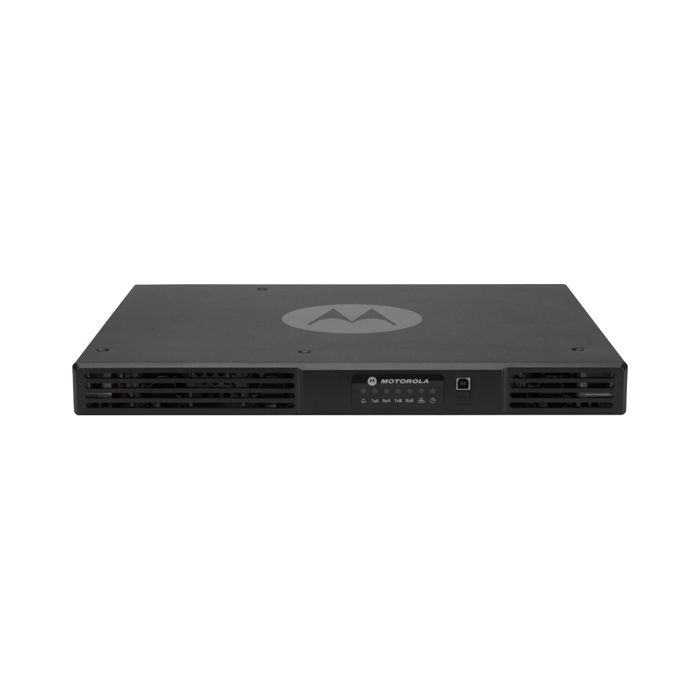
For the exact part number MDR10QCGANQ1AN, public reseller and service-manual references consistently map it to the SLR 5500 UHF model, not the higher-power SLR 5700. Those sources identify it as a 400–470 MHz UHF repeater with 1–50 W transmit power. Motorola’s service manual explicitly lists MDR10QCGANQ1AN as “400–470 MHz, 1–50 W, SLR 5500 Repeater,” while multiple dealers describe the same SKU as the SLR 5500 403/400–470 MHz 50W UHF version.
That distinction matters because some store pages use the broader phrase “SLR 5000 Series Repeater” in the title while selling a specific submodel. The most accurate way to describe MDR10QCGANQ1AN is therefore as a Motorola MOTOTRBO SLR 5500 repeater within the SLR 5000 Series.
Design and Features
Compact 1U Infrastructure Design
Motorola designed the SLR 5000 Series to fit neatly into a standard 19-inch rack at just 1U high. The official data sheet lists dimensions of about 44 x 483 x 370 mm, while reseller pages for MDR10QCGANQ1AN describe the same rack-mount format and often note wall mounting as an option with the appropriate hardware. This compact footprint helps communications rooms and equipment cabinets support repeater infrastructure without consuming excessive space.
Mixed-Mode Analog and Digital Operation
A defining strength of the SLR 5000 platform is its support for analogue, digital, and mixed-mode analogue/digital operation. Motorola states that the repeater can serve legacy analogue fleets and newer MOTOTRBO DMR users at the same time, which allows organizations to modernize gradually rather than replacing every radio at once. That makes the MDR10QCGANQ1AN especially attractive in upgrade projects where a business wants better infrastructure first and subscriber replacement later.
Built for Continuous Operation
Motorola describes the SLR 5000 Series as a continuous-duty repeater platform. Brochure and data-sheet materials call out 50 W continuous-duty output for the series, and the official SLR 5000 data sheet lists a 100% duty cycle. For buyers evaluating repeater infrastructure, this is one of the most important differences between light-duty equipment and enterprise-grade gear.
Serviceability and Site Features
Motorola says the SLR 5000 Series includes field-replaceable major modules, including the power amplifier, power supply, and modem. The platform also includes a front USB port, alarm connections, auxiliary power output, and an integrated 3A battery charger to support backup power arrangements. These features make the repeater easier to maintain and more practical for unattended or lightly supervised sites.
Technology and Specifications
Exact Configuration of MDR10QCGANQ1AN
The best-supported identification for the requested part number is:
- Model family: MOTOTRBO SLR 5000 Series
- Specific model: SLR 5500
- Frequency band: UHF 400/403–470 MHz
- Transmit power: 1–50 W
The slight wording difference between 400–470 MHz and 403–470 MHz appears across seller pages, but the authoritative Motorola service-manual entry for the SKU identifies the model as 400–470 MHz.
Core Platform Specifications
Motorola’s official SLR 5000 Series data sheet lists the platform with 64-channel capacity, ±0.5 ppm frequency stability, 12.5/20/25 kHz channel spacing, and support for 100–240 Vac or 11.0–14.4 Vdc power input. The same document lists operation from -30 °C to +60 °C, underscoring that the repeater is meant for serious infrastructure use rather than office-only environments.
RF and Network Capabilities
Motorola states that the SLR 5000 Series supports Digital Conventional, IP Site Connect, Capacity Plus, Linked Capacity Plus, Connect Plus, Analog Conventional, and MPT 1327. The IP interface also allows applications and consoles to connect directly into the system. For organizations planning for future growth, this is one of the series’ biggest strengths: it can begin as a single-site repeater and later become part of a wider IP-linked or trunked network.
Receiver and Audio Performance
The Motorola data sheet lists high sensitivity and positions the SLR 5000 Series as engineered for optimum coverage. Motorola’s broader MOTOTRBO materials specifically describe the series as combining 50 W output with high sensitivity for better range and dependable site performance.
Applications and Use Cases
The Motorola MDR10QCGANQ1AN is intended for organizations that need to extend radio coverage, improve reliability, and support more structured communications across a site or network. Motorola frames the SLR 5000 Series as infrastructure that connects teams “whether you’re in the field or on the factory floor,” which makes it suitable for logistics, manufacturing, utilities, hospitality, facilities management, education, transport, and private security.
Because MDR10QCGANQ1AN is a UHF model, it is especially relevant in built environments where UHF propagation and building penetration are often preferred. That includes warehouses, shopping centres, hospitals, campuses, and industrial plants. This last point is an inference based on the UHF band and common deployment practice, not a Motorola sentence tied to this exact SKU. Supported directly by Motorola, though, is the product’s role as professional infrastructure for workplace-wide communications.
Advantages / Benefits
One of the clearest benefits of the Motorola MDR10QCGANQ1AN is that it combines professional infrastructure design, continuous-duty reliability, and migration flexibility. The repeater supports analogue and digital users, making it practical for staged MOTOTRBO upgrades.
Another advantage is space and energy efficiency. Motorola repeatedly emphasizes the SLR 5000 Series’ sleek form factor, low power consumption, and low cost of ownership. These factors matter for organizations running always-on infrastructure at one or more sites.
A third advantage is system scalability. Support for IP Site Connect, Capacity Plus, Linked Capacity Plus, and Connect Plus means the same repeater can serve simple or more advanced deployments as requirements evolve.
FAQ Section
What is the Motorola MOTOTRBO SLR 5000 Series Repeater (MDR10QCGANQ1AN)?
It is a Motorola MOTOTRBO repeater SKU within the SLR 5000 Series. Public service-manual and reseller references identify MDR10QCGANQ1AN specifically as the SLR 5500 UHF 400–470 MHz model.
How does the Motorola MDR10QCGANQ1AN work?
Like other repeaters, it receives radio traffic on one frequency and retransmits it on another to extend range and improve coverage. Motorola also supports digital and analogue modes plus systems such as IP Site Connect, Capacity Plus, and Linked Capacity Plus.
Why is the Motorola MDR10QCGANQ1AN important?
It is important because it provides continuous-duty, rack-mount repeater infrastructure for professional radio systems, while also allowing analogue-to-digital migration within the MOTOTRBO ecosystem.
What are the benefits of the Motorola MDR10QCGANQ1AN?
Its main benefits are UHF operation, up to 50 W output, 64-channel capacity, analogue/digital mixed-mode support, 1U rack design, and compatibility with major MOTOTRBO system architectures.
Is MDR10QCGANQ1AN an SLR 5500 or a generic SLR 5000 model?
It is best identified as an SLR 5500 within the SLR 5000 Series. Some reseller pages use the broader series name in the title, but the Motorola service manual and several reseller listings map the exact SKU to the SLR 5500 UHF model.
Summary
The Motorola MOTOTRBO SLR 5000 Series Repeater (MDR10QCGANQ1AN) is most accurately understood as the SLR 5500 UHF 400–470 MHz repeater within Motorola’s broader SLR 5000 family. It combines a compact 1U rack format, mixed analogue/digital operation, continuous-duty design, and support for scalable MOTOTRBO architectures, making it a strong fit for professional workplace radio systems. For search and procurement purposes, the exact part number MDR10QCGANQ1AN is the clearest identifier, especially because some seller pages use the broader series name while the underlying SKU maps to the specific SLR 5500 model.