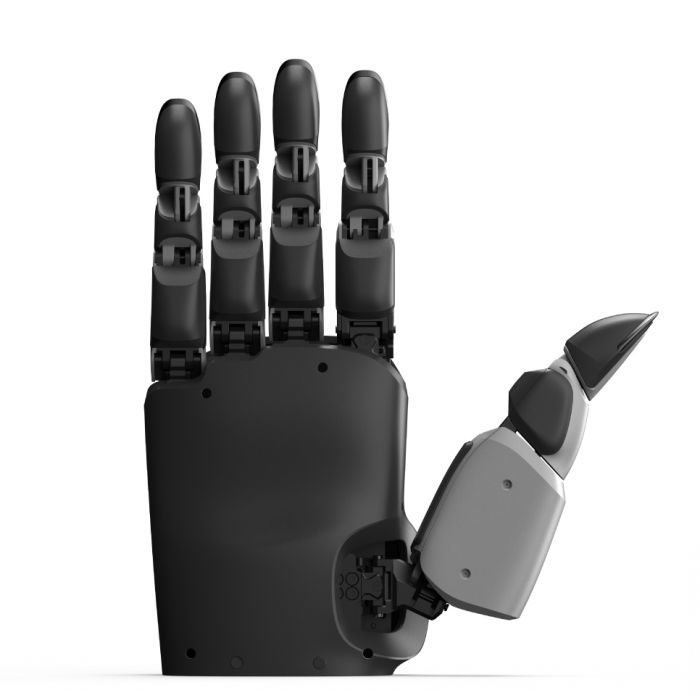
Paxini GMH18 Robot Hand
In stock
- МАРКА:
- PAXINI
- ЧАСТ #:
- GMH18
- ORIGIN:
- Китай
- AVAILABILITY:
- SUBJECT TO AVAILABILITY
- SKU:
- Paxini-GMH18
Paxini GMH18 Robot Hand
The Paxini GMH18 Robot Hand is a five-finger, multi-dimensional tactile dexterous hand developed by PaXini Tech of China. It combines 18 degrees of freedom with full-domain tactile coverage and a rated load capacity of 20 kg, positioning it among the more capable commercially available dexterous end effectors for humanoid, industrial, service, and research robots. With bionic flexible adaptive grasping, modular camera expansion options, and complete communication protocol support, the GMH18 is designed to let robots pick up, hold, and manipulate objects that vary widely in shape, size, and material. This page summarizes the publicly available information on the GMH18 for engineers and procurement teams evaluating dexterous hands.
Background
PaXini Tech and tactile sensing
PaXini Tech is a Chinese robotics company whose core technology is multi-dimensional tactile sensing built around a hall-array approach. The company's public materials describe a product matrix that spans high-precision multi-dimensional tactile sensors, consumer-grade tactile sensors, a family of tactile dexterous hands including the GMH18 and its DexH-series siblings, and tactile humanoid robot platforms. This positioning matters for buyers: the GMH18 is not a gripper with sensors added as an afterthought, but a hand designed by a sensor company around dense tactile feedback. According to the manufacturer's positioning, the goal is human-like perception — letting a robot feel pressure, force, and slip the way a human hand does, and adjust its grasp accordingly.
Why dexterous tactile hands matter
Most industrial automation still relies on two-finger grippers or suction cups, which work well for repetitive handling of known objects but struggle with variability. Humanoid robots and flexible automation cells increasingly need end effectors that can handle mixed objects — rigid and deformable, heavy and delicate — without per-object retooling. A tactile dexterous hand addresses this by combining many controllable joints with distributed touch sensing, so the controller can detect contact, modulate grip force, and react to slip in real time. The GMH18 sits in this category: third-party documentation highlights its blend of a human-like hand form, adaptive sensor-rich fingertips, and a payload rating high enough to cover both delicate tasks and heavier object handling.
Technical Specifications
The table below combines the manufacturer-attributed catalog description with figures reported in third-party technical listings.
| Attribute | Reported value |
|---|---|
| Type | Five-finger tactile dexterous robot hand |
| Degrees of freedom | 18 total; described in third-party documentation as 11 active + 7 passive |
| Load capacity | 20 kg |
| Grasping | Bionic flexible adaptive grasping with flexible fingertips |
| Tactile sensing | Full-domain tactile coverage; pressure, force, and slip sensing across palm, fingertips, and fingernail areas (third-party reported) |
| Drive | Hollow-cup motor with multi-link drive (third-party reported) |
| Hand weight | Approximately 700-1,000 g (third-party reported) |
| Structure | Lightweight metal alloys and engineered polymers with embedded tactile sensor layers (third-party reported) |
| Expansion | Modular camera expansion, including optional palm or back-of-hand cameras |
| Integration | Complete communication protocols; quick setup |
| Software | AI algorithms for human-like perception |
| Manufacturer | PaXini Tech, China |
Several of these figures come from third-party summaries rather than a full official datasheet; confirm the current manufacturer specification, mounting interface, and protocol details at quotation time.
How does the GMH18 sense and grasp objects?
The GMH18's defining feature is its combination of multi-joint articulation and distributed tactile feedback. Its 18 degrees of freedom — reported as a mix of active driven joints and passive compliant joints — allow the fingers to conform to object geometry rather than clamping with a fixed profile. As the hand closes, embedded multi-dimensional tactile sensors report contact location, normal force, and shear across the palm and finger surfaces. Third-party documentation specifically notes sensing on the fingertips and even fingernail regions, which supports fine tasks such as edge picking and controlled re-grasping. The control stack uses AI algorithms to interpret this tactile stream, enabling adaptive grasping behaviors: gripping delicate items lightly, detecting incipient slip and increasing force before an object drops, and stabilizing heavier loads up to the rated 20 kg. Optional camera modules on the palm or back of the hand can add close-range vision for hand-eye coordination in manipulation research and deployment.
Who is the Paxini GMH18 for?
The GMH18 targets three main groups. First, humanoid robot developers who need a production-grade five-finger hand with genuine tactile feedback for whole-body manipulation platforms. Second, industrial and logistics automation teams handling variable objects — mixed-SKU picking, assembly assistance, or kitting — where a two-finger gripper is too limited and grip-force control matters. Third, research groups working on dexterous manipulation, tactile perception, and learning-based grasping, who benefit from dense sensor coverage and standard communication protocols. Because payload, protocols, and mounting details drive integration effort, teams should confirm compatibility with their robot arm or humanoid platform during quotation.
What is the Paxini GMH18 used for?
- Humanoid robot manipulation, serving as a tactile five-finger end effector on humanoid arms for general-purpose object handling.
- Logistics and warehouse tasks such as mixed-object picking and placing, where adaptive grasping copes with varied shapes and materials.
- Assembly and manufacturing assistance, using force and slip feedback to insert, hold, and position parts with controlled grip.
- Tactile-intensive research, including grasp learning, slip detection studies, and multi-dimensional tactile perception experiments.
- Service robotics, enabling robots to handle everyday household and commercial objects that vary in fragility and geometry.
- Teleoperation and data collection, where the hand's articulation and tactile stream support imitation-learning datasets for manipulation policies.
For procurement teams, the practical evaluation of Paxini GMH18 Robot Hand should connect the catalog description to the intended operating environment. Buyers should confirm the working scenario, operator training, accessories, maintenance route, and integration requirements before treating a short listing as a complete deployment plan.
A useful quotation request for Paxini GMH18 Robot Hand should therefore describe the site, task sequence, expected duty cycle, communications requirements, and any safety or compliance constraints. That information helps confirm the correct configuration and keeps the purchase discussion grounded in documented capability rather than assumptions.
Pricing and Availability
The GMH18 is supplied on a project and quotation basis. Configuration options — such as left or right hand, camera expansion modules, and communication interface details — along with current lead times are confirmed during the quotation process. To receive pricing and integration guidance for your platform, submit a request for quotation and a specialist will respond with a formal offer.
Frequently Asked Questions
What is the Paxini GMH18?
It is a five-finger, multi-dimensional tactile dexterous robot hand from PaXini Tech, offering 18 degrees of freedom, adaptive grasping, and a 20 kg load capacity for humanoid, industrial, and research robots.
How many degrees of freedom does the GMH18 have?
The hand provides 18 degrees of freedom in total, described in third-party documentation as 11 active and 7 passive.
How much can the GMH18 lift?
The rated load capacity is 20 kg, which covers both delicate handling and heavier object manipulation. Actual usable payload depends on the host robot and grasp geometry.
What tactile sensing does the GMH18 provide?
It offers full-domain tactile coverage, with third-party documentation describing pressure, force, and slip sensing across the palm, fingertips, and fingernail areas.
Can I add a camera to the GMH18?
Yes. The hand supports modular expansion, including optional palm or back-of-hand camera modules for close-range vision during manipulation.
Is the GMH18 easy to integrate with existing robots?
The hand is promoted with complete communication protocols and quick setup for integration into humanoid, industrial, service, and research platforms. Confirm your specific arm interface and protocol requirements during quotation.
Where can I buy the Paxini GMH18 and what does it cost?
The GMH18 is available through authorized distribution on a quotation basis. Pricing, configuration, and delivery details are confirmed when you submit a request for quotation on this page.
Summary
The Paxini GMH18 Robot Hand brings together the two capabilities that matter most in modern dexterous manipulation: many-jointed, human-like articulation and dense multi-dimensional tactile sensing. Its 18 degrees of freedom, 20 kg load rating, full-domain touch coverage, and modular camera expansion make it a strong candidate for humanoid platforms, flexible automation, and manipulation research alike, while complete communication protocols keep integration practical. As with any rapidly evolving robotics component, final specifications and configuration options should be confirmed with the current manufacturer documentation during quotation. For teams evaluating a tactile dexterous hand, this page is the starting point.