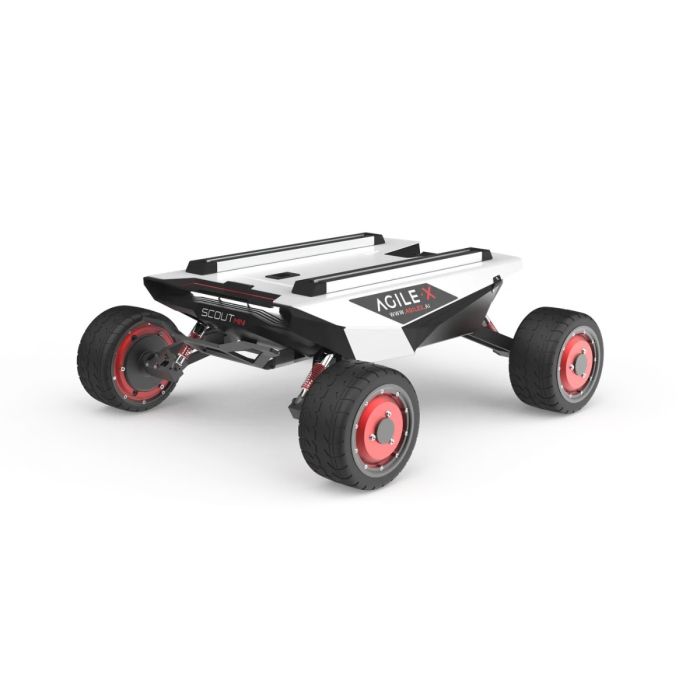
Agilex Scout Mini 4WD Mobile Robot
In stock
- VÖRUMERKI:
- AGILEX
- HLUTI #:
- SCOUT MINI
- ORIGIN:
- Kína
- AVAILABILITY:
- SUBJECT TO AVAILABILITY
- SKU:
- AgileX-Scout-Mini
Agilex Scout Mini 4WD Mobile Robot
Agilex Scout Mini 4WD Mobile Robot
In practice, the Scout Mini is used as a “mobile base” or “robot chassis” that can carry onboard compute (for example, an embedded PC or edge AI module), environmental sensors (LiDAR, depth cameras, GNSS/RTK, IMU), and custom payloads. AgileX markets the platform in both standard-wheel and mecanum-wheel configurations, with mecanum wheels enabling omnidirectional motion compared to the differential steering behavior of the standard wheel kit.
Design and Features
The Scout Mini is built around a compact rectangular chassis with a low center of gravity, designed to remain stable during quick turns and while traversing uneven ground. Key design elements include:
-
4WD drivetrain with four motors and a suspension system intended to improve traction and ride quality on mixed terrain.
-
Dual wheel options: a standard wheel kit for differential steering and an optional mecanum wheel kit for omnidirectional movement.
-
Mounting and expansion provisions, including rails intended for attaching sensors and payload hardware, supporting typical robotics “stacking” workflows (compute + sensors + power management).
From a systems-integration perspective, Scout Mini is commonly positioned as a platform where researchers can focus on autonomy (mapping, localization, planning, perception) without fabricating a drivetrain from scratch.
Technology and Specifications
Because mobile robot performance depends strongly on configuration and test conditions (payload mass, speed profile, terrain, temperature, and battery health), published specifications are often presented as “no-load” or typical values. The Scout Mini documentation and manufacturer product page provide a set of commonly cited figures.
Core platform specifications (standard wheels)
Commonly listed specifications for the standard-wheel Scout Mini include: dimensions 612 × 580 × 245 mm, weight ~26 kg, payload ~10 kg, battery 24V 15Ah, IP22 ingress rating, range (no load) ~10 km, and maximum speed (no load) ~2.7 m/s.
The manufacturer product page also summarizes headline capabilities such as 10 kg payload, ~3 hours runtime, and speed presented as up to ~3 m/s (often communicated as “about 10 km/h” in marketing and documentation).
Terrain and mobility figures
Documentation commonly cites ~115 mm ground clearance, ~70 mm obstacle height, and ~30° slope capability (typically described under no-load or controlled conditions).
Interfaces and development support
The platform is described as supporting CAN bus and serial interfaces, and it is often bundled (via documentation/distributors) with items such as a USB-to-CAN module, USB-to-RS232 module, and an RC transmitter for manual operation and testing.
Open-source development resources are commonly referenced for C++ and ROS, supporting robotics middleware integration and “secondary development” workflows.
Notes on configuration variability
Some specifications differ between standard wheels and mecanum wheels. For example, mecanum configurations are often listed with higher payload but lower maximum speed than standard wheels in the same documentation set.
For procurement and project planning, it is generally best to treat payload, speed, and runtime as configuration-dependent and to confirm final figures with the seller for the exact kit (standard wheels vs. mecanum wheels, battery option, included compute, and accessory payload).
Applications and Use Cases
The Scout Mini is used across multiple robotics categories where a compact 4WD base is advantageous:
Academic research and robotics education
Universities and labs frequently use small UGV (unmanned ground vehicle) platforms for teaching and research in SLAM (simultaneous localization and mapping), sensor fusion, and motion planning. A ready-made mobile base helps shift effort from mechanical fabrication to experimentation with perception and autonomy algorithms.
Autonomous navigation prototyping
With CAN/serial connectivity and mounting rails for sensors, the platform can be configured for indoor-outdoor navigation trials e.g., warehouse aisles, campuses, light industrial sites, or structured outdoor paths where researchers evaluate localization drift, route planning, and obstacle avoidance.
Perception payload testing
A compact chassis with predictable motion control is often used to test LiDAR placement, camera baselines, and vibration effects on IMU performance. The Scout Mini’s expansion approach is explicitly presented as sensor/kit-friendly.
Inspection and “proof-of-concept” field robotics
While not a heavy-duty industrial UGV, a small 4WD base can be used for proof-of-concept inspection workflows—such as creating repeatable routes, capturing imagery, or validating teleoperation/assistive autonomy in a controlled environment—before migrating to larger platforms.
Advantages / Benefits
In neutral terms, the Scout Mini’s main advantages are tied to reducing barriers to mobile robotics experimentation:
-
Rapid start for R&D: a complete drivetrain, battery system, and control interfaces allow teams to focus on autonomy and sensors rather than chassis design.
-
Compact form factor: smaller footprint can simplify indoor testing and transportation while still enabling outdoor trials on moderate terrain.
-
Wheel-kit flexibility: standard wheels for differential steering versus mecanum wheels for omnidirectional motion provides a choice aligned with different research needs (e.g., corridor navigation vs. tight-space maneuvering).
-
Developer-oriented interfaces: CAN/serial connectivity and references to ROS/C++ resources align with common robotics development pipelines.
FAQ Section
What is the AgileX Scout Mini 4WD mobile robot?
The AgileX Scout Mini is a compact 4WD mobile robot base intended for robotics education and research, commonly used as a development platform for autonomous navigation and sensor integration.
How does the Scout Mini work?
Scout Mini functions as a powered chassis with onboard battery and motor control, exposing interfaces such as CAN and serial for connecting a computer and sensors. Developers typically run robotics software (often ROS-based) to command velocity, integrate sensors, and implement autonomy behaviors.
Why is the Scout Mini important for robotics R&D?
A ready-made, compact UGV base reduces the time and cost required to begin experiments in mapping, localization, and navigation. This allows teams to focus on algorithms, perception stacks, and system integration rather than mechanical drivetrain design.
What are the benefits of the Scout Mini platform?
Commonly cited benefits include compact size, modular mounting for sensors, wheel-kit options (standard vs. mecanum), and development-friendly interfaces (CAN/serial) with references to open-source software resources for robotics development.
Summary
The AgileX Scout Mini 4WD Mobile Robot is widely used as a compact research-grade UGV base that supports rapid prototyping in autonomy, navigation, and perception. With configurable wheel kits, documented mobility figures, and developer-oriented interfaces, it serves as a practical foundation for robotics education and R&D projects that require a small, capable, and integration-focused mobile platform.