
BSN NAL Filtered Active Antenna (ASE-PFA0-A)
In stock
- HLUTI #:
- ASE-PFA0-A
- AVAILABILITY:
- SUBJECT TO AVAILABILITY
- SKU:
- BSN NAL-ASE-PFA0-A
BSN NAL Filtered Active Antenna (ASE-PFA0-A)
BSN NAL Filtered Active Antenna (ASE-PFA0-A)
In practical deployments, the ASE-PFA0-A is selected when installers need a resilient RF link in RF-noisy environments (multiple radios/antennas nearby), when cable runs exceed typical passive-antenna limits, or when installations demand a professional-grade antenna assembly with integrated filtering and an active receive/transmit approach.
Design and Features
Active antenna architecture (powered operation)
Unlike passive Iridium antennas that rely entirely on the terminal’s RF output and tolerate only short coax runs before performance degrades, the ASE-PFA0-A uses active electronics that operate from an external DC supply. In commercial descriptions of this antenna class, it is often characterized as using internal gain stages and a transmit/receive architecture intended to maintain performance over longer distances and challenging RF conditions.
Integrated filtering for interference resilience
A defining element of the ASE-PFA0-A is its filtered design. Published specifications for the equivalent AD511-2/ASE-PFA0-A platform describe a ceramic filter bandwidth of 25 MHz (Rx), which is commonly used to help suppress out-of-band energy and reduce receiver desensitization in RF-dense environments.
Rugged external form factor and mounting
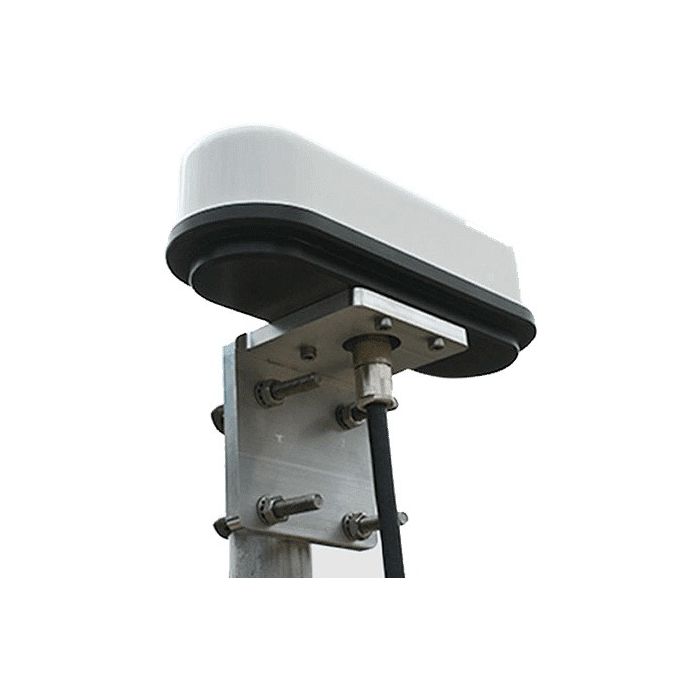
The antenna is built as a compact external unit designed for fixed mounting using a heavy-duty bracket. Documentation for the AD511-2 / ASE-PFA0-A equivalence lists the antenna body dimensions and weight (excluding bracket), reflecting a form factor appropriate for roof, mast, or structure mounting.
Power break-in / interface approach
Active antennas require DC power injection into the RF line (or a dedicated feed) to energize the antenna electronics. AD511-2/ASE-PFA0-A documentation describes a power break-in box concept and DC lead requirements, which is consistent with how active satellite antennas are typically deployed near the terminal end of the coax run.
Technology and Specifications
Core RF band and polarization
Published specifications for the AD511-2 / ASE-PFA0-A platform list:
-
Frequency range: 1610–1630 MHz (Iridium L-band)
-
Polarization: Right-hand circular (RHCP)
-
Antenna type: RHCP dipole
These characteristics align with Iridium system requirements and typical Iridium handset/docking-station antenna ecosystems.
Mechanical and environmental specifications
Commonly published device parameters include:
-
Dimensions (excluding mounting bracket): approximately 240–245 mm × 85 mm × 70 mm
-
Weight (excluding mounting bracket): 0.8 kg
-
Operating temperature: -40°C to +85°C
Connectors and filtering
-
Antenna head connection: N-Type
-
Ceramic filter bandwidth (Rx): 25 MHz
Power requirements
The AD511-2 / ASE-PFA0-A specification lists:
-
Operating voltage: +18 to +36 VDC (nominal 24 VDC)
What’s included (typical listings)
Retail and dealer listings commonly describe the ASE-PFA0-A as “antenna only” (no long coax cable kit included) while bundling required power components depending on seller configuration. For example, some storefront listings describe “No Cables Included” and include a PS071-series power supply / power cord.
(Installations requiring long cable runs typically pair the antenna with a specific cable kit length/type—e.g., 27 m LMR-200 or 40 m RG-213—depending on system design and vendor guidance. )
Applications and Use Cases
Iridium docking stations and fixed indoor terminals
A primary use case is improving Iridium handset or docking-station connectivity when the handset/base unit must remain indoors (security desk, bridge, comms room), but the antenna requires outside mounting for sky visibility and reduced obstruction.
Maritime installations (vessels and workboats)
On vessels, the ASE-PFA0-A class is used to place the antenna higher and clearer—reducing blockage from superstructure and improving link stability—while routing the terminal to protected interior spaces.
Vehicle and fleet communications
Vehicles operating in remote areas may mount the antenna externally (roof rack, cabin roof) while keeping the docked handset inside. The active design supports longer routing and helps mitigate losses that would otherwise degrade service.
RF-noisy industrial and remote infrastructure sites
Industrial sites often contain radios, telemetry systems, and electrical equipment that elevate the RF noise floor. Commercial descriptions of the ASE-PFA0-A emphasize improved outcomes when “external radiation from other antennas” interferes, and the filtered receiver design supports that deployment intent.
Advantages / Benefits
Better performance over longer cable runs than passive solutions
Passive antennas can suffer rapid degradation when coax losses exceed a few dB, impacting both transmit and receive paths. The ASE-PFA0-A’s powered/active approach is specifically marketed for scenarios “beyond 20 meters,” supporting installations where antenna placement is physically distant from the handset or dock.
Improved resilience in RF-dense environments
The antenna’s filtered receiver path (including the specified ceramic filter characteristic) is designed to reduce the effect of unwanted energy and improve usable signal quality in difficult RF settings.
Wide operating temperature range for harsh environments
A rated range down to -40°C and up to +85°C supports use in cold climates, hot sun-exposed rooftops, maritime environments, and industrial deployments.
Standard Iridium-band polarization and frequency support
RHCP polarization and the 1610–1630 MHz band coverage align with Iridium operational needs, supporting compatibility with Iridium-focused docking and fixed-station systems.
FAQ Section
What is the BSN NAL Filtered Active Antenna (ASE-PFA0-A)?
The ASE-PFA0-A is a powered, filtered Iridium-band external antenna (commonly cross-referenced with AD511-2) designed to improve satellite connectivity when passive antennas are limited by distance, placement, or interference.
How does the ASE-PFA0-A work?
It uses active electronics powered by DC (18–36 VDC) and a power break-in/interface method to energize the antenna, supporting better performance over longer coax runs and improving signal robustness in challenging RF environments.
Why is the ASE-PFA0-A important?
It enables professional Iridium installations where the terminal must stay indoors while the antenna must be mounted outside with clear sky view, and it helps reduce receiver issues in RF-noisy locations through its filtered design.
What are the benefits of the ASE-PFA0-A?
Key benefits include support for longer cable routing, Iridium-band RHCP operation, filtered receive design, and wide-temperature ruggedness (-40°C to +85°C) for reliable field deployments.
Summary
The BSN NAL Filtered Active Antenna (ASE-PFA0-A) is a specialized Iridium L-band (1610–1630 MHz) RHCP external antenna solution engineered for installations where passive antennas fall short due to distance, placement constraints, or RF interference. With active power operation (18–36 VDC), a filtered receive path, and a rugged environmental rating, it is widely used to enhance Iridium handset and docking-station deployments across maritime, vehicle, industrial, and remote fixed-site scenarios.
Specifications
| HLUTI # | ASE-PFA0-A |
|---|