
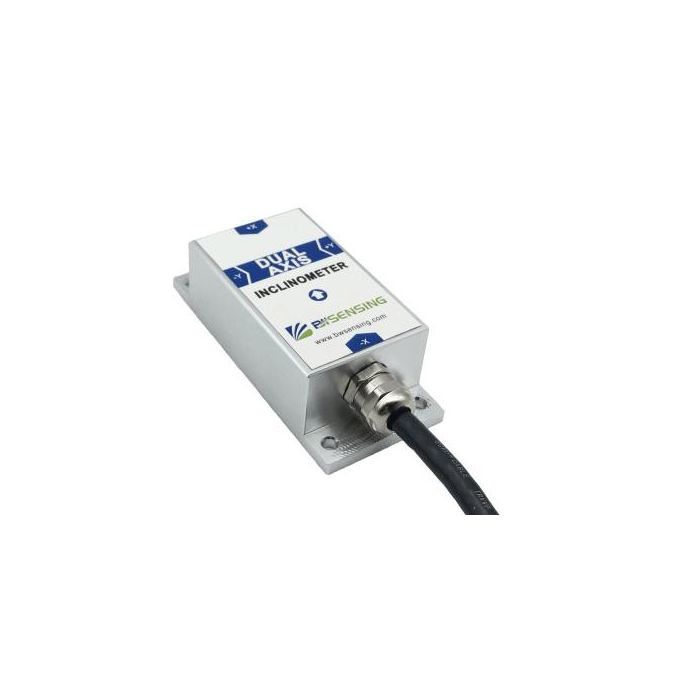
BWSENSING Cost-Effective Dual-Axis Digital Output Inclinometer (BWM426)
In stock
- VÖRUMERKI:
- BWSENSING
- HLUTI #:
- BWM426
- ORIGIN:
- Kína
- AVAILABILITY:
- SUBJECT TO AVAILABILITY
- SKU:
- BWSENSING-BWM426
BWSENSING Cost-Effective Dual-Axis Digital Output Inclinometer (BWM426)
BWSENSING Cost-Effective Dual-Axis Digital Output Inclinometer (BWM426)
Manufacturer documentation describes the BWM426 series as a MEMS-based inclinometer that combines inclination measurement with digital communication interfaces for control systems, data loggers, and monitoring platforms.
In typical deployments, a dual-axis inclinometer like the BWM426 provides two independent angle channels (commonly X and Y, or pitch and roll), enabling monitoring of platform leveling, equipment attitude, or structural deformation from a fixed reference frame.
Design and Features
Mechanical design
The BWM426 is built as a compact sensor module intended for rigid mounting to the monitored object (e.g., a chassis, bracket, beam, mast, or equipment frame). The product listing includes a metal housing form factor with defined mounting geometry and a cable interface intended for industrial environments.
Environmental and durability features
Manufacturer specifications for the BWM426 series emphasize suitability for field conditions, including:
-
Wide operating temperature range (specified for industrial use). Ingress protection rating intended for dust and water exposure (the product specification lists an IP-grade).
-
Stated shock/impact and vibration tolerance values aimed at mobile machinery and outdoor installations.
Interface and integration
A defining feature of the BWM426 is digital output for direct integration with automation and monitoring systems. The manufacturer lists multiple digital interface options depending on configuration (commonly including RS485, and in some series variants additional interfaces).
Technology and Specifications
Measurement principle (MEMS inclination sensing)
BWSENSING documentation describes the inclinometer as using micro-electro-mechanical systems (MEMS) technology and internal conversion/processing to deliver angle outputs via digital interfaces. In general terms, MEMS inclinometers estimate tilt by measuring the gravity vector projection on sensor axes and converting this to angles through calibration and compensation algorithms.
Key specifications
The precise specification set can vary by sub-model and configuration, but published manufacturer specs for the BWM426 series include:
-
Measurement axes: Dual-axis (two-channel inclination).
-
Measurement range: ±90° (listed for the BWM426 series).
-
Resolution: 0.001° (manufacturer listing).
-
Accuracy: 0.01° (manufacturer listing).
-
Power supply: DC 9–36 V (manufacturer listing).
-
Output / communications: Digital output via supported interfaces (with RS485 commonly referenced in the technical manual for the BWM426E series).
-
Output update rate: Adjustable update/output frequency (the product specification lists selectable Hz settings).
These values place the BWM426 in the category of high-resolution dual-axis inclinometers used for leveling, alignment, and deformation monitoring, especially where a digital fieldbus-style interface is preferred over analog voltage/current outputs.
Calibration and compensation considerations
Like most precision tilt sensors, real-world accuracy depends not only on the sensor’s internal calibration but also on mounting flatness, mechanical stability, thermal gradients, and installation technique. Manufacturer documentation typically provides installation guidance and configuration/communication details for system integration.
Applications and Use Cases
Construction, civil engineering, and structural monitoring
Dual-axis digital inclinometers are widely used for structural health monitoring and deformation measurement—such as tracking tilt of retaining walls, bridge components, piers, towers, or temporary supports. In these contexts, a digital-output inclinometer like the BWM426 is often chosen when the system needs robust wiring runs and noise-resistant communication.
Mobile machinery and industrial equipment leveling
Industrial and mobile equipment—such as platforms, lifting systems, material-handling machinery, and specialized vehicles—frequently requires leveling feedback and attitude sensing to improve safety and control accuracy. Dual-axis measurement supports combined pitch/roll monitoring.
Energy and utilities infrastructure
Installations such as pole-mounted equipment, antenna masts, and remote cabinets may use tilt sensors for alignment verification and tamper/shift detection, especially when continuous monitoring is needed.
Automation, robotics, and test rigs
In automation environments, a digital inclinometer with RS485/Modbus-style integration can be used for calibration fixtures, alignment jigs, motion platforms, or lab rigs where logged measurements and repeatability matter.
Advantages / Benefits
Digital integration and longer cable runs
Compared with analog-output inclinometers, digital-output devices can provide improved resilience to electrical noise and signal degradation over distance (depending on interface and implementation). This is a common reason to select RS485 inclinometer designs in industrial installations.
Dual-axis measurement in one device
A dual-axis inclinometer provides two tilt channels in one unit, reducing wiring complexity and simplifying synchronization compared with using two single-axis sensors.
High resolution for fine alignment tasks
A published resolution of 0.001° supports applications where small angular changes are meaningful (e.g., precision leveling and deformation trend monitoring).
Practical field deployment
The stated environmental ratings (temperature range, ingress protection, vibration/shock tolerance) support outdoor and industrial deployments where consumer-grade sensors would be unsuitable.
FAQ Section
What is the BWSENSING BWM426?
The BWSENSING BWM426 is a cost-effective dual-axis digital output inclinometer designed to measure tilt angles on two axes for industrial monitoring and control applications.
How does the BWM426 inclinometer work?
It uses MEMS inclination sensing to estimate tilt relative to gravity and outputs calculated angle values through a digital communication interface (commonly RS485 in the BWM426E documentation).
Why is a dual-axis digital inclinometer important?
Dual-axis measurement supports simultaneous monitoring of pitch and roll (or X/Y tilt), which is important for leveling, alignment, and deformation tracking. Digital output can simplify integration with industrial monitoring networks and controllers.
What are the benefits of the BWM426?
Key benefits include dual-axis measurement, published high resolution (0.001°), specified accuracy (0.01°), and digital output suited to industrial systems, along with environmental specifications aimed at field deployment.
Summary
The BWSENSING BWM426 is a dual-axis digital inclinometer engineered for industrial tilt measurement where practical installation, digital integration, and cost efficiency matter. With published specifications including ±90° range, 0.001° resolution, and 0.01° accuracy, the BWM426 is positioned for leveling, alignment, and monitoring tasks across construction, machinery, infrastructure, and automation environments.