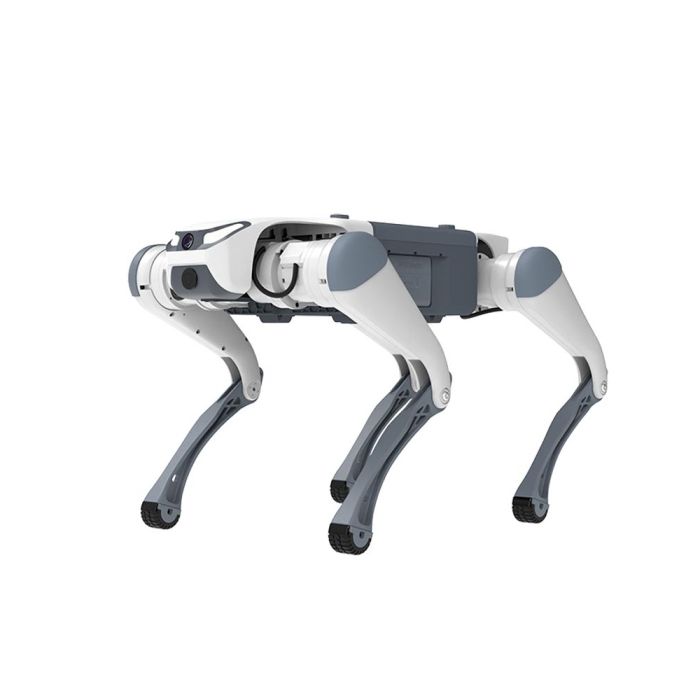
Deep Robotics Lite3 Basic Quadruped Robot Dog
In stock
- VÖRUMERKI:
- DEEP ROBOTICS
- HLUTI #:
- Lite3
- ORIGIN:
- Kína
- AVAILABILITY:
- ALLOW 2-4 WEEKS FOR DELIVERY
- SKU:
- Deep-Robotics-Lite3-Basic
Deep Robotics Lite3 Basic Quadruped Robot Dog
Lite3 Academic & Research Quadruped Robot Dog (Lite3)
In the Lite3 family lineup (commonly presented as Basic, Venture, Pro, and LiDAR variants), the Basic model emphasizes a lightweight chassis, core mobility performance, and developer-oriented “secondary development” support, while keeping hardware interfaces and autonomy features simpler than higher-tier configurations.
Deep Robotics markets the Lite3 series as a compact legged system for experimentation with locomotion, perception, and human–robot interaction. The Basic configuration is typically chosen when teams want a dependable baseline for gait testing, classroom labs, or introductory robotics middleware work without the added complexity of advanced autonomy sensors.
Design and Features
Lightweight quadruped architecture
Lite3 Basic is designed around portability and repeatable testing. Deep Robotics lists the Basic robot’s standing dimensions as 610 × 370 × 406 mm and a weight of 12 kg (including battery), which places it in the “carryable” research-quadruped category compared with larger industrial inspection quadrupeds.
Mobility-first configuration for training and prototyping
Deep Robotics positions the Lite3 family around “extraordinary locomotion” and highlights performance-oriented changes in marketing materials, including claims of increased joint torque and improved control responsiveness for the series. While such statements are promotional rather than standardized lab metrics, they reflect the intended design goal: stable, agile motion suitable for demos and controlled field tests.
Baseline perception functions for safer operation
For Basic, Deep Robotics lists front/rear obstacle stop and visual following as its perception features. These functions are commonly used for supervised walking demonstrations, basic safety behavior (auto-stop near obstacles), and education scenarios involving person/object following.
Secondary development support as a core feature
Deep Robotics explicitly states that Lite3 supports secondary development, providing models, a motion control SDK and APIs, and perception development interfaces with sample code. This emphasis is central to Lite3’s role as a research and education platform rather than a closed consumer “robot pet.”
Technology and Specifications
The following specifications are listed by Deep Robotics for the Lite3 Basic configuration:
Dimensions, weight, and payload
-
Standing dimensions (L × W × H): 610 × 370 × 406 mm
-
Weight (incl. battery): 12 kg
-
Payload capacity (walking load): 5 kg
Terrain capability and endurance
-
Maximum slope: 40°
-
Obstacle / step capability: 18 cm
-
Continuous operation: 1.5–2 hours
-
Maximum range: up to 5 km
Perception and interfaces
-
Perception features: front/rear obstacle stop; visual following
-
Interfaces (Basic): listed as N/A on the US product specification and “/” on a Deep Robotics product listing, indicating a simpler interface set than Venture/Pro/LiDAR variants.
Software, ROS, and messaging architecture
Deep Robotics states Lite3 provides open SDK/API access and supports secondary motion and perception development on ROS1 and ROS2.
Deep Robotics’ public repositories also show how Lite3 development often bridges robot subsystems through network messaging (e.g., ROS-to-UDP conversion and host-to-host transport), which is typical for robots that separate motion control and perception stacks.
Applications and Use Cases
Robotics education and classroom labs
Lite3 Basic is commonly aligned with robotics curricula where students need a real legged platform to learn:
-
gait commands and motion primitives,
-
basic perception behaviors (following / obstacle stop),
-
robotics middleware workflows (ROS topics/services),
-
logging, testing, and validation in real environments.
Academic research and early-stage prototyping
For research groups, Basic provides a stable physical baseline for experiments in:
-
locomotion control and gait generation,
-
system identification and disturbance testing,
-
teleoperation-style supervision and scripted behaviors,
-
software integration and middleware benchmarking.
Deep Robotics positions Lite3 broadly for academic research and reinforcement learning experimentation at the series level, which also informs common Basic use cases even when advanced autonomy sensors are not included.
Lightweight site demos and supervised patrol pilots
The Basic model’s obstacle stop and visual following features support pilot-style demos such as guided campus walks, supervised perimeter demonstrations, and showcase events where simple autonomy cues are desired without deploying full mapping/navigation stacks.
Advantages / Benefits
Cost- and complexity-efficient entry point into legged robotics
Compared with more sensor-rich configurations, Lite3 Basic is designed to keep the platform approachable while still offering meaningful mobility performance and development access. Deep Robotics’ emphasis on SDK/API access and secondary development is especially relevant for institutions scaling robotics programs across multiple student teams.
Portable payload capacity for real research sensors
A 5 kg payload rating is meaningful for educational and research payloads (compact cameras, lightweight compute modules, small sensor rigs), especially when combined with the platform’s slope and obstacle performance.
Strong baseline terrain performance for its size
Published capabilities—40° slope and 18 cm obstacle—support experiments on ramps, curbs, uneven grass, and other “real world” conditions that often break wheeled robots without infrastructure changes.
Developer ecosystem and ROS support
Support for ROS1/ROS2, plus publicly visible tooling and documentation, reduces the friction of adopting the platform for robotics teaching and lab workflows.
FAQ Section
What is the Deep Robotics Lite3 Basic Quadruped Robot Dog?
The Lite3 Basic is an entry configuration of the Deep Robotics Lite3 series: a compact quadruped robot designed for robotics education, research, and secondary development, with baseline perception features and published mobility specs.
How does the Lite3 Basic work?
Lite3 Basic uses quadruped locomotion for terrain traversal and includes basic perception functions such as front/rear obstacle stop and visual following. Deep Robotics also provides models, SDK/APIs, and development interfaces to support custom motion and perception work.
Why is the Lite3 Basic important?
It offers a practical way for labs and universities to run real legged-robot experiments without building a robot from scratch, while still supporting ROS1/ROS2 development and developer-accessible interfaces.
What are the benefits of the Lite3 Basic?
Deep Robotics lists 12 kg weight, 5 kg payload, 40° slope, 18 cm obstacle, 1.5–2 hours runtime, and up to 5 km range, plus developer-oriented secondary development support.
Summary
The Deep Robotics Lite3 Basic is a lightweight quadruped robot dog configuration aimed at education and research, combining published mobility performance (40° slope, 18 cm obstacle) with a practical payload (5 kg) and developer enablement through secondary development resources and ROS1/ROS2 support. With its compact form factor and baseline perception features (obstacle stop, visual following), Lite3 Basic is commonly used as a dependable entry platform for legged locomotion experiments, coursework, and early-stage robotics prototyping.
Specifications
General
Physical
Performance
Software
Battery + Power
What's included
Downloads
Related Products
Out of stock