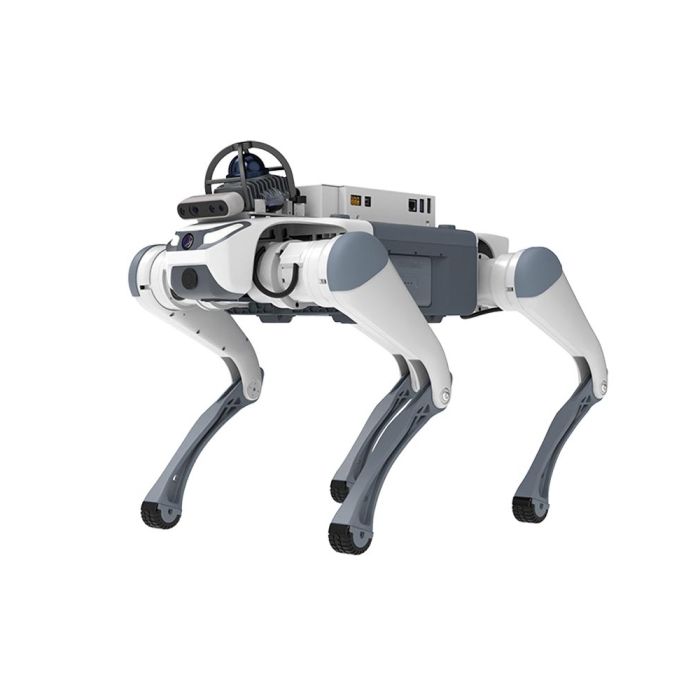
Deep Robotics Lite3 LIDAR Quadruped Robot Dog
In stock
- VÖRUMERKI:
- DEEP ROBOTICS
- HLUTI #:
- Lite3 Venture
- ORIGIN:
- Kína
- AVAILABILITY:
- ALLOW 2-4 WEEKS FOR DELIVERY
- SKU:
- Deep-Robotics-Lite3-LIDAR
Deep Robotics Lite3 LIDAR Quadruped Robot Dog
Deep Robotics Lite3 LIDAR Quadruped Robot Dog
In the Lite3 product family (often presented as Basic, Venture, Pro, and LiDAR configurations), the LiDAR variant is positioned as the most autonomy-oriented option, adding perception functions such as obstacle avoidance and automatic navigation.
Deep Robotics describes the Lite3 series as an advanced bionic robot dog emphasizing mobility performance, environmental interaction, and expandability via optional modules and software interfaces.
Design and Features
LiDAR-enabled perception for autonomy
The defining feature of the Lite3 LiDAR configuration is its autonomy-ready perception package. In Deep Robotics’ published specifications, the LiDAR model includes:
-
Front/Rear obstacle stop
-
Visual following
-
Forward obstacle avoidance
-
Auto navigation
Compact quadruped form factor
Deep Robotics lists the Lite3 LiDAR’s standing size as 610 mm × 370 mm × 496 mm, with a weight of 13.5 kg (including battery). This size class is typically associated with “lab-portable” quadruped platforms that can be deployed quickly for repeated experiments.
Mobility-first chassis with modular expansion
Deep Robotics’ Lite3 series marketing highlights increased driving force and algorithm improvements, including a claim of “50% joint torque increased” for the series. While this phrasing reflects product messaging rather than a standardized benchmark, it indicates the platform’s intended emphasis on dynamic locomotion and responsive control.
Developer-facing “secondary development” support
Deep Robotics explicitly promotes Lite3 for secondary development, stating it provides models, motion control SDK and APIs, and perception development interfaces with sample code. This positioning aligns Lite3 LiDAR with research workflows where teams implement custom perception, mapping, or control modules.
Technology and Specifications
Official published specifications (Lite3 LiDAR)
Deep Robotics’ Lite3 LiDAR listing includes the following parameters:
-
Standing size: 610 × 370 × 496 mm
-
Weight (incl. battery): 13.5 kg
-
Walking load (payload): 2.5 kg
-
Slope capability: 40°
-
Stair/obstacle specification: 18 cm
-
Battery endurance: 1.5–2 hours
-
Mileage (range): 2.7 km
-
Perception functions: obstacle stop (front/rear), visual following, forward obstacle avoidance, auto navigation
-
Interfaces: USB 3.0, HDMI, Ethernet, external power input (24V/12V/5V), power connector
Degrees of freedom and development access (manual)
A Lite3 LiDAR user manual describes Jueying Lite3 as an intelligent quadruped robot with 12 degrees of freedom, and states that the Lite3 LiDAR provides an SDK for motion control algorithm development, plus source code for some perception development examples and a communication protocol for re-development.
Perception compute and OS/ROS environment
A perception development manual for Lite3 indicates the Pro/LiDAR versions use an NVIDIA Jetson Xavier NX as the perception host and notes the manual applies to Ubuntu 20. It also states that Lite3 supports both ROS1 and ROS2 (with version notes in the manual’s update history).
LiDAR drivers and SLAM development (development manual)
An official Deep Robotics perception development manual (PDF) includes guidance for LiDAR driver development and references driver workspaces and SLAM launch files, reflecting a development workflow oriented toward mapping and navigation experimentation.
Applications and Use Cases
SLAM, mapping, and autonomous navigation research
Because the LiDAR configuration explicitly adds forward obstacle avoidance and auto navigation, it is commonly used for prototyping and evaluating SLAM, mapping pipelines, localization approaches, and navigation behaviors on a real legged platform.
Academic research in legged locomotion and embodied AI
Lite3 LiDAR is frequently used in university labs studying locomotion, contact-rich control, and perception-informed motion. The availability of a motion-control SDK and perception development examples (per the user manual) supports experiments spanning classic control, learning-based policies, and sim-to-real validation.
Robotics education and advanced coursework
In educational settings, Lite3 LiDAR can support advanced modules in robotics middleware (ROS), sensor calibration, mapping/navigation, and systems engineering. The platform’s documented ROS support and Ubuntu-based perception stack aligns with common university robotics toolchains.
Field pilots in controlled environments
With published mobility capabilities such as 40° slope and 18 cm obstacle specification, Lite3 LiDAR is often used in controlled outdoor or semi-structured environments for supervised pilots and demonstrations—particularly where legged locomotion offers advantages over wheels on uneven ground.
Advantages / Benefits
Autonomy-oriented feature set in a portable size class
Compared with non-LiDAR configurations, the LiDAR model’s published perception functions include both forward obstacle avoidance and auto navigation, supporting faster iteration for navigation-centric research and prototypes.
Research-grade developer access (SDK, examples, protocol)
The Lite3 LiDAR user manual’s description of an SDK for motion control algorithm development, perception example source code, and a communication protocol indicates an explicit focus on re-development rather than purely closed-box operation.
Integration-ready interfaces and power options
USB 3.0, HDMI, Ethernet, and multi-voltage external power input (24V/12V/5V) are practical for integrating sensors, payload computing, and data logging hardware during experiments—without requiring extensive custom wiring.
Documented mapping and LiDAR development workflow
Availability of development documentation covering LiDAR drivers and SLAM workflows can reduce onboarding time for labs and teams that want reproducible autonomy experiments on real hardware.
FAQ Section
What is the Deep Robotics Lite3 LiDAR Quadruped Robot Dog?
The Deep Robotics Lite3 LiDAR is the LiDAR-equipped Lite3 configuration, designed for research and development with published perception functions including obstacle avoidance and auto navigation.
How does the Lite3 LiDAR work?
It combines quadruped locomotion with a perception stack designed for environment sensing and navigation. Deep Robotics lists obstacle stop, visual following, forward obstacle avoidance, and auto navigation, and the user manual describes SDK access and perception development examples for re-development.
Why is the Lite3 LiDAR important?
For many teams, the hardest step is moving autonomy from simulation into real environments. Lite3 LiDAR packages navigation-oriented sensing and documented development workflows (LiDAR drivers, SLAM mapping) to accelerate real-world testing on a legged platform.
What are the benefits of the Lite3 LiDAR?
Key published benefits include a compact footprint (610 × 370 × 496 mm), autonomy-oriented perception functions (including auto navigation), documented SDK access for development, and interfaces such as USB 3.0/HDMI/Ethernet plus external power input.
Summary
The Deep Robotics Lite3 LiDAR is a compact quadruped robot dog designed for autonomous navigation and perception-driven R&D, integrating LiDAR-oriented capabilities with developer-accessible tooling. Deep Robotics’ published specifications highlight auto navigation and forward obstacle avoidance, a portable form factor (13.5 kg), and practical interfaces (USB 3.0, HDMI, Ethernet, external power input). Combined with a documented development ecosystem—SDK support, perception examples, and SLAM-related manuals—Lite3 LiDAR is positioned as a practical platform for universities, labs, and developers building and validating real-world mapping and autonomy workflows on legged hardware
Specifications
General
Physical
Performance
Software
What's included
Downloads
Related Products
Out of stock