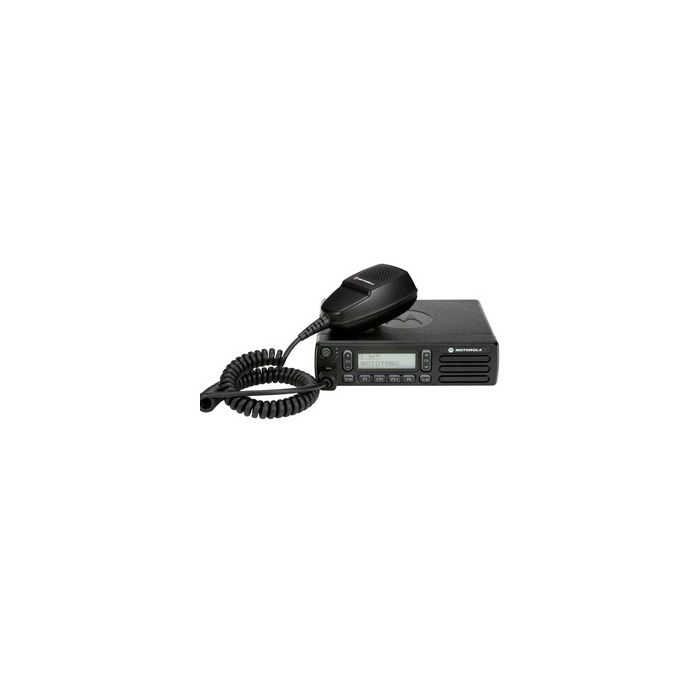
Motorola CM300d-DV-45 Mobile Two-Way VHF Radio (AAM01JQH9JA1_N)
In stock
- VÖRUMERKI:
- MOTOROLA
- FYRIRMYND:
- CM300d-DV-45
- HLUTI #:
- AAM01JQH9JA1_N
- AVAILABILITY:
- SUBJECT TO AVAILABILITY
- SKU:
- Motorola-CM300d-DV-45
Motorola CM300d-DV-45 Mobile Two-Way VHF Radio (AAM01JQH9JA1_N)
Within the CM Series, the CM300d is the more feature-rich model. Motorola’s official CM Series specification sheet identifies the CM300d with an alphanumeric display and 99-channel capacity, while the related CM200d is limited to 16 channels and a simpler interface. That places the CM300d in a strong middle ground for organizations that need more channel flexibility and better on-screen identification without moving to a more complex premium mobile radio tier.
The specific model code AAM01JQH9JA1_N, commonly marketed as CM300d-DV-45, is listed by dealers as a VHF 136–174 MHz, 45-watt, 99-channel mobile radio. Those details align with Motorola’s published CM Series family specifications, which show VHF CM300d configurations in the 136–174 MHz range with power options up to 45 watts.
For businesses searching for a Motorola VHF mobile two-way radio with analog and digital flexibility, the CM300d-DV-45 is typically positioned as a dependable communications tool for fleet coordination, field service, utilities, education, construction, and commercial operations. That positioning is partly an inference based on Motorola’s published CM Series use cases and partly supported by dealer descriptions for the CM300d family.
Design and Features
Professional mobile form factor
Motorola’s official CM Series product sheet lists radio dimensions of approximately 44 x 169 x 134 mm and a weight of about 1.3 kg, giving the CM300d a compact profile for vehicle dashboards, mounting brackets, service counters, and dispatch desks. The radio is designed for practical installation in working environments where space is limited and controls must remain accessible.
Alphanumeric display
A defining feature of the CM300d is its high-contrast alphanumeric display. Motorola and dealer descriptions note that this display allows users to view information such as caller ID, channel number, and contacts, which is especially useful in larger fleets or multi-team operations where workers need more than a simple channel number readout.
Analog and digital capability
Motorola’s published CM Series materials emphasize that the CM300d supports both analog and digital operation. This is one of the model’s key strengths, because it allows organizations to continue working with legacy analog systems while gaining access to MOTOTRBO digital features as they upgrade infrastructure over time.
Business-oriented feature set
The CM300d feature set includes Radio Management, Dual Capacity Direct Mode, and Transmit Interrupt capability (decode only) in Motorola’s official documentation. Dealer listings for the exact or closely matching VHF CM300d variants also mention functions such as Radio Check, Remote Monitor, Radio Inhibit, and Dual Priority Scan, all of which reinforce the radio’s role as a managed business communications device rather than a basic consumer walkie-talkie.
Technology and Specifications
Frequency range and transmit power
Motorola’s CM Series product specification sheet lists VHF 136–174 MHz as the relevant VHF band for the CM300d family, with VHF power options of 25W or 45W. Dealer listings for AAM01JQH9JA1_N identify this exact part number as the 45W VHF version, matching the “DV-45” naming convention used in commercial listings.
Channel capacity
The CM300d supports 99 channels, a notable advantage over the CM200d’s 16-channel design. This higher capacity makes the radio more suitable for organizations that need separate channels for drivers, supervisors, maintenance teams, security staff, and site-specific operations. The operational suitability is an inference drawn from the official channel count.
Audio and voice performance
Motorola specifies 4 watts internal audio output for the CM Series, with higher output possible through supported external speakers depending on impedance. Motorola’s marketing language also describes digital operation as offering better voice quality, better range, and better battery life than analog-only systems, while maintaining compatibility with existing fleets. The battery-life benefit is Motorola’s family-level digital positioning rather than a promise of standalone radio battery operation, since this is a mobile radio.
Digital standards and system efficiency
The CM Series uses 2-slot TDMA DMR technology and complies with ETSI TS 102 361-1, -2, and -3, according to Motorola’s official specification sheet. Motorola also highlights Dual Capacity Direct Mode, which improves spectral efficiency in supported digital direct-mode use by enabling more efficient channel utilization on a standard 12.5 kHz assignment.
Environmental durability
Motorola rates the CM Series at IP54 for protection against dust and splashing water when properly configured with the required sealing components. The radios also meet multiple MIL-STD 810 environmental test methods and are specified for an operating temperature range of -30°C to +60°C, which makes the CM300d suitable for demanding commercial use.
Applications and Use Cases
Transportation and fleet management
The CM300d-DV-45 is well suited to transportation fleets, school bus operations, shuttles, delivery services, and service vehicles. Motorola’s CM Series messaging specifically frames the radios as ideal for people delivering packages or transporting passengers, which makes the model a natural choice for mobile voice coordination in fleet environments.
Utilities and field service
Utilities, telecom technicians, infrastructure teams, and field service organizations often need dependable mobile radios with strong transmit power and broad channel planning. With 45W VHF output, the CM300d-DV-45 is especially relevant where mobile coverage in wider or less obstructed areas is important. That last point is an inference based on the VHF band and power class, supported by Motorola’s official published frequency and wattage ranges.
Construction and commercial operations
Construction firms, industrial sites, and commercial campuses can use the CM300d as a dispatch, supervisor, or vehicle-mounted radio. The 99-channel structure gives larger operations more room to separate workgroups, job sites, and support functions, while the alphanumeric display helps staff identify channels and contacts more easily than on simpler numeric-display units.
Education and facilities management
Schools, universities, hotels, warehouses, and property management teams often need robust site-wide communications without relying on cellular coverage. Dealer descriptions for the CM300d emphasize simple, safe communication for everyday users who want to stay connected, which fits well with maintenance, operations, transport, and facility support roles.
Advantages / Benefits
More advanced than entry-level CM mobiles
The biggest advantage of the CM300d over the CM200d is its 99-channel capacity and alphanumeric display. For organizations with more complex radio planning needs, that difference alone can make the CM300d the better long-term choice.
Strong analog-to-digital migration path
Motorola’s CM Series is designed to let users continue operating in analog while upgrading to digital when ready. That is especially valuable for buyers who want to modernize gradually rather than replacing a whole radio network in one step.
High-power VHF configuration
Because AAM01JQH9JA1_N is the 45W VHF version, it is one of the higher-power configurations in the CM300d family. That makes it attractive for vehicle-based deployments and broader-area voice coverage planning, although real-world coverage always depends on antenna choice, installation quality, terrain, and repeater design.
Commercial durability and accessory ecosystem
The radio benefits from IP54 protection, MIL-STD-oriented durability testing, and access to Motorola’s CM-series accessory ecosystem. Motorola’s accessory fact sheet specifically lists certified accessories for CM200d and CM300d radios, including options designed for rugged and noisy environments.
FAQ Section
What is the Motorola CM300d-DV-45 Mobile Two-Way VHF Radio?
The Motorola CM300d-DV-45 is a MOTOTRBO mobile two-way radio in Motorola’s CM Series. The part number AAM01JQH9JA1_N is commonly listed as a VHF 136–174 MHz, 45W, 99-channel model with an alphanumeric display.
How does the Motorola CM300d-DV-45 work?
It works as a vehicle-mounted or desk-mounted push-to-talk radio operating on licensed VHF channels. It supports both analog and digital DMR-based MOTOTRBO communications, which lets it operate in legacy systems or newer digital deployments depending on programming and infrastructure.
Why is the Motorola CM300d-DV-45 important?
It is important because it combines high-power VHF mobile performance, 99-channel flexibility, and a practical analog-to-digital migration path in a straightforward business radio platform. For fleets and field teams, that combination can improve coordination without requiring a jump to a much more complicated radio system.
What are the benefits of the Motorola CM300d-DV-45?
Its main benefits include 45W VHF power, 99 channels, analog/digital compatibility, an alphanumeric display, IP54 durability, and access to CM-series digital features such as Dual Capacity Direct Mode and Transmit Interrupt (decode only).
Summary
The Motorola CM300d-DV-45 Mobile Two-Way VHF Radio (AAM01JQH9JA1_N) is a capable commercial mobile radio for organizations that need dependable VHF voice communications, flexible channel planning, and a manageable path from analog to digital operation. With 136–174 MHz VHF coverage, 45W output, 99 channels, an alphanumeric display, and MOTOTRBO digital support, it remains a strong fit for fleets, dispatch operations, field service teams, utilities, and commercial facilities seeking reliable professional mobile communications.
Specifications
| FYRIRMYND | CM300d-DV-45 |
|---|---|
| HLUTI # | AAM01JQH9JA1_N |
| VÖRUTEGUND | TVÍHLIÐA ÚTVARP |
| VÖRUMERKI | MOTOROLA |