
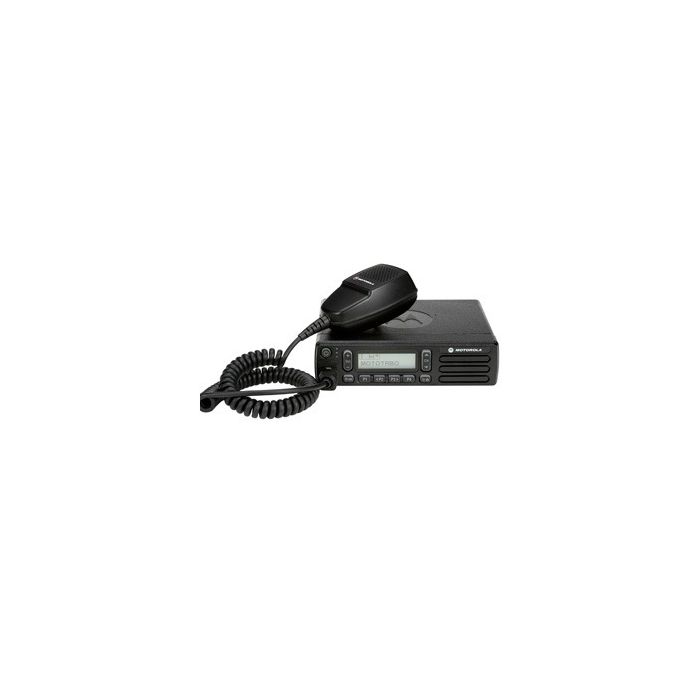
Motorola CM300d-DU-25 Mobile Two-Way UHF Radio (AAM01QNH9JA1_N)
In stock
- VÖRUMERKI:
- MOTOROLA
- FYRIRMYND:
- CM300d-DU-25
- HLUTI #:
- AAM01QNH9JA1_N
- AVAILABILITY:
- SUBJECT TO AVAILABILITY
- SKU:
- Motorola-CM300d-DU-25
Motorola CM300d-DU-25 Mobile Two-Way UHF Radio (AAM01QNH9JA1_N)
Motorola CM300d-DU-25 Mobile Two-Way UHF Radio (AAM01QNH9JA1_N)
The CM300d-DU-25 variant is widely listed by dealers as a UHF digital conventional model covering 403–470 MHz, delivering 25 watts of RF output and supporting 99 channels. Dealer listings for the exact part number AAM01QNH9JA1_N consistently associate it with features such as Radio Check, Remote Monitor, Radio Inhibit, Dual Priority Scan, Transmit Interrupt, and Dual Capacity Direct Mode, positioning it as a more capable option than basic analog-only mobile radios.
For buyers searching phrases such as Motorola CM300d DU-25, AAM01QNH9JA1_N mobile radio, 25 watt UHF digital mobile radio, or Motorola CM300d digital UHF radio, this model stands out because it combines straightforward mobile-radio operation with MOTOTRBO digital capability and analog interoperability. Motorola’s official CM300d documentation confirms the broader platform’s support for mixed analog/digital operation, 99-channel capacity, IP54 protection, and commercial deployment in transportation and similar business environments.
Introduction / Overview
The Motorola CM300d is the higher-capability display-equipped model in the CM Series Mobile Two-Way Radio lineup, paired with the simpler CM200d. Motorola’s product page and specification sheet identify the CM300d as the version with an alphanumeric display and 99 channels, while the CM200d uses a simpler numeric display and lower channel capacity. That distinction makes the CM300d better suited to organizations that need more structured communications across departments, vehicles, routes, or job functions.
The AAM01QNH9JA1_N model fits within Motorola’s UHF Band 1 CM300d range, which the official specification sheet lists as 403–470 MHz. Motorola lists the UHF CM300d platform with 1–25 W low-power and 25–40 W high-power options, while dealer listings for the DU-25 specify this exact configuration as the 25-watt digital UHF version. In other words, the DU-25 is the lower-power UHF digital model in the CM300d family, intended for commercial users who need dependable vehicle-mounted communications without moving to a higher-power 40-watt unit.
Unlike analog-only CM300d variants, the DU-25 is marketed as a digital conventional radio. That is important because it places the radio directly within Motorola’s MOTOTRBO DMR ecosystem from the start, rather than requiring a later upgrade to add digital operation. Dealer listings also note that it can be programmed for analog interoperability, which helps organizations migrate gradually from legacy analog systems to digital networks.
Design and Features
Alphanumeric Display and Daily Usability
A defining feature of the CM300d platform is its high-contrast alphanumeric display. Motorola says the display is intended to show caller ID, channel number, and contacts, making the radio more usable in vehicles and dispatch-driven environments where quick, glanceable information matters. This is a practical advantage for drivers, technicians, and field staff who need clear channel and call information without navigating a complicated interface.
The broader CM300d design emphasizes simple controls, easy ergonomics, and clear voice communications rather than consumer-style complexity. Wireless Solutions, a specialist dealer, describes the CM300d as a mixed-mode mobile radio with up to 99 channels, multiple scan options, and six programmable buttons, reinforcing its role as a practical work radio for business users.
Digital Conventional Operation
The CM300d-DU-25 is not just a standard analog fleet radio. Dealer listings for the exact model specify UHF, Digital Conventional, 25W, 99 Channels, and repeatedly list digital control and management features including Radio Check, Remote Monitor, Radio Inhibit, Transmit Interrupt, and Dual Capacity Direct Mode. These features are associated with managed digital communications systems and make the DU-25 particularly suitable for supervised fleets and operational environments where control and status awareness matter.
Motorola’s official CM300d documentation supports this positioning by listing platform features such as Transmit Interrupt (decode only), Voice Announcement, Basic Privacy, and Dual Capacity Direct Mode, with digital-only features identified in the product sheet. This confirms that the DU-25’s feature set is grounded in the broader MOTOTRBO CM300d platform rather than only in reseller marketing copy.
Analog Interoperability
One of the radio’s strongest business advantages is its compatibility with analog migration strategies. Dealer listings describe the model as a digital CM300d that can also be programmed with analog for interoperability, while Motorola’s broader product documentation describes the CM Series as supporting analog and digital use cases depending on configuration. For organizations replacing older analog mobiles over time, this dual-mode flexibility can reduce disruption and preserve compatibility during a phased transition.
Commercial Ruggedness
Motorola rates the CM300d platform to IP54 and references MIL-STD 810 testing in its official materials. The company also states that the radios undergo Accelerated Life Testing intended to simulate years of demanding field use. These details matter because the DU-25 is designed for commercial vehicles, service fleets, and operational sites where heat, vibration, splashes, and dust are common.
Technology and Specifications
Core Technical Specifications
Motorola’s official CM200d/CM300d specification sheet lists the following key platform-level specifications relevant to the UHF CM300d range:
- Frequency range: 403–470 MHz
- Channel capacity: 99
- Dimensions: 1.7 x 6.7 x 5.3 in (44 x 169 x 134 mm)
- Weight: 2.9 lb (1.3 kg)
- UHF power ranges: 1–25 W low power, 25–40 W high power
Dealer listings for the exact AAM01QNH9JA1_N variant narrow that down to the 25-watt digital UHF model, confirming where the DU-25 sits in the family. Those listings consistently describe it as 403–470 MHz, 25W, and 99 channels.
Receiver, Audio, and Channel Performance
Motorola specifies 12.5 kHz and 25 kHz channel spacing, ±0.5 ppm frequency stability, and receiver sensitivity figures of 0.3 µV analog (12 dB SINAD) with 0.22 µV typical, plus 0.25 µV digital (5% BER) with 0.19 µV typical. Motorola also lists 4 W internal audio output, 7.5 W external at 8 ohms, and 13 W external at 4 ohms. These numbers indicate a commercial-grade mobile radio designed for clear business voice communications with external speaker support where needed.
Digital Standards and MOTOTRBO Compatibility
Motorola’s CM300d specification sheet lists compliance with ETSI TS 102 361-1, -2, and -3 for digital operation. The radio platform also uses AMBE+2 vocoder technology and 4FSK digital modulation, and Motorola states that Dual Capacity Direct Mode uses 2-slot TDMA DMR to improve channel efficiency in direct mode without a repeater in supported configurations. These details are important because they confirm the DU-25 is based on recognized DMR digital standards and fits within the broader MOTOTRBO ecosystem.
Electrical and Environmental Performance
Motorola lists the CM300d platform with current draw figures of 0.81 A max standby, 2 A max receive at rated audio, and 11.0 A max transmit for the 1–25 W configuration. Environmental specs include an operating temperature range of -30°C to +60°C, storage temperature of -40°C to +85°C, IEC 61000-4-2 Level 3 ESD, and IP54 ingress protection. Those ratings support use in work trucks, shuttle fleets, property vehicles, and other field-oriented operating environments.
Applications and Use Cases
The Motorola CM300d-DU-25 is intended for businesses and organizations that need vehicle-mounted or fixed mobile UHF communications in a structured, professional environment.
Transportation and Fleet Dispatch
Motorola explicitly markets the CM Series to everyday drivers, including cargo delivery, trucking, and school transportation. In these use cases, the DU-25 provides organized channel access, digital fleet features, and dependable voice communications for mobile workers who need to stay connected to dispatch or operations centers.
Retail, Hospitality, and Built Environments
UHF radios are commonly chosen for more built-up environments because of their typical advantages in and around structures. Dealer descriptions for nearby CM300d UHF models position them for retail and hospitality use, and that positioning is consistent with the DU-25’s UHF band, 25-watt output, and business-focused feature set. This makes the radio a plausible fit for hotel engineering vehicles, campus operations, mall service fleets, and site support teams.
Maintenance, Utilities, and Service Teams
The DU-25’s digital control features, 99-channel capacity, and rugged commercial design make it suitable for maintenance fleets, utility teams, campus operations, contractors, and service vehicles. Features such as Radio Check, Remote Monitor, and Radio Inhibit are especially relevant in managed operations where supervisors need better oversight of deployed equipment.
Fixed Mobile or Control Point Installations
Although primarily designed as a mobile radio, CM300d units are also sold for use in fixed installations when paired with the proper power supply and antenna. This makes the DU-25 useful not only in vehicles but also at desks, gates, workshops, warehouses, or local control points where a compact commercial radio is needed. This application is a common pattern among CM300d dealers and installers, even when the base radio is sold primarily as a mobile unit.
Advantages / Benefits
The Motorola CM300d-DU-25 offers a strong balance of reliability, digital capability, and operational simplicity.
True Digital UHF Operation
Because the exact model is listed as Digital Conventional, buyers get MOTOTRBO digital capability from the start rather than beginning with an analog-only radio and planning a later upgrade. That is one of the clearest reasons to choose the DU-25 over neighboring analog CM300d variants.
25-Watt Mobile Performance
Its 25-watt UHF output gives it significantly more practical coverage potential than a handheld radio in mobile or fixed-mobile use. Dealers consistently describe the DU-25 as the 25-watt version of the digital UHF CM300d.
99-Channel Flexibility
The 99-channel capacity gives businesses room to separate communications by department, task, route, site, or event. That is one of the CM300d’s main advantages over more basic mobile radios.
Analog Compatibility During Migration
Even as a digital model, the DU-25 can be programmed for analog interoperability, which makes it useful for phased upgrades from legacy systems. This is especially valuable for organizations that cannot replace their entire fleet at once.
Commercial Durability
With IP54 protection, Motorola life-testing, and MIL-STD references, the DU-25 is designed for real work environments rather than casual consumer use.
FAQ Section
What is the Motorola CM300d-DU-25 Mobile Two-Way UHF Radio?
The Motorola CM300d-DU-25 is a digital conventional UHF mobile radio in the MOTOTRBO CM Series. It is commonly listed as a 403–470 MHz, 25-watt, 99-channel business radio under part number AAM01QNH9JA1_N.
How does the Motorola CM300d-DU-25 work?
It works by transmitting and receiving voice communications over licensed UHF business radio channels. The radio is typically installed in a vehicle or fixed-mobile setup and supports digital conventional MOTOTRBO operation, while also allowing analog interoperability in mixed fleets.
Why is the Motorola CM300d-DU-25 important?
It is important because it combines digital UHF communications, 25-watt mobile output, 99-channel flexibility, and fleet-oriented management features in a compact, commercial-grade platform. That makes it useful for transportation, dispatch, maintenance, and other structured business operations.
What are the benefits of the Motorola CM300d-DU-25?
Its main benefits are digital conventional UHF operation, 25-watt output, 99 channels, analog interoperability, an alphanumeric display, and IP54-rated commercial durability.
Is the Motorola CM300d-DU-25 analog or digital?
The exact AAM01QNH9JA1_N model is widely listed as digital conventional, but dealers also note that it can be programmed for analog interoperability.
Summary
The Motorola CM300d-DU-25 Mobile Two-Way UHF Radio (AAM01QNH9JA1_N) is a practical digital mobile radio built for dependable business communications in vehicles and fixed mobile installations. With 403–470 MHz UHF coverage, 25-watt output, 99 channels, an alphanumeric display, digital conventional operation, analog interoperability, and IP54-rated durability, it offers a strong mix of usability, fleet control, and long-term value. For organizations seeking a Motorola CM300d digital UHF mobile radio for transportation, dispatch, maintenance, or site operations, the DU-25 is one of the most relevant models in the CM300d family.
Specifications
| FYRIRMYND | CM300d-DU-25 |
|---|---|
| HLUTI # | AAM01QNH9JA1_N |
| VÖRUTEGUND | TVÍHLIÐA ÚTVARP |
| VÖRUMERKI | MOTOROLA |