PUDU T300 Towing
In stock
- VÖRUMERKI:
- PUDU ROBOTICS
- HLUTI #:
- PUDU T300 Towing
- ORIGIN:
- Kína
- AVAILABILITY:
- SUBJECT TO AVAILABILITY
- SKU:
- PUDU-T300-Towing
PUDU T300 Towing
PUDU T300 Towing
Instead of carrying goods directly on a platform, the towing version focuses on hooking to a cart, transporting it to the target destination, and then unhooking so the robot can continue to the next task. This approach is commonly evaluated in factories and warehouses where “cart trains” or rolling carriers are already optimized for local workflows (kitting, line-side delivery, WIP transfer, returns) and the main automation target is the repetitive push/pull labor between zones.
Design and Features
Smart towing and automatic unhooking
Pudu’s official T300 brochure describes the towing accessory as supporting “smart towing & auto unhooking” and notes that once the robot unhooks, it can immediately switch to new tasks. This capability is central to the towing concept: the robot’s value increases when it can complete a delivery, release the cart, and continue operating without waiting for staff intervention.
Integration with existing trailers and carts
A recurring positioning statement for T300 Towing is “no modifications are required to existing trailers”, indicating that the towing device is intended to work with typical carts already in use on site, reducing the need to redesign material-handling assets. (In practice, compatibility depends on tow point geometry, cart stability, and floor conditions.)
Coupling hardware as an accessory (towing device / towbar)
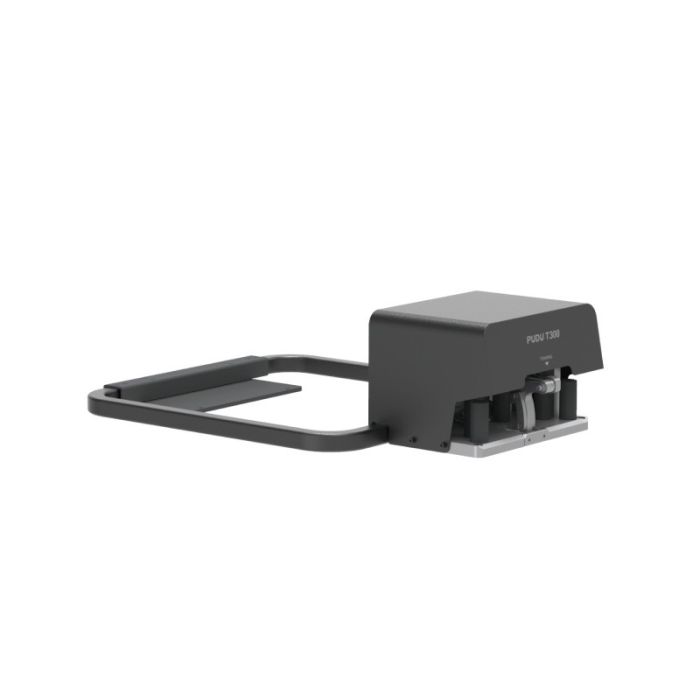
Towing is usually enabled by a towing device/towbar accessory attached to the T300. Commercial listings describe the towing device as an add-on that extends the robot’s capabilities by adding the ability to pull carts or trailers and often mention automatic coupling as part of the workflow.
Shared T300 platform features
Because T300 Towing is a configuration of the same base robot, it inherits several platform-level design features commonly highlighted in T300 materials, including:
-
a 10.1-inch touchscreen for local operation,
-
visual and audible signaling (indicator lights/alerts),
-
and a power-assist mode that supports manual hand-pushing when needed.
Technology and Specifications
Navigation: VSLAM + LiDAR SLAM
The PUDU T300 platform is described as using VSLAM (including Pudu’s VSLAM+ positioning messaging) and LiDAR SLAM, enabling autonomous navigation without fixed physical path markers. This matters for towing deployments because routes often change with production layouts, staging areas, and seasonal warehouse re-zoning.
Safety: ISO 3691-4 posture and multi-sensor perception
Pudu’s T300 documentation emphasizes a safety approach aligned with ISO 3691-4 and describes a multi-sensor stack (LiDAR and depth cameras among others) for obstacle detection and collision avoidance in dynamic environments. For towing, conservative safety behavior is especially important because a towed cart increases the system’s effective length and turning envelope.
Towing-version specification table (from Pudu T300 brochure)
Pudu’s T300 brochure includes a dedicated column for the Towing Version, listing distinctive figures that differ from the Standard/Shelf/Lifting configurations:
-
Machine weight (Towing Version): 90 kg
-
Loading / towing capacity: 400 kg with (200 kg counterweight) noted
-
Max speed: 0.8 m/s
-
Threshold overcoming height: 5 mm
-
Run-time (full load): 6 h
-
Navigation methods: VSLAM & LiDAR SLAM
These numbers are operationally meaningful: towing often reduces top speed and obstacle/threshold tolerance compared to a non-towing configuration because stability and traction become more critical once a cart is attached.
Towing weight and floor conditions (retailer context)
Retailer towbar listings sometimes specify towing limits under particular conditions, for example a maximum towing weight of 400 kg when used with a 200 kg counterweight and on specific floor types (e.g., epoxy floors). These conditions mirror the brochure’s towing-capacity note and highlight that towing performance can depend heavily on traction, grade, and surface finish.
Applications and Use Cases
Factory line-side replenishment with wheeled carriers
Many factories use standardized carts to deliver parts and subassemblies to workstations. Towing AMRs are most useful when the facility already has reliable cart standards and wants to automate the “milk run” loops that repeatedly move carts between supermarkets, kitting cells, and production lines.
Work-in-progress (WIP) transport between stations
In multi-step manufacturing (assembly → test → packaging), WIP commonly moves on wheeled fixtures. A towing robot can reduce waiting time by pulling loaded carts from upstream stations and returning empties, supporting a more consistent inter-station cadence—especially during peak output windows.
Warehouse internal logistics and returns loops
Warehouses frequently shuttle rolling cages and carts between receiving, QA, storage, and packing. Towing can be an efficient fit when loads are bulky or already organized on carts and when manual pushing distance is significant.
Multi-zone facilities with controlled access
Pudu highlights “IoT capabilities” on the T300 platform, including options such as e-gate access and elevator control. In towing deployments, these integrations can be important when cart routes cross controlled doors or zones (integration feasibility depends on local building systems and project scope).
Advantages / Benefits
Preserves existing cart-based workflows
A major advantage of towing automation is that it can retain established cart standards rather than forcing a new containerization model. Pudu explicitly positions the towing device as requiring no modifications to existing trailers in typical use, which can reduce change-management friction and capital retooling.
Faster cycle times through autonomous coupling and release
“Smart towing & auto unhooking” supports higher robot utilization: the robot can complete a cart delivery, release the carrier, and proceed to the next task instead of waiting for staff to detach hardware.
Heavy towing capacity for internal logistics
The towing version’s published 400 kg capacity (with counterweight) targets heavier internal loads than typical service robots, aligning with industrial and warehouse transport requirements.
Standardized navigation and fleet behavior across T300 variants
Facilities that deploy multiple T300 configurations (standard carriers, lifting racks, towing) can standardize on a shared navigation approach and operational tooling, simplifying training and maintenance while allowing different cargo interfaces per zone.
FAQ
What is PUDU T300 Towing?
PUDU T300 Towing is a towing configuration of the PUDU T300 industrial AMR that enables the robot to pull existing wheeled carts or trailers, using a towing device and autonomous navigation.
How does PUDU T300 Towing work?
The robot navigates using VSLAM + LiDAR SLAM, couples to a compatible cart using a towing device, transports the cart along mapped routes, and then automatically unhooks so it can continue to the next task.
Why is PUDU T300 Towing important?
It helps automate repetitive internal transport while preserving cart-based workflows, reducing manual pushing labor and improving throughput for factories and warehouses with standardized wheeled carriers.
What are the benefits of PUDU T300 Towing?
Commonly cited benefits include smart towing and auto unhooking, compatibility with existing trailers, and a published towing capacity of up to 400 kg (with counterweight), along with the T300 platform’s SLAM navigation and safety stack.
Summary
The PUDU T300 Towing configuration extends the PUDU T300 industrial AMR platform with a towing workflow designed for facilities that move materials on existing wheeled carriers. With published towing-version specifications including 90 kg robot weight, 0.8 m/s max speed, and up to 400 kg towing capacity (with counterweight), plus features like smart towing and automatic unhooking, T300 Towing is positioned for scalable internal logistics where preserving established cart standards is a key requirement.