
Paxini Dexh13 (DexH13)
In stock
- MERKI:
- PAXINI
- HLUTI #:
- DexH13
- ORIGIN:
- Kína
- AVAILABILITY:
- SUBJECT TO AVAILABILITY
- SKU:
- Paxini-DexH13
Paxini Dexh13 (DexH13)
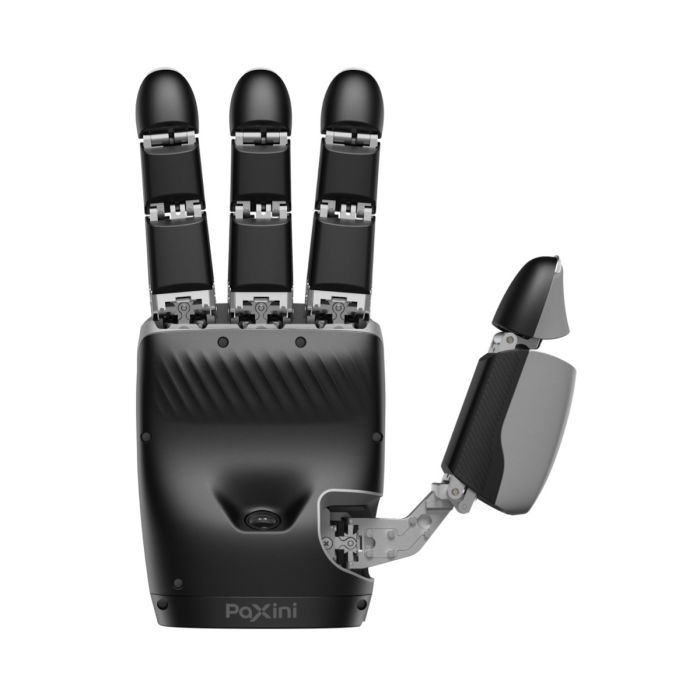
DexH13 integrates a multi-degree-of-freedom (multi-DOF) hand structure with a dense tactile sensing array and an AI “hand-eye” camera module, aiming to improve robotic handling performance in contact-rich environments.
PaXini presents DexH13 as part of a broader tactile-centric robotics product matrix, spanning ITPU-based tactile sensors, dexterous hands, and humanoid robotic platforms. Within this ecosystem, DexH13 functions as a high-sensing, high-dexterity manipulation module intended to bridge the gap between perception and reliable real-world execution.
Design and Features
Four-finger biomimetic structure optimized for practical grasping
DexH13 uses a four-finger, multi-joint biomimetic design, intended to simulate key aspects of human grasping while reducing mechanical complexity versus five-finger hands. Industry coverage has noted that many practical grasping scenarios can be achieved with four fingers, allowing lower cost and easier engineering integration.
The hand supports a range of manipulation primitives including grasping, pinching, pressing, and finger opening/closing, enabling both power grasps and more delicate object interactions.
Dense multi-dimensional tactile coverage
A defining capability of DexH13 is its built-in tactile sensor density. PaXini specifies that DexH13 includes 1,140 GEN2 ITPU multi-dimensional tactile sensing units with 3,420 tactile signal channels.
This tactile architecture is intended to provide richer contact feedback than simple force sensors by capturing multi-dimensional touch information across the hand, improving stability when objects are irregular, deformable, partially occluded, or subject to slip.
Integrated AI “hand-eye” camera and vision algorithms
DexH13 includes an 8-megapixel RGB AI hand-eye camera, and PaXini highlights the use of zero-shot pose estimation algorithms for identifying object position and shape.
This vision-tactile combination is used to support manipulation workflows such as:
-
aligning grasp approach before contact,
-
stabilizing grasp posture through tactile feedback after contact,
-
handling tasks requiring both object localization and contact sensing.
Motion control and integration-first design
PaXini markets DexH13 as designed for integration and deployment in robotics stacks, citing industrial communication support such as EtherCAT and Modbus.
This focus makes DexH13 relevant to labs and integrators that need a tactile end-effector compatible with industrial automation controllers and real-time communication requirements.
Technology and Specifications
Key specifications (officially listed by PaXini)
PaXini provides the following headline specifications for DexH13:
-
Finger count: 4
-
Degrees of freedom (DoF): 16 total (13 active + 3 passive)
-
Tactile sensing units: 1,140 GEN2 ITPU tactile units
-
Tactile signal channels: 3,420 channels
-
Vision module: 8 MP RGB AI hand-eye camera
-
Rated payload: 5 kg
-
Maximum grasp diameter: 15 cm
-
Minimum opening/closing time: 1.5 s
-
Fingertip force: 15 N (noted with an asterisk in official parameter list)
-
Drive method: coreless motor drive
-
Communication protocols: EtherCAT / Modbus
-
Service life: 1,000,000 cycles
These specifications place DexH13 in the class of dexterous hands that target both fine manipulation and practical payload handling, rather than being limited to low-force research demonstrations.
“Vision + tactile” dual-modality positioning
In public communications around CES 2026, PaXini described DexH13 as a tactile-driven dexterous-hand system that can mirror hand gestures and demonstrate delicate manipulation tasks such as turning knobs and grasping irregular objects (e.g., test tubes).
This highlights the product’s positioning as a manipulation module intended for real-world variability, where tactile information helps stabilize grasps that vision cannot fully guarantee.
Applications and Use Cases
Logistics and warehouse automation
PaXini lists logistics and warehousing as a primary DexH13 application area.
In these environments, tactile dexterous hands can improve handling reliability for:
-
mixed packaging shapes,
-
unknown object orientations,
-
delicate or slippery materials,
-
tasks requiring grip adaptation rather than fixed suction or rigid gripping.
Medical and healthcare robotics
DexH13 is also presented for medical and healthcare contexts.
In practical deployments, tactile end-effectors can help maintain safe contact and controlled force application, particularly in tasks involving human interaction, compliant materials, or medical tools that require careful handling.
Industrial manufacturing and inspection
PaXini highlights industrial manufacturing use cases, where DexH13 can support contact-rich handling workflows such as:
-
part positioning,
-
bin picking with uncertain object contact,
-
gentle insertion tasks,
-
light assembly operations that benefit from tactile feedback rather than pure positional control.
Commercial and service robotics
PaXini lists commercial service and home service scenarios among DexH13 application categories.
Service deployments often include unpredictable objects, human proximity, and variable contact conditions—domains where tactile sensing is a major advantage.
Research and embodied AI development
DexH13’s high-density tactile sensing and industrial communications are relevant for:
-
imitation learning and teleoperation research,
-
tactile dataset generation,
-
manipulation policy training that benefits from real tactile feedback,
-
academic R&D in embodied intelligence and dexterous manipulation.
Advantages / Benefits
High-density tactile feedback for stable grasping
With 1,140 tactile units and 3,420 signal channels, DexH13 emphasizes tactile richness that can improve grip stability on irregular objects.
This is particularly important when:
-
object surfaces are reflective or texture-poor (vision struggles),
-
contact points are hidden by the hand itself,
-
friction conditions change during lifting or rotation.
Dual-modality perception (vision + touch)
DexH13’s combination of an 8 MP AI hand-eye camera and tactile sensing supports a manipulation workflow where vision guides approach and tactile signals refine and stabilize contact execution.
Industrial communication support for integration
Support for EtherCAT / Modbus makes DexH13 easier to integrate into industrial robotics stacks and automation systems where deterministic communication and controller compatibility matter.
Practical payload capacity
The listed 5 kg rated payload expands usability beyond purely lightweight object demonstrations, enabling more realistic industrial and logistics tasks.
Long service-life target
PaXini lists a 1,000,000-cycle service life, which is significant for deployments requiring repetitive contact operations.
Availability and lead time
Availability is typically listed as subject to stock / supplier lead time through resellers and international channels.
PaXini has also demonstrated and promoted DexH13 in major industry exhibitions (including CES 2026-related communications), which often corresponds to expanding global availability through distribution partners.
FAQ Section
What is Paxini DexH13 (DexH13)?
Paxini DexH13 is a multi-dimensional tactile dexterous robotic hand that combines 1,140 tactile sensing units, 16 DoF, and an 8 MP AI hand-eye camera for vision + touch manipulation.
How does Paxini DexH13 work?
DexH13 uses a four-finger multi-joint mechanism with ITPU tactile sensing to measure contact signals during grasping, while its AI camera supports object recognition and pose estimation to guide manipulation.
Why is Paxini DexH13 important?
DexH13 is important because it adds dense tactile feedback and dual-modality perception (vision + touch), helping robots maintain stable grasps on irregular objects and perform contact-sensitive actions more reliably.
What are the benefits of Paxini DexH13?
Key benefits include 16 DoF (13 active + 3 passive), 5 kg rated payload, 1,140 tactile units / 3,420 channels, 8 MP AI camera, and listed 1,000,000-cycle service life.
Summary
Paxini DexH13 (DexH13) is a vision-tactile dual-modality dexterous robotic hand built around dense multi-dimensional tactile sensing and a four-finger, multi-DOF biomimetic structure. With 1,140 tactile sensing units, 16 degrees of freedom, an 8 MP AI hand-eye camera, EtherCAT/Modbus support, and a 5 kg rated payload, DexH13 is positioned as a practical manipulation end-effector for embodied intelligence research and deployment across logistics, healthcare, manufacturing, and service robotics.
Specifications
| HLUTI # | DexH13 |
|---|---|
| MERKI | PAXINI |