Pudu PUDU T300 Lifting (PUDU T300 Lifting)
In stock
- VÖRUMERKI:
- PUDU ROBOTICS
- HLUTI #:
- PUDU T300 Lifting
- ORIGIN:
- Kína
- AVAILABILITY:
- SUBJECT TO AVAILABILITY
- SKU:
- Pudu-PUDU-T300-Lifting
Pudu PUDU T300 Lifting (PUDU T300 Lifting)
Pudu PUDU T300 Lifting (PUDU T300 Lifting)
Unlike flat-top AMRs that require manual loading and unloading, the lifting version is intended to automate “pick-up + move + drop-off” workflows using existing wheeled racks or dedicated lift racks, reducing human handling time in factories, warehouses, and large back-of-house logistics environments.
Design and Features
Dock-and-lift workflow for modular racks
The defining feature of T300 Lifting is the ability to recognize a compatible rack, approach it with docking accuracy, lift it, transport it, and unload it with minimal manual intervention. Pudu’s documentation and reseller descriptions emphasize this as a way to increase throughput for repetitive internal logistics routes—especially where goods are already staged on racks.
Compatibility with lifting racks and “existing carriers”
Pudu and its channel partners describe the T300 ecosystem as supporting multiple external attachments and carrier styles. In lifting mode, the robot is designed to integrate with modular racks (including dedicated lifting racks) and—depending on deployment—may be configured to work with existing wheeled carriers commonly found in production and warehouse operations.
Industrial signaling and operator interface
Like other T300 configurations, the lifting version includes a 10.1-inch touchscreen, plus visible cues (indicator lights and intent/traffic-signal-style lighting) and audible alerts aimed at improving predictability in human-robot shared spaces. These features matter in lifting scenarios because the robot may move heavier loads and operate in narrow aisles where staff must easily interpret robot intent.
Manual intervention support via power-assist mode
Pudu’s T300 platform includes power-assist mode to facilitate hand-pushing when manual intervention is required (for example, during special operations or mapping activities). This capability is shared across T300 variants, including lifting configurations.
Technology and Specifications
Navigation: Visual SLAM + LiDAR SLAM
The T300 platform is specified as using Visual SLAM (VSLAM/VSLAM+) and LiDAR SLAM, positioning it as an AMR that does not rely on fixed physical guides typical of traditional AGVs. This is intended to support faster redeployment when facility layouts change.
Safety: ISO 3691-4 alignment and multi-sensor detection
Pudu markets the T300 as compliant with ISO 3691-4 and describes a safety stack including LiDAR sensors, depth cameras, collision protection sensing, and emergency stops. In lifting mode, robust perception and conservative motion control are particularly important because the robot may carry tall or heavy racks that change center of mass and visibility lines.
Core platform specifications (shared by lifting version)
Pudu’s official T300 overview lists these core figures, which generally apply to the platform used by lifting configurations:
-
Dimensions: 835 × 500 × 1350 mm
-
Maximum loads: 300 kg
-
Battery capacity: 30 Ah
-
Charging time: 2 hours (0% → 90%)
-
Run-time: 12 h (no load), 6 h (fully loaded)
-
Maximum speed: 1.2 m/s
-
Minimum path clearance: 60 cm
-
Threshold crossing height: up to 20 mm
-
Groove crossing width: up to 35 mm
-
Navigation methods: VSLAM & LiDAR SLAM
Weight difference for the lifting configuration
Documentation and reseller listings commonly note that the lifting configuration weighs more than the standard base. For example:
-
The T300 presentation and operational guide indicate the lifting functionality version is approximately 81 kg (WTIDL1), compared with 65 kg for the standard (WTID01).
-
RobotShop’s “with lift” listing also specifies 80 kg weight for the lift configuration.
Lifting rack specifications and constraints
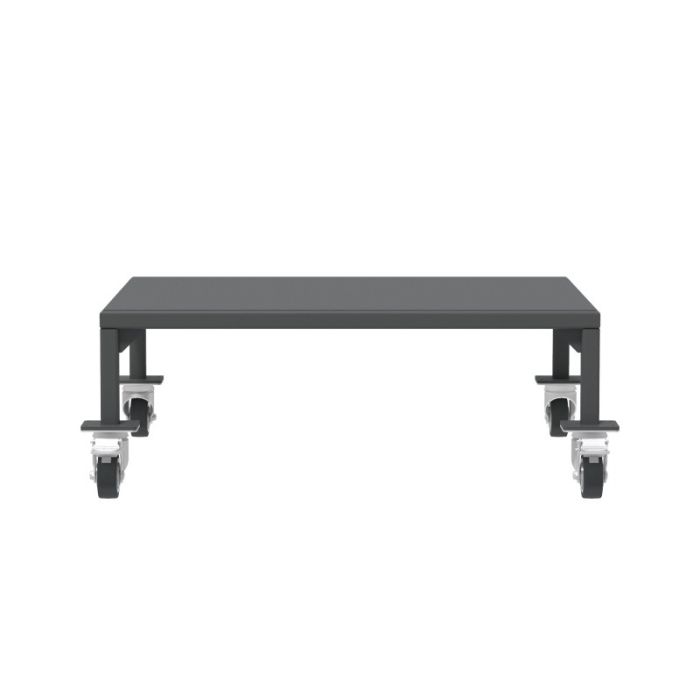
A common approach in deployments is pairing the lifting robot with a dedicated PUDU T300 Lifting Rack. RobotShop describes the rack as enabling autonomous lifting and transport of modular racks, with key design constraints such as:
-
Rack dimensions: 900 × 660 × 308 mm
-
Maximum rack height: ≤ 1300 mm
-
Bottom clearance zone: 120–210 mm (no crossbars/supports in that zone)
-
Docking accuracy: ± 10 mm
A separate industry PDF describing “PUDU T300 Lifting” also publishes rack geometry details (used to ensure lift compatibility), including:
-
Rack dimensions (L×W×H): 900 × 660 × 308 mm
-
Rack base height from ground: 275 mm
-
Load surface: 820 × 610 mm
-
Rack weight: 15.7 kg
Pudu’s official operation guide further provides rack parameter guidance (for customized racks), such as recommended rack lengths/widths and a rack bottom height range, reinforcing that correct rack geometry is central to reliable docking and lifting.
Applications and Use Cases
Factory line-side delivery and kitting
In manufacturing, lifting mode supports kitting racks and line-side replenishment where parts are staged on wheeled racks or modular frames. The robot can pick up a prepared rack, deliver it to a workstation, and return empties, reducing manual cart pushing and improving scheduling predictability.
Work-in-progress transport between stations
For multi-stage production (assembly → test → packaging), lifting AMRs are used to move racks of WIP items between stations with less waiting and fewer handoffs. Pudu’s T300 materials frame the platform for industrial delivery processes such as WIP and line-side logistics, and lifting mode extends that to “rack-as-a-unit” transfers.
Warehouse internal logistics (picking to staging)
In warehouses, lifting mode can automate the movement of picked items on racks from picking zones to packing/staging areas. Because many facilities already rely on standardized carts and frames, lifting AMRs are often evaluated when operators want to keep existing material flows while reducing walking and pushing labor.
Multi-zone facilities with doors, gates, and elevators
T300 materials describe IoT capabilities such as e-gate access and elevator control modules, which can be critical in large facilities where racks must travel between controlled zones or floors. (Actual feasibility depends on local building systems and integration scope.)
Advantages / Benefits
Automated rack handling reduces “touch time”
The primary benefit of a lifting AMR is reducing manual “touch time” in the workflow: staff prepare a rack once, then the robot handles transport and placement—often improving throughput during peak production windows.
Uses existing material-handling patterns
Many factories already standardize around wheeled racks and frames. Lifting mode is attractive because it can preserve existing “rack-based” processes while automating the movement step, rather than forcing a new container standard.
Real-world passability in tight industrial layouts
Published mobility tolerances (60 cm clearance, 20 mm threshold, 35 mm grooves) address common “real building” constraints that can block AMR projects if ignored.
Fleet scaling and centralized scheduling
Pudu’s T300 presentation references multi-robot collaboration and dispatch capacity (e.g., “dispatch up to 20 robots in one environment”), which is relevant for lifting mode because rack movement often becomes a fleet problem—traffic coordination, queueing, and congestion management in narrow aisles.
FAQ
What is the PUDU T300 Lifting?
PUDU T300 Lifting is a lifting-enabled configuration of the PUDU T300 industrial AMR that can autonomously dock with a compatible rack, lift it, transport it, and unload it for automated internal logistics.
How does the PUDU T300 Lifting work?
It navigates using Visual SLAM + LiDAR SLAM, approaches a rack within docking tolerances, performs a dock-and-lift action, and then transports the rack along mapped routes while using multi-sensor safety features in human-shared environments.
Why is the PUDU T300 Lifting important?
It automates one of the most time-consuming steps in factories and warehouses—moving staged racks and carts—reducing manual pushing labor and enabling more consistent scheduling and throughput.
What are the benefits of the PUDU T300 Lifting?
Commonly cited benefits include 300 kg load class, rack-based automation (dock + lift + transport), practical passability (60 cm clearance, 20 mm thresholds), and fast charging (0–90% in ~2 hours).
Summary
The PUDU T300 Lifting extends the PUDU T300 industrial AMR platform with a rack-handling capability that enables automatic docking, lifting, transport, and placement of modular racks and compatible carriers. Built on Visual SLAM + LiDAR SLAM navigation with published mobility tolerances for narrow aisles and floor discontinuities, and supported by rack geometry standards (including maximum rack height guidance), the T300 Lifting configuration is designed for factories and warehouses seeking scalable, flexible internal logistics automation without fixed infrastructure.