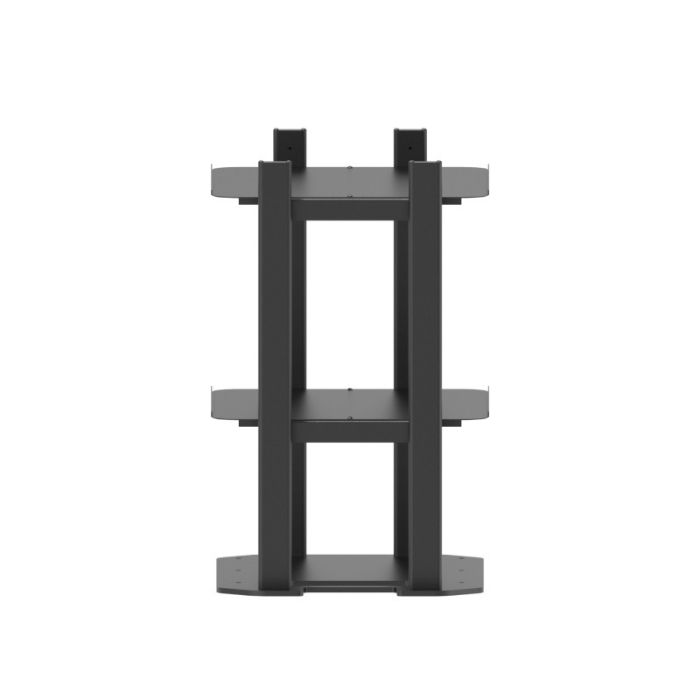
Pudu PUDU T300 Tray (PUDU T300 Tray)
In stock
- VÖRUMERKI:
- PUDU ROBOTICS
- HLUTI #:
- PUDU T300 Tray
- ORIGIN:
- Kína
- AVAILABILITY:
- SUBJECT TO AVAILABILITY
- SKU:
- Pudu-PUDU-T300-Tray
Pudu PUDU T300 Tray (PUDU T300 Tray)
Pudu PUDU T300 Tray (PUDU T300 Tray)
The underlying T300 platform is positioned as a heavy-load industrial delivery AMR with VSLAM + LiDAR SLAM navigation, ISO 3691-4 safety alignment, and built-in IoT integration options (e.g., elevator and e-gate support) for facility logistics.
Where the Standard T300 is typically a flat load-bearing platform, the Tray configuration emphasizes a defined “load surface” tray to stabilize cargo and simplify loading/unloading—especially for small-to-medium items that benefit from edge protection and consistent placement points (bins, cartons, kits, supplies). In some catalogs, the tray is also referenced as a dedicated accessory with its own part number and price.
Design and Features
Tray load surface for structured material transport
The core characteristic of the T300 Tray configuration is a fixed tray-style carrying surface. This design is aimed at improving day-to-day usability in factories and warehouses where operators repeatedly load similar items (component bins, maintenance tools, QC materials, packaged products) and want predictable placement and retention during motion. The tray approach can be used for:
-
Kitting and line-side replenishment (kits staged on the tray)
-
Work-in-progress transfers (bins moved between stations)
-
Back-of-house logistics (supplies moved across departments)
Some retailers and dealers list a “Tray” variant as part of a broader T300 series lineup (Standard, Lifting, Conveyor, Tray, Towing).
Compatibility with the T300 attachment ecosystem
Pudu markets the T300 as a platform that supports multiple operating configurations (Standard, Shelf, Lifting, Towing) through external attachments. The Tray configuration fits within this expansion concept by providing a cargo interface tailored to item transport rather than towing carriers or lifting loads.
Power-assist handling for manual repositioning
The T300 platform includes a power-assist mode (electric assistance when pushing manually), intended for situations where staff need to reposition the robot or support map generation and special operations without fully relying on autonomous routing. This applies equally to tray-equipped configurations, since the mobility base is shared.
Multi-modal signaling for human–robot collaboration
Pudu emphasizes industrial “cohabitation” features such as indicator lighting, intent/turn signals, audible prompts, and a touchscreen for onsite control—important in mixed pedestrian/vehicle environments where staff must quickly interpret robot behavior.
Technology and Specifications
Navigation: VSLAM + LiDAR SLAM
The T300 platform uses VSLAM (including Pudu’s VSLAM+ positioning messaging) combined with LiDAR SLAM to map and localize in large indoor spaces without relying on fixed physical path markers typical of traditional AGVs.
This positioning is intended to reduce site rework when floor plans change and to support rapid redeployment in evolving production environments.
Safety and sensing
Pudu positions the T300 as compliant with ISO 3691-4 and describes a safety stack that includes LiDAR sensors, depth cameras, collision protection sensors, and emergency stop buttons.
These systems support obstacle detection for low-lying hazards (e.g., pallets, loose items) and navigation in dynamic spaces where people cross routes frequently.
Mobility: tight aisles and floor discontinuities
A common reason industrial AMR projects fail is inadequate passability across real facilities (tight aisles, door thresholds, floor grooves). Pudu’s published specs for the T300 include:
-
Minimum path clearance: 60 cm
-
Threshold crossing: up to 20 mm
-
Groove crossing width: up to 35 mm
-
Max speed: up to 1.2 m/s
These figures are typically applicable to tray configurations because the base chassis remains the same; the main operational changes come from the tray’s load dimensions and center-of-mass behavior.
Platform specifications (commonly published for T300)
Pudu’s official product overview lists core T300 specs that are widely used for tray-equipped deployments:
-
Dimensions: 835 × 500 × 1350 mm
-
Payload capacity: 300 kg
-
Battery capacity: 30 Ah
-
Charging time: 2 hours (0% → 90%)
-
Run-time: 12 h (no load) / 6 h (fully loaded)
Some regional catalogs list “tray” or “lift” related configurations at different weights (reflecting add-on structures and mechanisms). For example, one dealer page lists a T300 configuration at 81 kg (for a lift model), illustrating that attachments can change the mass even when the base dimensions and payload class remain similar.
Tray accessory identification (examples)
In some reseller catalogs, the tray is sold as an add-on. Examples include:
-
An “Attachment-Tray with Load Surface” accessory listed as 21510-000194 (example retailer listing).
-
A “PUDU Tray for T300” add-on listed by RobotShop as an accessory line item (example retail catalog).
Because bundles vary by market, buyers typically confirm whether “T300 Tray” means robot + tray included, or tray attachment only.
Applications and Use Cases
Factory line-side replenishment and kitting
In manufacturing, the tray configuration is commonly used for line-side supply runs: transporting bins of parts, subassemblies, or kitted sets from supermarkets/kitting zones to production stations. The tray surface supports quick loading and consistent placement during repeated loops.
Work-in-progress and inter-station transport
AMRs like the T300 are often used for predictable transfers between stations (assembly → test → packing). Tray transport is especially useful when goods are already packaged in containers, bins, or cartons that should remain upright and organized.
Warehouse internal logistics (receiving, QC, packing)
Warehouses can deploy tray-equipped T300 robots to move items between receiving, QC inspection points, and packing lines—reducing manual cart pushes and enabling scheduled, repeatable runs.
Commercial back-of-house transport
Although primarily positioned for industrial environments, the T300 is also marketed for “heavy-load delivery in commercial settings,” which can include large venues with long corridors and frequent internal deliveries where carts and trolleys are standard.
Advantages / Benefits
Structured load handling for small-to-medium items
Compared with a bare flat platform, a tray surface can improve handling of:
-
mixed-size cartons and bins
-
maintenance tools and consumables
-
staged kits and parts trays
This can reduce loading errors and improve throughput during shift changes and peak production windows.
Reduced site constraints through SLAM navigation
VSLAM + LiDAR SLAM is positioned as enabling faster layout changes than fixed-path AGVs, which can be valuable for factories that reconfigure lines or re-zone storage frequently.
Practical mobility specs for real buildings
Specs like 60 cm aisle clearance, 20 mm threshold, and 35 mm groove crossing address common “real building” constraints that often determine whether an AMR can be deployed without expensive facility modifications.
Integration-ready workflows
Pudu’s T300 materials highlight IoT capabilities such as elevator control, e-gate passing, and paging, plus software/hardware interfaces for system integration—useful when tray transport spans controlled zones or requires orchestration with WMS/MES systems.
FAQ
What is the PUDU T300 Tray?
The PUDU T300 Tray refers to a tray-equipped T300 industrial AMR (or the tray attachment for the T300) used to transport materials indoors with autonomous navigation and industrial safety features.
How does the PUDU T300 Tray work?
It uses the T300’s VSLAM + LiDAR SLAM navigation to move along mapped routes, avoids obstacles using LiDAR and depth sensing, and carries goods on a tray load surface to support repeatable loading/unloading workflows.
Why is the PUDU T300 Tray important?
It targets a common factory and warehouse bottleneck—repetitive internal transport—by combining a 300 kg payload class with practical passability (60 cm clearance, 20 mm threshold, 35 mm grooves) and a structured tray interface for common item types.
What are the benefits of the PUDU T300 Tray?
Benefits commonly include structured cargo handling, 300 kg payload capacity, fast charging (0–90% in ~2 hours), and the T300’s SLAM-based navigation and safety stack designed for mixed human–robot environments.
Summary
The PUDU T300 Tray is a tray-equipped configuration (or tray attachment) for the PUDU T300 industrial AMR, intended to streamline indoor material transport with a structured load surface that supports repeatable handling of bins, cartons, and supplies. Built on the T300 platform’s VSLAM + LiDAR SLAM navigation, ISO 3691-4 safety positioning, and practical mobility specs for tight aisles and floor discontinuities, T300 Tray deployments are commonly evaluated for factories and warehouses seeking consistent, scalable “last-meter” logistics automation.