
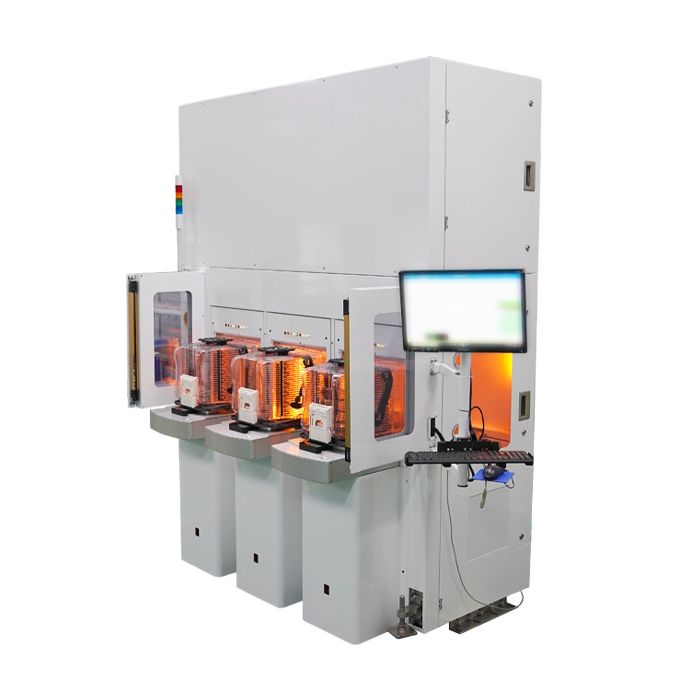
SIASUN TSS-3000 EFEM (TSS-3000)
In stock
- VÖRUMERKI:
- SIASUN
- HLUTI #:
- TSS-3000
- ORIGIN:
- Kína
- AVAILABILITY:
- SUBJECT TO AVAILABILITY
- SKU:
- SIASUN-TSS-3000
SIASUN TSS-3000 EFEM (TSS-3000)
In wafer fabs, an EFEM serves as the controlled interface between the factory’s material transport system and a process tool’s internal transfer environment, coordinating wafer loading, alignment/hand-off, and transfer while helping maintain contamination control and standardized equipment communication.
In SIASUN’s product positioning, the TSS-3000 EFEM is described as a front-end wafer transfer device and SEMI-compatible interface system designed to move wafers manually or in coordination with factory transport (e.g., overhead systems), and is characterized by a small footprint and a dual-arm transfer robot with an external axis for high-efficiency handling.
Although “EFEM” can refer to a broad category of front-end automation modules across the semiconductor industry, implementations typically share common roles: they provide standardized mechanical and software interfaces, support repeatable wafer transfers, and reduce operator contact with critical substrates.
Design and Features
Front-end architecture and cleanroom interface
A typical EFEM sits at the tool front end and bridges multiple environments:
-
The factory interface (where carriers arrive and depart)
-
The front-end handling volume (often a mini-environment designed to reduce particle exposure)
-
The process tool interface (load locks, transfer chambers, or interface slots, depending on tool type)
SIASUN’s TSS-3000 EFEM is presented as an interface system compatible with SEMI standards, implying alignment with common semiconductor automation expectations for interoperability and integration in fab ecosystems.
Dual-arm transfer robot and external axis
One of the differentiating descriptors for the TSS-3000 is its dual-arm robot paired with an external axis, a configuration commonly used to increase throughput by overlapping pick/place motions and extending reachable positions within the module’s working envelope. SIASUN positions this configuration as supporting high transfer efficiency while keeping a compact footprint.
Compatibility with factory material transport
SIASUN states that the TSS-3000 can transfer wafers manually or in conjunction with MR or OHT carrying levels (i.e., working with automated material transport infrastructure).
In modern fabs, OHT (Overhead Hoist Transport) is a common factory transport approach used to move carriers across bay and tool locations, and EFEMs are frequently designed to integrate into such automated logistics to reduce manual handling.
Technology and Specifications
EFEM functions in semiconductor automation
While publicly available product listings for TSS-3000 often emphasize the system role rather than disclosing full engineering specifications, an EFEM classically performs several technical functions:
-
Substrate hand-off between carriers and tool interfaces
-
Position repeatability and controlled motion for safe wafer handling
-
Sequencing and interlocks to coordinate doors, sensors, and transfer motions
-
Integration hooks for factory control or tool control frameworks
Industry overviews describe EFEMs as essential transport and interface modules for wafers or photomasks between ultra-clean process tools and the fab’s material handling environment.
Standards alignment and interoperability
SIASUN explicitly notes SEMI compatibility for the TSS-3000 EFEM.
In practice, “SEMI standards” in front-end automation commonly relate to expectations around equipment safety and automation interfaces, carrier handling conventions, and factory-to-tool communication patterns (exact standards depend on fab architecture and tool type). A common example in fab terminology is OHT, which appears in SEMI terminology compilations as an established factory transport concept.
Published product details (public-facing)
From SIASUN’s public-facing description, the following attributes are stated for the TSS-3000 EFEM:
-
Type: Front-end wafer transfer device / interface system
-
Standards: Compatible with SEMI standards
-
Handling modes: Manual transfer or integrated transfer with MR/OHT logistics
-
Mechanism: Dual-arm robot with external axis
-
Form factor: Small footprint
-
Goal: High transfer efficiency
Note: Details such as supported wafer sizes, load port counts, accuracy, cycle time, and cleanroom class are often model- and configuration-specific; they may be available in vendor datasheets or quotations but are not consistently published in brief public catalogs.
Applications and Use Cases
Semiconductor wafer processing lines
The most direct use case for a TSS-3000 EFEM is as part of a semiconductor process tool front end—supporting controlled wafer transfers into equipment used for deposition, etching, metrology, inspection, or other fabrication steps. EFEM-based automation helps reduce handling variability and supports higher tool utilization by coordinating consistent substrate movement.
Automated fabs and AMHS integration
In facilities that use automated material handling systems (AMHS) such as OHT-based logistics, EFEM integration supports:
-
Reduced operator intervention at the tool
-
More predictable carrier delivery and pickup
-
Consistent sequencing for tool loading/unloading cycles
Clean manufacturing beyond semiconductors
EFEM-style front-end modules also appear in adjacent clean manufacturing domains where particle control, repeatability, and standardized interfaces are important (for example, some photonics and advanced packaging contexts). These deployments tend to mirror semiconductor requirements: stable motion, minimal contact, and structured tool handshakes.
Advantages / Benefits
Reduced contamination risk and improved repeatability
By minimizing manual contact with wafers and enforcing controlled transfer sequences, EFEMs can reduce opportunities for particulate contamination and handling damage—two persistent yield and reliability concerns in microfabrication.
Higher throughput through dual-arm handling
SIASUN highlights a dual-arm + external axis configuration and high transfer efficiency for the TSS-3000. Dual-arm architectures are commonly used to overlap actions (e.g., staging one wafer while moving another), improving cycle efficiency in front-end handling.
Integration with fab logistics
Support for operation in conjunction with OHT-style systems indicates suitability for automated fabs and standardized carrier flow, helping tools participate in broader, factory-level optimization.
FAQ Section
What is the SIASUN TSS-3000 EFEM (TSS-3000)?
The SIASUN TSS-3000 EFEM is a front-end wafer transfer device and interface system designed for semiconductor manufacturing equipment. It provides a standardized front-end automation layer and is described as compatible with SEMI standards.
How does the TSS-3000 EFEM work?
In general EFEM operation, wafers arrive in carriers at the tool front end; the EFEM coordinates wafer transfer using a handling robot, enabling controlled hand-off into the process tool interface. SIASUN describes the TSS-3000 as using a dual-arm robot with an external axis to support high-efficiency transfers and a compact footprint.
Why is an EFEM important in semiconductor manufacturing?
EFEMs help reduce manual handling, improve repeatability, and support cleaner substrate transfers—key factors for yield and reliability in wafer processing. Industry descriptions emphasize EFEMs as core automation modules for transferring wafers or masks between clean transport environments and process tools.
Can the TSS-3000 EFEM integrate with OHT transport systems?
SIASUN states that the TSS-3000 can transfer wafers manually or in conjunction with MR or OHT carrying levels, indicating compatibility with automated fab logistics such as overhead hoist transport.
What are the benefits of the TSS-3000 EFEM?
Public product positioning highlights a small footprint, dual-arm handling with an external axis, high transfer efficiency, and SEMI-standard compatibility, which collectively support clean, repeatable, and automation-ready wafer transfers.
Summary
The SIASUN TSS-3000 EFEM (TSS-3000) is positioned as a SEMI-compatible front-end wafer transfer and interface module that supports manual or logistics-integrated handling and emphasizes a compact footprint with a dual-arm, external-axis transfer mechanism for efficient wafer movement. In semiconductor manufacturing environments where cleanliness, repeatability, and interoperability are central, EFEM-class systems like the TSS-3000 function as a key bridge between factory transport and process tools, enabling scalable automation and consistent substrate handling.