
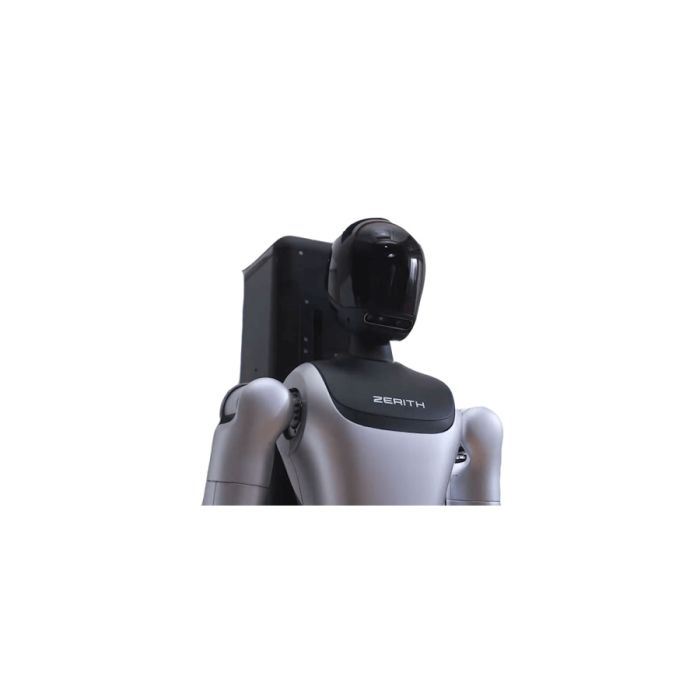
Zerith Z1 Humanoid Robot (Z1)
In stock
- VÖRUMERKI:
- ZERITH
- HLUTI #:
- Z1
- ORIGIN:
- Kína
- AVAILABILITY:
- SUBJECT TO AVAILABILITY
- SKU:
- Zerith-Z1
Zerith Z1 Humanoid Robot (Z1)
Z1 Humanoid Robot (Z1)
Public reporting describes Z1 as the company’s first humanoid robot product, engineered for stable walking across complex terrain, strong anti-interference balance, and dynamic full-body motion control suited to commercial demonstrations and service-oriented scenarios.
Unlike many early humanoids designed primarily for lab experimentation, the Zerith Z1 has been presented as a platform that combines high-torque joint actuation, real-time industrial communications, and AI-assisted mechanical design to improve the robot’s energy efficiency and dynamic movement performance. Chinese coverage also highlights Z1’s ability to learn behaviors from human video and reproduce expressive upper-body motions, which has helped position it as a showcase system for embodied AI and whole-body coordination.
Design and Features
Bipedal form factor and whole-body coordination
Zerith Z1 is designed as a full biped (two-legged) humanoid robot. Media descriptions emphasize long-duration stable walking on irregular ground and operation in complex terrain, supported by a balance system that remains stable under external impacts (pushes or collisions).
High-torque joint architecture
The Z1 uses actuators capable of up to 150 N·m peak joint torque, which is a key enabler for dynamic stabilization, recovery behaviors, and vigorous motion (including striking and defensive movement demonstrations).
Degrees of freedom and dexterity
Public specifications reported in Chinese tech coverage describe the Z1 as having 27 degrees of freedom (DoF) across the body, supporting coordinated legged locomotion and humanlike arm motion.
AI-assisted mechanical design
One distinguishing feature reported for Zerith Z1 is that its mechanical structure was designed with AI-assisted optimization, aimed at achieving lower energy consumption (often described via “COT” / cost of transport in robotics contexts) and improved dynamic performance.
Technology and Specifications
Motion control and terrain adaptability
Zerith Z1 has been presented as capable of sustained stability across irregular surfaces and varied operating conditions. Reports describe a control approach combining the robot’s dynamic whole-body motion capabilities with an internal algorithm stack sometimes characterized as a physical interaction world-model used for motion control and robustness under disturbance.
EtherCAT communication module
Z1 is reported to include an in-house developed EtherCAT communication module, intended to provide low-latency, high-bandwidth internal communications—an important requirement for tightly synchronized multi-joint control in humanoid robots.
Payload capability (reported)
Coverage of the robot’s early testing states a maximum load test limit of up to 20 kg, and highlights a payload-to-weight ratio above 70% as a performance benchmark cited by the team.
Learning from human video (behavior imitation)
Zerith’s public demonstrations have been described as using human video-based learning (“learn from human video”) to imitate actions such as punches, defensive movements, and other coordinated upper-body behaviors—an approach aligned with current embodied AI research directions for skill acquisition from observation.
Applications and Use Cases
Service-oriented humanoid demonstrations
Public descriptions of Z1 position it for commercial and service contexts such as hospitality environments, educational showcases, and interactive experiences, where stable biped locomotion and expressive motion create high user engagement.
Education and research (embodied intelligence)
With 27 DoF and a high-torque design focus, the Z1 can serve as an embodied AI platform for:
-
whole-body control research
-
dynamic balance and recovery studies
-
imitation learning and motion generation
-
humanoid navigation across non-ideal floors and surfaces
These are common research directions for biped robots that blend perception, planning, and control into a single physical system.
Entertainment and interactive robotics
Multiple reports highlight Z1 demonstrations inspired by competitive or performance-style movement (including boxing-like sequences), where the robot’s stability under interference and arm motion fidelity are central selling points.
Industrial relevance (early-stage potential)
While Z1 has been publicly framed as a capable biped, industrial deployment typically requires additional integration work:
-
end-effector tooling (hands/grippers)
-
safety zoning and collision strategy
-
repeatability characterization
-
task libraries and QA procedures
Advantages / Benefits
Humanlike mobility in constrained spaces
A biped humanoid can theoretically operate in spaces built for humans—stairs, tight corridors, and mixed-surface interiors—without redesigning the environment around the robot.
High peak torque for stability and dynamic control
Reported 150 N·m peak joint torque can help support stronger push resistance, faster stabilization, and more dynamic movements than low-torque educational bipeds.
Real-time control communications via EtherCAT
An EtherCAT-based internal control system supports high-frequency synchronization across multiple joints, which is widely used in advanced robotics where precise timing matters.
Demonstrated anti-interference balancing
Public reporting repeatedly emphasizes the robot’s ability to remain upright under impacts from multiple directions—an important benchmark for real-world reliability in bipedal locomotion.
FAQ Section
What is Zerith Z1 Humanoid Robot (Z1)?
Zerith Z1 is a bipedal humanoid robot reported to feature 27 degrees of freedom, up to 150 N·m peak joint torque, and an in-house EtherCAT communication module for low-latency control.
How does Zerith Z1 work?
Z1 combines multi-joint actuation and whole-body control algorithms to maintain balance, walk over irregular surfaces, and perform coordinated movements. Public reporting highlights AI-assisted structural design and human-video learning demonstrations for motion imitation.
Why is Zerith Z1 important?
Z1 is notable because it represents a modern humanoid approach that blends high-torque actuation, real-time EtherCAT control, and embodied AI methods aimed at stability under interference and dynamic mobility—key requirements for real-world humanoid adoption.
What are the benefits of Zerith Z1?
Key benefits reported for Zerith Z1 include 27 DoF humanlike motion, 150 N·m peak torque, low-latency EtherCAT synchronization, and robust balance under external disturbance, making it useful for R&D, demonstrations, and embodied AI experimentation.
Summary
Zerith Z1 (Z1) is a bipedal humanoid robot positioned as a modern embodied intelligence platform, combining 27 degrees of freedom, high peak joint torque (reported up to 150 N·m), and an in-house EtherCAT communication module to support stable, dynamic motion and strong anti-interference balancing. With its emphasis on efficient structure design and imitation-driven demonstrations, Z1 represents a fast-evolving class of humanoid systems aimed at bridging research-grade locomotion with real-world service and interactive applications.