
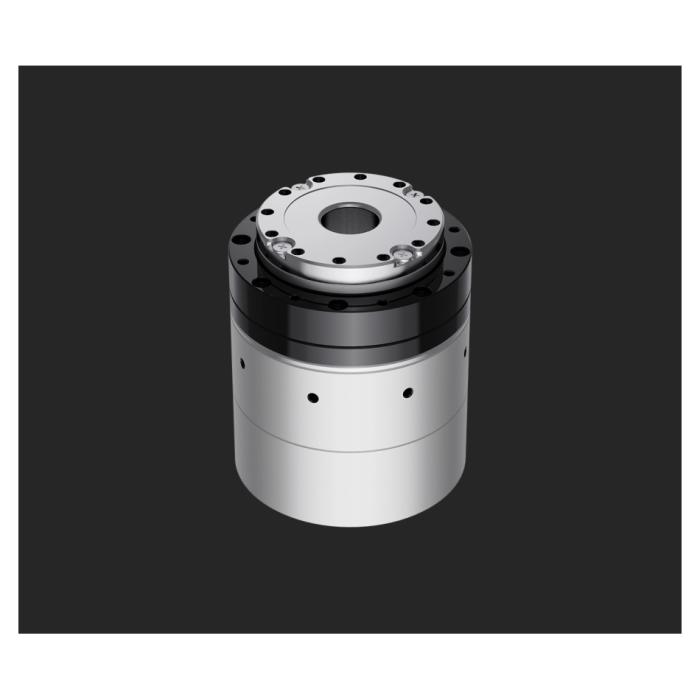
Ti5 Robotics 40-52 Lightweight Joint Module
Op voorraad
- MERK:
- TI5 ROBOTICS
- MODEL:
- 40-52
- ORIGIN:
- China
- Warranty:
- 12 MAANDEN
- AVAILABILITY:
- SUBJECT TO AVAILABILITY
- SKU:
- Ti5-Robotics-Joint-Module-40-52
Ti5 Robotics 40-52 Lightweight Joint Module
Ti5 Robotics 40-52 Lightweight Joint Module is a compact, highly integrated rotary actuator developed for humanoid robots, collaborative manipulators, and other articulated machines that demand dense torque in a small, serviceable package. The manufacturer documents four joint versions within this model family — CRA-RI40-52-PRO-2-XXX, CRA-RI40-52-PRO-2-XXX-B, CRA-RI40-52-PRO-2-XXX-2E-EC, and CRA-RI40-52-PRO-2-XXX-B-2E-EC — built on a shared motor platform but differing in housing length, mass, rotor inertia, and, in the EtherCAT-capable version, encoder resolution and communication options. Each documented version is offered with two gear ratios, 51:1 and 101:1, which trade output speed against torque. This page covers the complete 40-52 family as a single listing rather than separate purchasable variants.
Background
Why modular joint actuation matters
Modern humanoid and collaborative robots are assembled from repeating joint units rather than bespoke drivetrains. An integrated joint module combines the motor, gearing, encoder, and drive electronics into one sealed unit, which shortens design cycles, simplifies maintenance, and lets engineers scale a limb design by selecting modules of different frame sizes. Ti5 Robotics positions the 40-52 within exactly this philosophy: the vendor describes the product line as featuring a modular, integrated, and lightweight design intended for flexible assembly, easy maintenance, improved mobility, and efficient use of space. The 40-52 is a complete joint module; the vendor's catalog category naming should not be read as implying it is a bare motor component.
The 40-52 family at a glance
All documented versions share the same electrical platform: 90 W rated power, a 24–48 V supply window, 3 A maximum continuous current, 2 A rated current, a 0.05 N·m/A torque constant, and a 12 mm hollow shaft for routing cables through the joint. The base CRA-RI40-52-PRO-2-XXX is the shortest and lightest at 62 ± 0.5 mm and 0.32 kg. The B version extends to 82 ± 0.5 mm and 0.42 kg with higher rotor inertia. The 2E-EC version adds a 16/18-bit encoder option and CAN/EtherCAT communication at 64.5 ± 0.5 mm and 0.37 kg. The fourth version, CRA-RI40-52-PRO-2-XXX-B-2E-EC, is listed in the source with a drawing and parameter-table heading but without published values, so its specifications are not reproduced here.
Technical Specifications
The following tables preserve the published configuration distinctions. Blank, malformed, or ambiguous source values are not confirmation of a capability; confirm the selected configuration during quotation.
CRA-RI40-52-PRO-2-XXX
| Gear Ratio | Peak Torque (N.m) | Max Allowable Torque At Average Load (N.m) | Rated Torque @ 2000RPM (N.m) | Peak Speed (RPM) | Rated Speed (With 1/2 Rated Torque) (RPM) | Gear Backlash (arcsec) |
| 51 | 8.3 | 5.5 | 3.5 | 118 | 80 | 40 |
| 101 | 11 | 8.9 | 5 | 59 | 40 | 30 |
| Rated Power(W) | Supply Voltage(V) | Max Continuous Current(A) | Rated Current(A) | Torque Constant (N.m/A) | Encoder Resolution (bit) | Communication Bus |
| 90 | 24-48 | 3 | 2 | 0.05 | 16 | CAN |
| Hollow Shaft(mm) | Length(mm) | Mass(kg) | Inertia(g * c㎡) |
| 12 | 62±0.5 | 0.32 | 73 |
CRA-RI40-52-PRO-2-XXX-B
| Gear Ratio | Peak Torque (N.m) | Max Allowable Torque At Average Load (N.m) | Rated Torque @ 2000RPM (N.m) | Peak Speed (RPM) | Rated Speed (With 1/2 Rated Torque) (RPM) | Gear Backlash (arcsec) |
| 51 | 8.3 | 5.5 | 3.5 | 118 | 80 | 40 |
| 101 | 11 | 8.9 | 5 | 59 | 40 | 30 |
| Rated Power(W) | Supply Voltage(V) | Max Continuous Current(A) | Rated Current(A) | Torque Constant (N.m/A) | Encoder Resolution (bit) | Communication Bus |
| 90 | 24-48 | 3 | 2 | 0.05 | 16 | CAN |
| Hollow Shaft(mm) | Length(mm) | Mass(kg) | Inertia(g * c㎡) |
| 12 | 82±0.5 | 0.42 | 116.2 |
CRA-RI40-52-PRO-2-XXX-2E-EC
| Gear Ratio | Peak Torque (N.m) | Max Allowable Torque At Average Load (N.m) | Rated Torque @ 2000RPM (N.m) | Peak Speed (RPM) | Rated Speed (With 1/2 Rated Torque) (RPM) | Gear Backlash (arcsec) |
| 51 | 8.3 | 5.5 | 3.5 | 118 | 80 | 40 |
| 101 | 11 | 8.9 | 5 | 59 | 40 | 30 |
| Rated Power(W) | Supply Voltage(V) | Max Continuous Current(A) | Rated Current(A) | Torque Constant (N.m/A) | Encoder Resolution (bit) | Communication Bus |
| 90 | 24-48 | 3 | 2 | 0.05 | 16/18 | CAN/EtherCAT |
| Hollow Shaft(mm) | Length(mm) | Mass(kg) | Inertia(g * c㎡) |
| 12 | 64.5±0.5 | 0.37 | 85.14 |
How do the four 40-52 versions differ in practice?
The practical selection comes down to three axes. First, gear ratio: 51:1 favors speed (118 RPM peak) with lower torque and slightly higher backlash, while 101:1 favors torque (11 N·m peak) and tighter 30 arcsec backlash at roughly half the speed. Second, packaging: the B version is longer and heavier, which typically reflects a different mechanical configuration, and this changes inertia noticeably. Third, control architecture: the 2E-EC version supports CAN/EtherCAT and a 16/18-bit encoder option, which matters for deterministic multi-axis synchronization, whereas the standard versions communicate over CAN with a 16-bit encoder.
Who is Ti5 Robotics 40-52 Lightweight Joint Module for?
This module suits robotics engineers and system integrators building humanoid platforms, lightweight collaborative arms, and research prototypes where every gram at the joint affects end-of-arm payload and dynamic performance. It is also relevant to laboratories and educational institutions developing legged or articulated systems, and to product teams that want a standardized, maintainable joint unit instead of designing a motor-gearbox-encoder stack from scratch. Buyers should match gear ratio and bus type to their control stack before ordering.
What is Ti5 Robotics 40-52 Lightweight Joint Module used for?
The manufacturer lists applications spanning industrial production, scientific research and education, medical and rehabilitation robotics, and commercial scenarios. Typical integration cases include:
- Humanoid robot limbs, where compact joints with hollow-shaft cable routing keep arms slim and serviceable.
- Collaborative robot arms that need low-backlash actuation in small wrist and elbow axes.
- Research and university platforms prototyping legged or articulated mechanisms on CAN or EtherCAT networks.
- Rehabilitation and assistive robotics projects requiring lightweight, low-inertia actuation, subject to the integrator's own validation.
- Commercial service robots performing repeatable positioning tasks within the module's torque and speed envelope.
- Automation fixtures and gimbals where a 90 W integrated joint replaces a discrete motor, gearbox, and encoder assembly.
Pricing and Availability
Pricing for the 40-52 family depends on the version, gear ratio, encoder and bus configuration, and order quantity, so it is quoted on request rather than published as a flat figure. Lead times vary with configuration and volume. To receive a formal quotation, submit a request through this listing specifying the version (for example, CRA-RI40-52-PRO-2-XXX-2E-EC), the desired gear ratio, and your target quantity, and our team will respond with current pricing and delivery details.
Frequently Asked Questions
What gear ratios are available for the 40-52 module?
Two ratios are documented: 51:1 and 101:1. The 51:1 option reaches 118 RPM peak speed with 8.3 N·m peak torque; the 101:1 option delivers 11 N·m peak torque at up to 59 RPM with 30 arcsec backlash.
Which communication buses are supported?
The standard and B versions communicate over CAN. The 2E-EC version is documented with CAN/EtherCAT support and a 16/18-bit encoder option.
Does the module have a hollow shaft?
Yes. The documented versions include a 12 mm hollow shaft, which allows cabling to pass through the joint axis for cleaner limb designs.
What supply voltage does the 40-52 accept?
The documented versions operate from a 24–48 V supply, with 90 W rated power, 3 A maximum continuous current, and 2 A rated current.
How heavy is the module?
Mass depends on the version: 0.32 kg for the base version, 0.37 kg for the 2E-EC version, and 0.42 kg for the B version. The B-2E-EC version's mass is not published in the source material.
Are specifications identical across all four versions?
No. Performance by gear ratio is shared across the documented versions, but length, mass, inertia, encoder resolution, and bus options differ, and the fourth version has no published parameter values. Confirm the exact version against your requirements.
Where can I buy Ti5 Robotics 40-52 Lightweight Joint Module and what does it cost?
You can purchase it through this listing by submitting a quote request with your chosen version, gear ratio, and quantity. Cost is configuration-dependent and provided in a formal quotation rather than as a published list price.
Summary
The Ti5 Robotics 40-52 Lightweight Joint Module family offers four versions of a compact, integrated joint actuator with 51:1 or 101:1 gearing, CAN or CAN/EtherCAT communication, a 12 mm hollow shaft, and masses from 0.32 kg to 0.42 kg among the documented versions. For engineers comparing versions, requesting drawings, or preparing a quotation for a humanoid or collaborative robot build, this page is the starting point.