
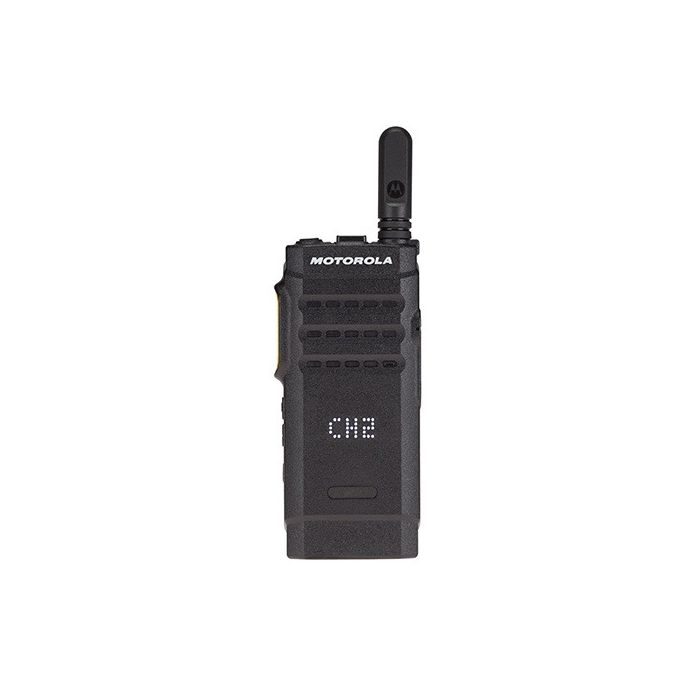
Motorola SL300-DV-2 Portable Two-Way VHF Radio (AAH88JCC9JA2_N)
In stock
- KAUBAMÄRK:
- MOTOROLA
- OSA #:
- SL300-DV-2
- AVAILABILITY:
- SUBJECT TO AVAILABILITY
- SKU:
- Motorola-SL300-DV-2
Motorola SL300-DV-2 Portable Two-Way VHF Radio (AAH88JCC9JA2_N)
The Motorola SL300-DV-2 belongs to a product family aimed at businesses that need a compact MOTOTRBO radio without moving to consumer-grade devices. Motorola’s official SL300 product page and datasheet describe the radio as an ultra-portable solution with simple operation, analog and digital support, and a form factor small enough to slip into pockets or bags without snagging. That combination is central to the product’s market identity: it is a professional radio for users who care about both communications performance and appearance.
The exact model AAH88JCC9JA2_N is commonly presented by dealers as the SL300 VHF 2-channel version, sometimes labeled SL300-DV-2. Dealer listings consistently identify it as digital, VHF, 2 channels, with features such as Lone Worker, Emergency, Quik Call, an LED battery indicator, and at least one programmable side button. Because some reseller pages describe it as digital while broader SL300 family materials describe the platform as both analog and digital, the most grounded characterization is that this exact model sits within the digital-capable SL300 family and is commonly sold for analog/digital interoperability.
For buyers comparing Motorola SL300 VHF radio, SL300-DV-2, or AAH88JCC9JA2_N, the main appeal is clear: it offers Motorola commercial-radio functionality in a sleek package. Instead of prioritizing rugged bulk and large controls, the SL300 emphasizes slim carry, business-ready styling, and lightweight usability while still remaining part of the MOTOTRBO ecosystem.
Design and Features
Ultra-slim profile
One of the defining characteristics of the SL300 is its ultra-slim design. Motorola’s official datasheet states that the radio is under an inch thick, with curved edges and a stubby antenna intended to prevent snagging or bulkiness. This gives the SL300 a distinct identity within the Motorola portable lineup: it is designed not just to communicate well, but to be carried comfortably and discreetly throughout a shift.
One-handed operation
Motorola highlights simple operation as a core SL300 feature. The official SL300 page says the radio includes a separate power button, top channel toggle switch, side volume control buttons, and a prominent push-to-talk button to support one-hand radio operation. That matters in real workplaces because it reduces the learning curve and helps users communicate quickly without needing a display-heavy interface.
Digital voice capability and analog interoperability
Motorola describes the SL300 platform as a MOTOTRBO digital radio that also supports analog operation, which helps organizations transition gradually from analog fleets. Reseller listings for the exact VHF 2-channel model also describe it as digital / analog or MotoTRBO / DMR, reinforcing that this radio is not limited to only one operating mode in normal business deployments.
Range Max and Dual Capacity Direct Mode
Motorola’s SL300 materials specifically call out Range Max technology, which the company says allows the 3W digital SL300 to deliver communication performance equivalent to most 4W digital radios. Motorola also highlights Dual Capacity Direct Mode, which uses the 2-slot TDMA DMR standard to double channel capacity in a 12.5 kHz channel without a repeater. These are meaningful technical selling points because they show that the SL300 is not just about appearance; it is also designed to improve spectrum efficiency and field performance.
Business-focused features
Dealer pages for AAH88JCC9JA2_N list business-oriented features such as Lone Worker, Emergency, Quik Call, and an LED battery indicator. Those functions matter for supervisors and team managers because they help align the radio with standard operational workflows rather than casual walkie-talkie use. While exact programmable layouts can depend on configuration, the consistent dealer descriptions indicate that the SL300-DV-2 is intended for structured business communications.
Technology and Specifications
Exact model profile
The most consistent reseller description of AAH88JCC9JA2_N identifies it as the Motorola SL300 VHF 2-channel model in the 136–174 MHz band. Dealers repeatedly list it as a 2-channel VHF radio, which distinguishes it from the 99-channel SL300 display variants. This makes the radio a simpler, more focused model for businesses that do not need large channel banks or display navigation.
Frequency range and power
Motorola family documentation and reseller listings place the VHF SL300 in the 136–174 MHz band. Reseller sources also state that SL300 radios operate at 3 watts in digital mode and 2 watts in analog mode, and this is consistent with Motorola’s Range Max positioning for the SL300 as a 3W digital radio. While the official snippet returned from Motorola does not restate the exact analog wattage for the VHF 2-channel SKU, the repeated reseller technical summaries make that the most grounded description available here.
Battery life and charging
Motorola’s SL300 datasheet emphasizes long battery life, while reseller listings commonly cite up to 15 hours of runtime for the non-display version and mention a micro-USB charging port. That charging method is notable because it makes the radio easier to top up without relying only on traditional desktop chargers. For mobile professionals and users who travel between sites, this can be a practical advantage.
Display and channel structure
The AAH88JCC9JA2_N version is generally treated as the 2-channel non-display model. Motorola’s family materials distinguish between the simpler SL300 and the 99-channel display version, while reseller model tables show AAH88JCC9JA2AN as the VHF 2-channel unit and AAH88JCP9JA2AN as the VHF 99-channel version. That distinction is important for buyers because the SL300 line includes models with materially different operating complexity.
Size and durability
Reseller specifications for the SL300 family list physical dimensions around 4.95 × 2.17 × 0.87 inches and a weight of roughly 5.9 ounces, while Motorola states that the radio is IP54 rated. Together, these figures support the SL300’s positioning as a compact but still professional-grade portable.
Applications and Use Cases
The Motorola SL300 is especially suitable where professional appearance, portability, and clear communications matter at the same time. One reseller explicitly says the SL300 is favored for schools, medical facilities, hospitality, and construction sites, while Motorola’s own design language points toward user groups that need a slim, carry-friendly radio rather than a large industrial handset.
In hospitality and customer-facing environments, the SL300’s discreet design is a clear asset. Staff can carry a professional radio without the bulk or visual prominence of heavier portables. In schools and healthcare-adjacent settings, the radio’s ease of carry and one-handed operation can be particularly useful for personnel who move frequently between rooms, floors, or outdoor areas. This use-case reading is supported by reseller application descriptions and the radio’s ultra-slim design focus.
The radio can also serve light commercial and mixed indoor-outdoor teams that want VHF operation. Because this exact model is a VHF 136–174 MHz unit, it is a logical fit for campuses, grounds, and operations where VHF planning is already in place. That said, exact suitability always depends on system design and environment, so band choice should still be matched to the user’s operating conditions. This is a reasoned inference from the model’s VHF identity rather than a Motorola statement about a specific vertical.
Advantages / Benefits
One of the SL300-DV-2’s biggest advantages is its form factor. Motorola’s official materials emphasize that the radio is slimmer than traditional portables while still delivering commercial communications performance. For many users, that is the main selling point: it is a genuine business radio that does not feel bulky.
Another major benefit is operational simplicity. The radio is built around direct controls and a limited channel structure in this variant, which reduces training burden and makes the device easier to standardize across teams. In environments where not every worker is a radio expert, this is a meaningful advantage.
The SL300 also offers digital-radio efficiency features such as Dual Capacity Direct Mode and Range Max, which strengthen its technical relevance beyond aesthetics. These features help Motorola position the SL300 not merely as a slim radio, but as a capable member of the MOTOTRBO platform.
Finally, because the radio supports analog and digital operation, it can serve as a practical migration device for fleets modernizing over time. That flexibility is important for buyers who want to preserve compatibility with existing analog communications while benefiting from newer MOTOTRBO capabilities.
FAQ Section
What is Motorola SL300-DV-2 Portable Two-Way VHF Radio (AAH88JCC9JA2_N)?
It is a Motorola MOTOTRBO SL300 Series VHF portable radio commonly listed as a 136–174 MHz, 2-channel handheld designed for professional business communications in a slim form factor.
How does Motorola SL300-DV-2 work?
The radio works as a push-to-talk portable, allowing users to communicate instantly on programmed channels. The SL300 family supports digital DMR operation and is also widely sold as analog-compatible, helping it integrate with mixed fleets.
Why is Motorola SL300-DV-2 important?
It is important because it combines professional MOTOTRBO communications, ultra-slim portability, and simple operation in a form factor that is easier to carry and more discreet than many traditional portables.
What are the benefits of Motorola SL300-DV-2?
Key benefits include an ultra-slim profile, one-handed operation, digital-radio efficiency features, analog/digital flexibility, and IP54-rated durability for business use.
Is AAH88JCC9JA2_N analog or digital?
The SL300 family is a digital MOTOTRBO platform, and reseller sources widely describe the VHF 2-channel model as supporting analog and digital operation. For exact programming on a given unit, the seller or dealer configuration should be confirmed.
Is AAH88JCC9JA2_N a display radio?
No. This model is generally listed as the 2-channel non-display VHF SL300, while the 99-channel VHF display version is identified separately under a different part number.
Summary
The Motorola SL300-DV-2 Portable Two-Way VHF Radio (AAH88JCC9JA2_N) is a slim, professional MOTOTRBO portable radio built for organizations that want dependable two-way communications in a compact, discreet form. With its 136–174 MHz VHF band, 2-channel configuration, ultra-slim profile, one-handed controls, and support for modern MOTOTRBO digital features, it remains a strong choice for hospitality, education, healthcare-adjacent environments, light commercial operations, and other teams that value both performance and portability. For buyers seeking a Motorola VHF slim portable radio that balances style, simplicity, and professional capability, the SL300-DV-2 remains a relevant and credible option.
Specifications
| OSA # | SL300-DV-2 |
|---|---|
| TOOTE TÜÜP | KAHESUUNALINE RAADIO |
| KAUBAMÄRK | MOTOROLA |