Galaxea A1 Robotic Arm (A1)
In stock
- VÖRUMERKI:
- GALAXEA
- HLUTI #:
- A1
- ORIGIN:
- Kína
- AVAILABILITY:
- SUBJECT TO AVAILABILITY
- SKU:
- Galaxea-A1
Galaxea A1 Robotic Arm (A1)
Galaxea A1 Robotic Arm (A1)
Introduction / Overview
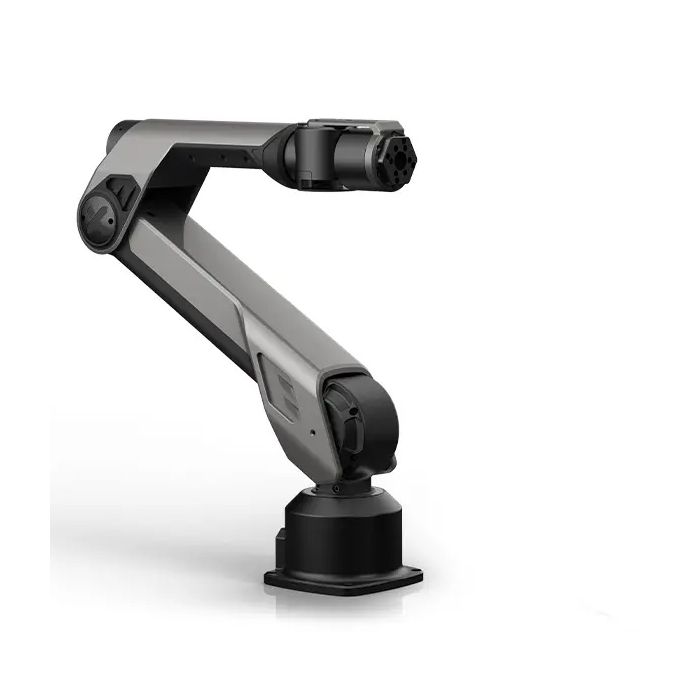
The Galaxea A1 Robotic Arm (A1) is a lightweight, 6-degree-of-freedom (6-DoF) robotic manipulator designed for research, education, prototyping, and embodied AI development. It is positioned as a force-controlled robot arm with a compact footprint and high dynamic motion characteristics, enabling both position control and interaction-focused tasks that benefit from compliant behavior (for example, gentle contact, insertion, and adaptive grasping).
In the broader robotics ecosystem, the A1 is commonly discussed as a lab-friendly arm intended to bridge the gap between “desktop experimentation” and real-world manipulation, offering a combination of portability, reach, and ROS-based software integration. Official documentation emphasizes its suitability for sophisticated scenarios requiring subtle interaction and stable motion control.
Design and Features
Lightweight, portable mechanical design
A key feature of the Galaxea A1 is its compact and portable build. The arm’s documentation lists a weight of ~6 kg, with foldable dimensions that make it easier to transport or mount on benches, carts, or mobile bases.
The A1 uses a multi-joint articulated structure with six independently driven joints, enabling flexible motion in confined workspaces while maintaining a usable reach for common manipulation tasks such as pick-and-place, tool handling, and basic assembly motions.
Force-controlled, interaction-oriented behavior
The A1 is often described as a force-controlled manipulator, meaning it is engineered not only to follow motion trajectories but also to better accommodate real-world contact dynamics. This design goal is particularly relevant in robotics research where arms must handle uncertain objects, variable friction, or delicate items without excessive force.
End-effector ecosystem (grippers and dexterous hands)
Galaxea documentation notes that the A1 can be paired with multiple end-effectors. A commonly referenced option is the Galaxea G1 parallel gripper, which is listed as a compatible accessory and is not necessarily included by default with the arm.
The documentation also mentions support for a “dexterous hand” option (depending on configuration and sourcing), reflecting a typical robotics workflow where the manipulator is a base platform and end-effectors are selected to match the use case.
Technology and Specifications
Key performance specifications (official documentation)
The Galaxea A1 technical specifications published in official guides include:
-
Degrees of freedom: 6
-
Reach: ~700 mm
-
Weight: ~6 kg
-
Repeatability: ~1 mm
-
Rated payload: ~2 kg
-
Maximum payload: reported as 3.5 kg in one hardware introduction and as 5 kg in another hardware guide
-
Max end-effector linear velocity: up to 10 m/s
Note on payload & acceleration values:
Official documentation contains slightly different values across pages (for example, maximum payload and maximum acceleration). In real deployments, payload ratings typically depend on arm posture, speed, duty cycle, and safety margin—so it is best practice to confirm the correct figures for your specific revision and use case.
Electrical interface and integration
The A1 documentation lists:
-
Rated voltage: 48V
-
Rated current: 6A (max current 10A)
-
Communication interface: USB 2.0
This configuration targets straightforward lab and development setups where the manipulator can be deployed without specialized industrial controllers, while still supporting higher-speed experimentation workflows.
Joint ranges and torque (robot kinematics and capability)
Joint motion limits and rated torque values are included in the hardware documentation. While ranges vary by joint, the A1 supports broad rotational travel suitable for multi-orientation manipulation, with higher torque allocated to the base joints and lower torque on wrist joints—typical of compact 6-DoF arms.
ROS control and software stack
Galaxea’s published software guide indicates the A1 is controlled through a ROS-based interface, with joint and end-effector movement control and a driver layer that exposes control/status topics for robotics development workflows.
This supports common robotics tasks such as:
-
trajectory execution,
-
teleoperation,
-
dataset collection for imitation learning,
-
closed-loop manipulation experiments, and
-
integration into navigation + manipulation platforms.
Applications and Use Cases
Research labs and embodied AI development
The Galaxea A1 is frequently positioned for robot learning and embodied intelligence experimentation, where developers need repeatable motion, stable integration, and the ability to test manipulation policies in real environments. Its balance of reach, payload class, and ROS control makes it suitable for applied research pipelines.
Education and advanced training
In universities and technical training environments, compact robotic arms are commonly used for:
-
robotics programming instruction,
-
motion planning fundamentals,
-
manipulation demos, and
-
vision-guided control labs.
The A1’s portability and published documentation can support these workflows, especially where space and setup time are constraints.
Industrial prototyping and light automation
While the A1 is not presented as a heavy industrial production robot, the payload and reach range can support light-duty tasks such as:
-
part sorting and kitting,
-
small-item pick-and-place,
-
tool presentation, and
-
structured lab automation (test fixtures, handling rigs).
Dual-arm humanoid and mobile manipulation platforms
Galaxea documentation for its humanoid-style platforms (such as R1 variants) notes configurations that integrate two A1-series arms, supporting bimanual workflows and research into whole-body manipulation.
Advantages / Benefits
High payload-to-weight efficiency
At approximately 6 kg total arm mass, a rated payload of ~2 kg and maximum payload figures reported in the 3.5–5 kg class indicate a strong payload-to-weight profile for a portable lab arm.
Compact reach for real manipulation tasks
A reach of ~700 mm gives the A1 a practical working radius for desk-scale and bench-scale setups, while still reaching across bins, work surfaces, and fixtures.
ROS-first development workflow
The presence of documented ROS interfaces and control packages makes it easier to:
-
integrate with existing robotics stacks,
-
reuse community tools (MoveIt/teleop patterns), and
-
accelerate prototyping and dataset generation.
Force-control focus
For tasks requiring safe contact and adaptation—common in modern manipulation research—force-oriented designs can reduce the burden on purely vision-based correction by allowing more natural physical interaction during execution.
What is the Galaxea A1 Robotic Arm?
The Galaxea A1 is a lightweight 6-DoF robotic arm designed for robotics research, education, and prototyping. It is described as a force-controlled manipulator with about 700 mm reach and a rated payload around 2 kg, supporting ROS-based control workflows.
How does the Galaxea A1 work?
The A1 uses six motor-driven joints to position an end-effector (such as a gripper) in 3D space. Control is typically performed through a ROS driver and motion interface, allowing users to send joint targets or end-effector commands while receiving real-time feedback and status information.
Why is the Galaxea A1 important?
The A1 is important for modern robotics because it supports real-world manipulation development, including contact-rich tasks that benefit from force-aware control. Its portability and ROS integration make it practical for embodied AI research, lab automation prototypes, and advanced robotics training.
What are the benefits of the Galaxea A1 Robotic Arm?
Key benefits include 6-DoF flexibility, portable weight (~6 kg), ~700 mm reach, ROS-based control interfaces, and a design philosophy focused on dynamic, interaction-friendly manipulation for research and prototyping.
Summary
The Galaxea A1 Robotic Arm (A1) is a compact, research-oriented 6-DoF force-controlled manipulator built for modern robotics workflows, especially those involving ROS development, embodied AI experimentation, and lab-scale automation. With an approximately 700 mm reach, portable ~6 kg build, and payload capability suited for light-to-medium manipulation tasks, the A1 represents a practical platform for teams seeking a balance between real-world performance and rapid integration into advanced robotics software stacks.
Galaxea A1 is a lightweight 6-DoF force-controlled robotic arm with 700mm reach, ROS support.