
Linkerbot Linker Hand 06
In stock
- VÖRUMERKI:
- LINKERBOT
- FYRIRMYND:
- LINKER HAND 06
- ORIGIN:
- Kína
- AVAILABILITY:
- SUBJECT TO AVAILABILITY
- SKU:
- Linkerbot-Linker-Hand-06
Linkerbot Linker Hand 06
Linker Hand 06 (Linker Hand 06)
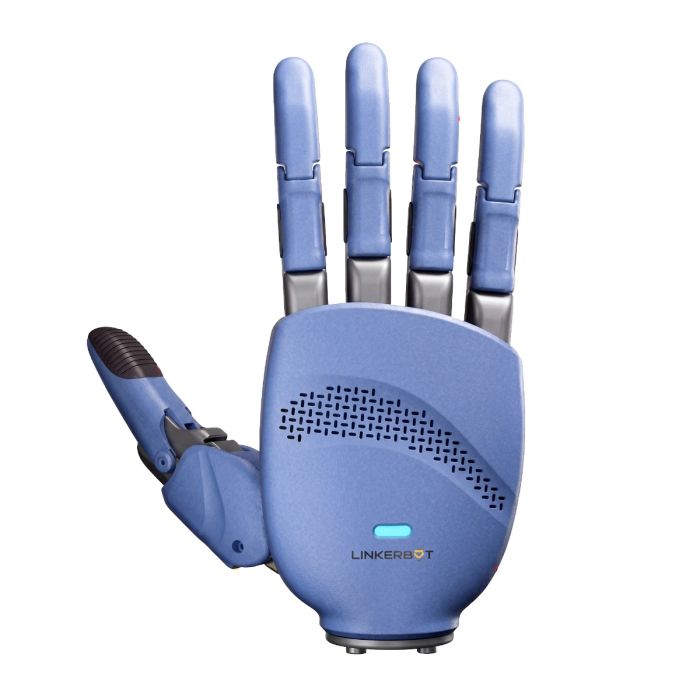
Developed by Linkerbot, the Linker Hand O6 is positioned as a cost-effective dexterous hand for applications that require multi-finger grasping, moderate in-hand manipulation, and repeatable force/position control—without the complexity and cost of very high degree-of-freedom anthropomorphic hands.
In typical deployments, the Linker Hand 06/O6 is mounted to a collaborative robot arm (cobot), an industrial robot wrist, or a mobile manipulation platform. It is controlled over industrial/embedded communication links (CAN bus or RS485) and operates from a 24 V DC supply, making it suitable for integration into automation cells and prototype robotic systems.
Design and Features
Hand architecture and joints
The Linker Hand O6 is a five-finger design with 6 degrees of freedom (DoF) and 11 joints, described as 6 active joints + 5 passive joints. This architecture aims to balance dexterity with mechanical simplicity: active joints provide the primary actuation for grasp formation, while passive joints support adaptive contact and compliance during grasping.
Transmission and actuation approach
A defining feature of the O6 is its worm-gear transmission, paired with a high-torque servo module concept in the product documentation. Worm gearing is commonly used in compact robotic drives to increase torque density and stiffness (often improving holding performance under load), which aligns with the O6’s emphasis on grip force and controlled positioning.
Size, weight, and integration footprint
The hand is marketed as an ultra-lightweight end effector at ~370 g, intended to reduce payload burden on the host robot and improve dynamic response. A reseller listing provides overall envelope dimensions of approximately 177 mm (height) × 76.5 mm (width) × 40 mm (thickness), supporting use on smaller robot wrists and compact platforms.
Optional tactile sensing
The O6 supports an optional tactile sensor configuration intended for force-aware grasping and basic tactile feedback (for example, adjusting force to prevent crushing fragile objects or reducing slip). The product manual describes this as an optional “tactile feedback (force control)” capability using fingertip sensors.
Technology and Specifications
Core specifications
Key specifications reported in the product listing and the product manual include:
-
Degrees of freedom (DoF): 6
-
Joints: 11 (6 active + 5 passive)
-
Transmission: Worm gear transmission
-
Control interface: CAN / RS485
-
Operating voltage: DC 24 V ±10%
-
Weight: 370 g
-
Repeat positioning accuracy: ±0.2 mm
-
Tactile sensor: Optional
Force performance
The O6 is specified with multiple force metrics intended to describe fingertip and overall grasp capability:
-
Maximum thumb tip force: 28 N
-
Maximum force of four fingers’ tips: 33 N
-
Maximum five-finger grip force: 130 N
Payload and “maximum load” claims
A published “maximum load” value of 30 kg appears in listings and the manual. In robotics practice, such a figure can depend heavily on grasp geometry, object shape, friction, and mounting orientation; it is best interpreted as a peak or scenario-dependent capability rather than a universal payload rating.
Range of motion
The product manual includes maximum designed joint angles for bending and thumb side-sway (with a note that actual commanded angles may include margins):
-
Four-finger second joint bending: up to 90°
-
Four-finger first joint bending: up to 80°
-
Thumb bending joints: up to 55° and 30° (depending on joint)
-
Thumb side-sway: up to 88°
Electrical and commissioning basics
The manual describes commissioning via a USB-to-CAN debugging cable, a power adapter, and connector cabling. Wiring is shown using an XT30 (2+2) connector with lines for CAN-L, CAN-H, GND, and 24 V.
A reseller “What’s Included” list matches these accessory items and explicitly includes the hand unit itself.
Applications and Use Cases
Logistics handling and material transfer
The O6 is positioned for logistics handling tasks such as picking and placing packaged goods, gripping irregular items, and transferring objects between conveyors, bins, or totes—particularly where a parallel gripper may struggle with shape variability.
Industrial assembly and light manufacturing
Documentation highlights suitability for industrial assembly scenarios. With repeatable positioning and optional force feedback, a dexterous hand can support tasks such as controlled insertion, handling small parts, or tool interaction—especially in pilot lines, labs, or flexible workcells.
Research, education, and manipulation studies
Because it combines multi-finger grasping with relatively simple industrial interfaces (CAN/RS485) and published parameters, the O6 is also relevant to academic and industrial R&D teams working on grasp planning, reinforcement learning for manipulation, teleoperation experiments, and tactile/force control research.
Service robotics and mobile manipulation
Its low mass and compact form factor support integration into service robots or mobile manipulators where payload margins are tight and human-hand-like grasping improves object coverage in unstructured environments.
Advantages / Benefits
Practical dexterity without extreme complexity
With 6 DoF and passive adaptation, the O6 targets a middle ground: more versatile than two-finger grippers for irregular objects, while avoiding the mechanical and control complexity of high-DoF anthropomorphic hands.
Strong grip metrics for a compact unit
Published grip force up to 130 N and a worm-gear drive strategy emphasize grasp strength and stability, which can be valuable for logistics items, consumer products, and many industrial parts.
Integration-friendly electrical stack
A 24 V DC power requirement and CAN/RS485 control interfaces align with common industrial and robotics integration practices, enabling use with embedded controllers, robot wrists, and industrial PCs.
Optional tactile feedback pathway
Support for optional tactile sensing offers a path toward safer, more reliable manipulation when handling delicate items or when slip detection improves grasp robustness.
FAQ Section
What is the Linkerbot Linker Hand 06 (Linker Hand O6)?
The Linkerbot Linker Hand 06 (Linker Hand O6) is a compact five-finger robotic hand designed for dexterous grasping in robotics systems. It uses a 6-DoF architecture with 11 joints (6 active, 5 passive) and is intended for tasks such as logistics handling, industrial assembly, and research manipulation.
How does the Linker Hand 06 work?
It actuates finger motion through high-torque joint modules and a worm-gear transmission, coordinating finger positions and (optionally) force control. The hand is powered by DC 24 V and communicates via CAN bus or RS485 for command and monitoring.
Why is the Linker Hand 06 important?
Dexterous hands expand what robots can pick up and manipulate—especially irregular objects—compared with basic two-finger grippers. The O6 is positioned as a cost-effective option that still provides five-finger grasping, published force metrics, and integration-friendly electrical interfaces.
What are the benefits of the Linker Hand 06?
Commonly cited benefits include a lightweight form factor (~370 g), strong published grip force (up to 130 N), repeatable positioning accuracy (±0.2 mm), and optional tactile sensing for improved force-aware grasping—all while using common robotics power (24 V) and communication interfaces (CAN/RS485).
Summary
The Linkerbot Linker Hand 06 (Linker Hand O6) is a lightweight, five-finger, 6-DoF robotic hand designed to deliver practical dexterous grasping for logistics, industrial assembly, and robotics R&D. With worm-gear transmission, CAN/RS485 control, optional tactile sensing, and published force/accuracy metrics, it represents a mid-complexity option for teams seeking more capable manipulation than standard grippers while maintaining integration-friendly requirements.