Noetix BUMI EDU Air Humanoid Robot
In stock
- VÖRUMERKI:
- NOETIX
- FYRIRMYND:
- BUMI EDU AIR
- ORIGIN:
- Kína
- Warranty:
- 12 MÁNUÐIR
- AVAILABILITY:
- SUBJECT TO AVAILABILITY
- SKU:
- Noetix-BUMI-EDU
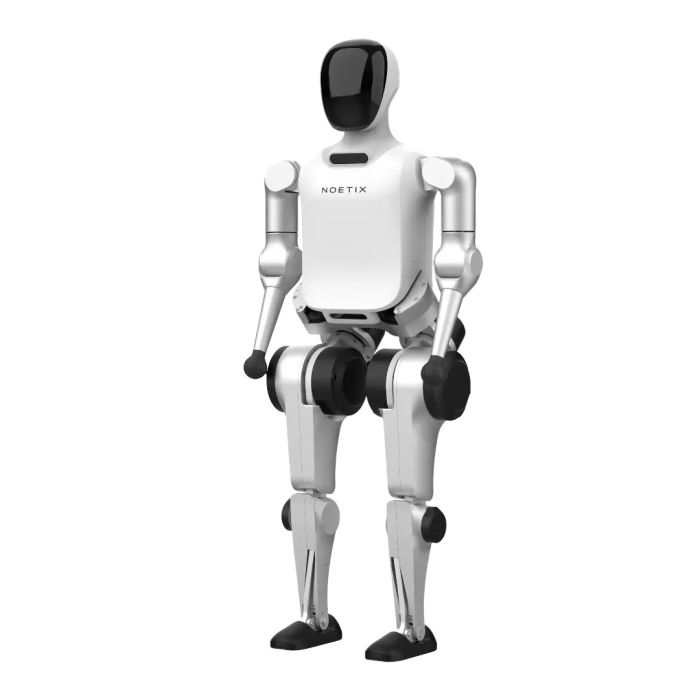
Noetix BUMI EDU Air Humanoid Robot
Noetix BUMI Air Humanoid Robot
Official Noetix materials present Bumi as a lower-cost consumer and education humanoid rather than a large industrial or research-only platform. In company coverage published in late 2025 and early 2026, Noetix said Bumi was intended to broaden access to humanoid robotics by combining consumer-level pricing with basic mobility, voice interaction, and graphical programming tools.
Design and Features
Compact, Education-Oriented Humanoid Design
One of BUMI EDU’s most distinctive qualities is its compact form factor. Official Noetix coverage says Bumi stands about 94 cm tall, weighs approximately 12 kg, and has more than 21 degrees of freedom, which places it in a much smaller and lighter category than full-size humanoid robots. This makes it more practical for classrooms, makerspaces, demo areas, and home learning environments.
Noetix also emphasizes approachability. In its February 2026 event coverage, the company said Bumi was designed to address pain points in family and educational settings, with a low barrier to entry, lightweight construction, safety-oriented structure and materials, and functions aimed at everyday use.
Beginner-Friendly Interaction and Programming
A major feature of the Bumi line is its graphical programming system. Noetix says the robot is intended to be easy for beginners to start using quickly, which is a strong signal that BUMI EDU is aimed not only at advanced robotics labs but also at schools, youth programs, and entry-level programming education.
The robot also supports voice interaction and app-based control. Reseller descriptions say BUMI EDU comes with native mobile applications, a standard control app, interactive voice explanations, and multiple levels of secondary development. Official Noetix materials similarly describe smooth voice interaction and a self-developed language model for intelligent communication.
Technology and Specifications
Motion, Joints, and Locomotion
According to reseller listings for BUMI EDU, the robot uses force-controlled robotic joints with peak torque of 50 N·m and a self-developed reinforcement-learning-based motion control algorithm. The same listings say BUMI EDU can perform stable walking, humanoid running, dancing, and gymnastic gait effects, with a maximum movement speed above 0.5 m/s.
Official Noetix materials do not provide the full EDU spec sheet in the sources I found, but they do confirm the core movement profile: Bumi has over 21 degrees of freedom and is capable of actions such as walking, running, and dancing. That alignment between Noetix’s official descriptions and reseller product copy suggests the EDU version is built around the same compact motion platform, even if some details come from retail listings rather than a direct manufacturer spec page.
Size, Weight, and Runtime
The clearest published numbers across sources are the robot’s dimensions and weight. Reseller listings specify 94.0 cm height, 34.5 cm width, 19.0 cm depth, and weight of at least 12 kg. Noetix’s own media coverage similarly describes Bumi as about 94 cm tall and 12 kg.
For power, reseller pages say BUMI EDU uses a high-discharge, quick-release lithium-ion battery and achieves more than 2 hours of runtime. The delivery configuration listed by retailers includes a quick-release battery and charger, which is consistent with an education robot that needs easier swapping and classroom-style usage cycles.
Software, Control, and Development
BUMI EDU’s most important technical feature may be its support for secondary development. Retail listings explicitly mark the model as supporting secondary development, and the included package is described as containing remote control/app tools, secondary development documentation, course materials, and debugging guidance.
That makes BUMI EDU more than a demo robot. It appears intended as a teachable humanoid platform for robotics education, app control, programming exercises, and embodied-AI experimentation at a simpler level than high-cost research humanoids. This interpretation is reinforced by Noetix’s own descriptions of Bumi as suitable for young programming learners, educational institutions, makerspaces, and family use.
Applications and Use Cases
Education and Robotics Learning
The most obvious use case for Noetix BUMI EDU is robotics education. The robot is explicitly described by retailers as a humanoid for education, and Noetix says Bumi includes zero-threshold graphical programming and targets programming learners and educational institutions.
This makes it suitable for coding classes, STEM labs, robot clubs, makerspaces, and demonstration-based instruction. Compared with a wheeled coding robot, a small bipedal humanoid can introduce students to locomotion, balance, multi-joint motion, voice interaction, and embodied AI concepts in a more engaging format. That last point is an inference based on the robot’s published capabilities and education-oriented positioning.
Family and Home Learning
Noetix repeatedly describes Bumi as being designed for family and educational settings, not just institutions. The company says it comes with a dedicated app for easy control and autonomous storage-related capability for everyday home use, alongside natural voice interaction.
That suggests BUMI EDU may appeal to families seeking a home learning robot for programming, AI exposure, or interactive technology experiences. While it is still a pre-order category product, the company’s messaging clearly aims to place Bumi closer to the consumer-education market than to enterprise robotics alone.
Advantages / Benefits
The biggest advantage of BUMI EDU is its attempt to make humanoid robotics more accessible in cost and complexity. Noetix says Bumi launched at 9,998 yuan and described it as the first high-performance humanoid robot at consumer-level pricing, while reseller pricing for the EDU model reflects a higher configuration and international retail packaging.
A second advantage is its small size and lighter weight. At roughly 94 cm and 12 kg, BUMI EDU is easier to deploy in classrooms and homes than larger humanoids that require more space, heavier-duty support, or specialized facilities.
A third advantage is its entry-level development path. With graphical programming, app control, voice interaction, and secondary development support, BUMI EDU appears designed to meet users at different skill levels, from beginners to more advanced educational developers.
FAQ Section
What is the Noetix BUMI EDU Humanoid Robot?
The Noetix BUMI EDU is a compact bipedal humanoid robot designed for educational use, coding, app control, voice interaction, and beginner-friendly robotics learning.
How does the Noetix BUMI EDU work?
BUMI EDU uses force-controlled joints, a reinforcement-learning-based motion control system, app control, voice interaction, and graphical programming tools to perform movement and learning tasks.
Why is the Noetix BUMI EDU important?
It is important because Noetix is positioning Bumi as a lower-cost humanoid platform that can bring humanoid robotics and embodied AI learning into schools, makerspaces, and homes.
What are the benefits of the Noetix BUMI EDU?
Its main benefits are compact size, beginner-friendly programming, voice interaction, secondary development support, and a more accessible path into humanoid robotics education.
What are the published specs for BUMI EDU?
Publicly listed specs include about 94 cm height, at least 12 kg weight, over 21 degrees of freedom, peak joint torque of 50 N·m, runtime over 2 hours, and maximum speed above 0.5 m/s, though some of these figures come from reseller listings rather than a direct official BUMI EDU spec page.
Summary
The Noetix BUMI EDU Humanoid Robot is a compact, education-focused humanoid designed to make coding, embodied AI, and humanoid robotics more accessible to schools, makerspaces, and families. Based on currently available public information, its strengths include a lightweight 94 cm form factor, app and voice interaction, graphical programming, and secondary development support. The “Coming April 2026” wording appears on reseller listings rather than in the official Noetix sources I found, but the broader Bumi platform is clearly being positioned as an affordable entry point into the humanoid robot market.