The vendor positions Adam-U alongside full-size bipedal and wheeled configurations in the broader “Adam” family, emphasizing modularity, developer access, and a path from research teleop to semi-autonomous task execution.
Commercial listings indicate Adam-U is available through regional distributors, typically as a configurable kit with software and optional accessories, reflecting an intent to serve labs, startups, and integrators building skill libraries, demos, and pilot services.
Design and Features
Form factor and manipulation focus
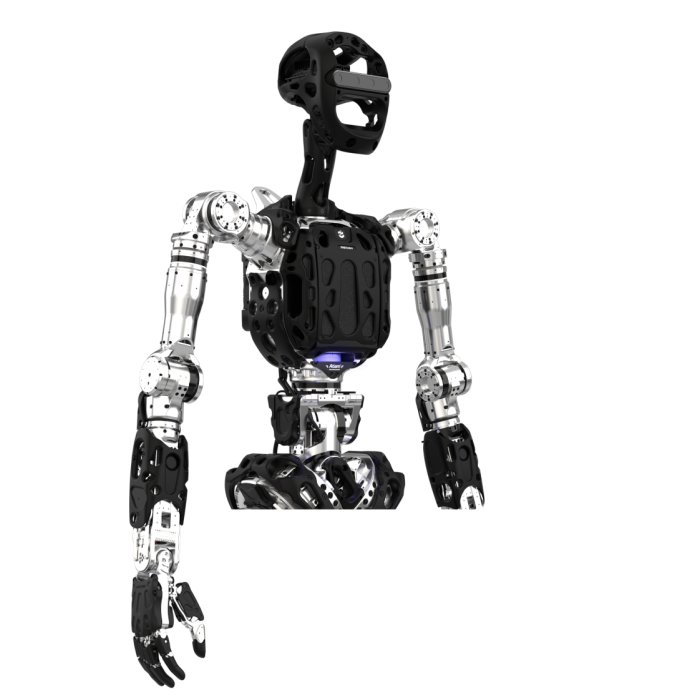
Adam-U is a humanoid torso: head (sensing and HRI), articulated shoulders/arms, and robotic hands mounted on a fixed pedestal or mobile base supplied separately. The format concentrates payload, dexterity, and workspace at countertop height for bimanual tasks such as sorting, placement, tool holding, and demonstration learning. Company materials describe the Adam family as modular and production-oriented, with standardized joints and drives.
Teleoperation and developer workflow
PNDbotics publishes a teleoperation framework for Adam/Adam-U that ingests motion from Noitom suits and (road-mapped) Meta Quest controllers, enabling motion-capture mirroring, kinesthetic teaching, and dataset creation. This aligns Adam-U with imitation-learning pipelines and quick skill prototyping in lab settings.
Sensing and HRI
The manufacturer highlights multi-camera vision for object recognition and pose estimation across the product line; public demos of related Adam variants show RGB/depth sensing, speech interfaces, and status signaling for human-robot interaction in service scenarios. While specific camera SKUs can vary by configuration, the company’s messaging centers on perception-guided grasping and scene understanding.
Software stack and embodied AI
Media coverage of closely related models (e.g., Adam-U Ultra) describes a Vision-Language-Action (VLA) policy layer and rapid skill uptake using large-model priors plus curated demonstrations—an architecture that also informs upper-body use when locomotion is out of scope. In practice, buyers typically combine teleop for data, scripted skills, and policy fine-tuning for targeted tasks.
Technology and Specifications
Exact specifications can vary by configuration and distributor; the following summarizes commonly reported attributes and vendor-published details.
-
Architecture: upper-body humanoid platform (head + dual arms + hands) for manipulation and HRI; pedestal or third-party mobile base optional.
-
Control & fieldbus: PNDbotics emphasizes integrated modular joints and a controls stack used across the Adam family; developer docs and product pages reference standardized, production-oriented modules for repeatability.
-
Teleoperation I/O: motion-capture suit (Noitom) and planned VR controller support for real-time mirroring and dataset logging.
-
Perception: configurable RGB/depth cameras; related Adam variants have been shown with Intel RealSense depth sensing and multi-camera rigs for VLA pipelines (variant-dependent).
-
Compute (variant-dependent): press items on Adam-family units mention edge AI modules suitable for real-time inference and closed-loop manipulation (e.g., NVIDIA Jetson-class systems in Ultra configurations).
-
Software: teleop framework + perception stack; supports imitation learning, scripted behaviors, and (optionally) VLA integration in higher-end builds.
Because Adam-U is sold as a configurable product, institutions typically select hand type, arm gearing/torque options, cameras, and compute, trading dexterity and latency against cost and power budgets.
Applications and Use Cases
Research and education
Adam-U serves as a bench-height manipulation platform for robot learning, grasping research, and HRI. Teleop speeds dataset creation; researchers can iterate from human-driven demos to policy rollouts without the complexity of bipedal locomotion.
Demonstrations and brand activations
The Adam family has been used for performances and public demonstrations (e.g., music-festival and dance showcases), indicating sufficient trajectory fidelity and arm bandwidth to script expressive motions—capabilities that carry over to upper-body staging for events, retail, and reception.
Light service and training
In pilot settings, an upper-body humanoid can handle counter tasks—sorting, handing items to people, or operating fixtures within reach—while teams validate safety and throughput before adding mobility. Coupled with a mobile base, Adam-U becomes a mobile manipulator for broader workflows.
Advantages / Benefits
-
Lower complexity than full humanoids: By omitting legs, Adam-U reduces mechanical, power, and safety complexity, focusing effort on hands-in-the-loop tasks where most value resides.
-
Fast iteration via teleop: Native support for motion-capture/VR speeds skill authoring and data collection for imitation learning and VLA fine-tuning.
-
Modularity and supply chain: PNDbotics markets modular, production-oriented joints and components, improving maintainability and consistency across fleets.
-
Clear upgrade path: Proven demos on related Adam variants (e.g., Adam-U Ultra) suggest a path from teleop to policy-driven autonomy as datasets mature.
FAQ
What is PNDbotics Adam-U?
Adam-U is an upper-body humanoid robot (head, arms, hands) from PNDbotics for manipulation, teleoperation, and embodied-AI research, sold as a configurable platform.
How does Adam-U work?
It combines teleoperation input (mocap/VR) with a perception stack for grasping and task execution; teams can progress from human-driven demos to learned policies (imitation/VLA) as datasets grow.
Why is Adam-U important?
By focusing on the hands and upper body, it delivers rapid, lower-risk deployment for labs and pilots where locomotion is secondary—accelerating skill development and HRI research.
What does Adam-U cost?
Public listings show ~US $60k MSRP and ~US $45k promotional pricing; total cost varies with hands, sensors, compute, software, and support.
Does Adam-U support teleoperation?
Yes. PNDbotics’ official teleop framework supports Noitom suits and is expanding to VR controllers for motion mirroring and data capture.
Summary
PNDbotics Adam-U is a humanoid upper-body platform that concentrates value on dexterous manipulation, HRI, and rapid skill iteration. With a teleop-ready toolchain, modular hardware, and an upgrade path toward VLA-assisted autonomy, Adam-U offers laboratories and integrators a practical entry point into embodied intelligence without the complexity of legged locomotion. Public distributor pages indicate transparent, configuration-based pricing, while official resources and demos provide a developer-friendly on-ramp from motion capture to real-world tasks.