
Pndbotics Adam Standard Humanoid Robot (Adam Standard)
In stock
- VÖRUMERKI:
- PDNBOTICS
- HLUTI #:
- Adam Standard
- ORIGIN:
- Kína
- AVAILABILITY:
- SUBJECT TO AVAILABILITY
- SKU:
- PNDbotics-Adam-Standard
Pndbotics Adam Standard Humanoid Robot (Adam Standard)
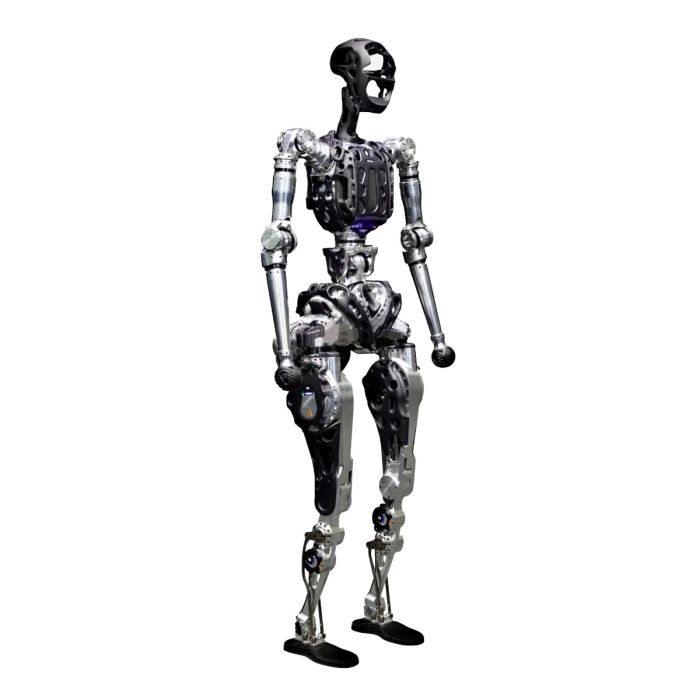
Adam Standard Humanoid Robot (Adam Standard)
It is intended to perform stable legged locomotion, expressive upper-body gestures, and basic manipulation in controlled, human-proximate environments.
Design and Features
Anthropomorphic layout
Adam Standard follows a conventional head–torso–two arms–two legs architecture. The form factor aligns the robot’s reach, viewpoint, and workspace with human fixtures—doors, handrails, countertops, and control panels—making it relevant for research on whole-body coordination and human–robot interaction (HRI).
Chassis and actuation
The platform uses a rigid but serviceable chassis housing high-bandwidth electric actuators with torque/force control. Back-drivability and compliance at the joints enable safer contacts, disturbance rejection, and ground adaptation during walking and stair stepping. The Standard trim typically supports bimanual arm motion with configurable end-effectors (simple grippers by default, upgradable to multi-finger hands in higher tiers).
Perception and HRI
Adam Standard commonly integrates RGB or RGB-D cameras, inertial sensing, and microphone/speaker modules for perception and interaction. In demonstration settings, the head and arm assemblies are tuned for status signaling, gaze alignment, and gesture mirroring (e.g., pointing, waving, hand-over postures) to support education labs, receptions, and public showcases.
Modularity and serviceability
The robot is designed with a modular service philosophy: field-replaceable links and actuators, swappable hands, and expansion bays for additional compute or sensors. This reduces mean time to repair (MTTR) and supports iterative upgrades over a multi-year research or pilot deployment cycle.
Technology and Specifications
-
Form factor: Bipedal humanoid, human-scale height class
-
Body dimensions: ~1.6–1.7 m height (variant-dependent)
-
Mass: ~60–65 kg typical build range
-
Actuator strategy: Torque/force-controlled electric joints (leg and arm chains), back-drivable
-
Degrees of freedom: 25–40+ DoF depending on selected hands/head modules
-
Locomotion: Level-ground walking, turning, and step negotiation under supervised conditions
-
Perception: Forward-facing RGB/RGB-D, IMU; optional depth/LiDAR add-ons for mapping and obstacle handling
-
Compute (typical): Edge AI module + real-time controller; optional GPU acceleration for perception/policy inference
-
I/O & networking: Ethernet/Wi-Fi; expansion for industrial or research fieldbuses as configured
-
Power: Swappable battery packs (run time depends on gait duty cycle, manipulation load, and sensors)
Controls and autonomy
Adam Standard uses a layered control stack:
-
Whole-body control: Balance, footstep planning, and contact management for legs, with coordinated torso and arm motion.
-
Motion generation: Trajectory generators for gait and upper-limb gestures; skill libraries for primitive actions (reach, grasp, present).
-
Learning-enabled behaviors: Support for teleoperation, imitation learning, and reinforcement-learning policies to accelerate sim-to-real transfer of locomotion and manipulation skills.
-
Safety envelope: E-stop circuitry, software limits, and guarded behaviors for human-proximate operation.
Applications and Use Cases
Research and higher education
Adam Standard is widely suited to legged-robotics curricula, state estimation, whole-body control, and HRI. Because its hardware exposes force-aware joints and human-scale kinematics, it serves as a repeatable platform for benchmarking gait robustness, recovery strategies, and bimanual coordination.
Demonstrations and public engagement
With anthropomorphic proportions and expressive arm motion, Adam Standard can execute scripted sequences for exhibitions, open days, and STEM outreach. Typical routines include greeting, pointing, object presentation, and choreographed movements with staff supervision.
Pilot service tasks (supervised)
In controlled spaces (lobbies, labs, mock retail), the robot may perform light fetch and hand-overs, wayfinding gestures, or prop interaction. These are usually pilot-grade, with humans in the loop for safety and exception handling—useful for building datasets and refining workflows.
Advantages / Benefits
-
Human-environment compatibility: Anthropomorphic reach and locomotion allow experiments around doors, stairs, switches, and counters without re-architecting spaces.
-
Balanced cost–capability tier: The Standard trim generally offers more capability than entry-level variants while avoiding the price premium of flagship configurations.
-
Force-controlled actuation: Back-drivable joints support compliance, fine force regulation, and safer interaction, aiding contact-rich skills and recovery behaviors.
-
Developer-ready stack: Teleoperation, imitation learning, and RL-friendly interfaces shorten the time from concept to repeatable demo or lab exercise.
-
Modular upgrades: Hands, sensors, and compute can be tailored to manipulation depth, perception needs, or HRI fidelity as projects mature.
FAQ
What is the Pndbotics Adam Standard humanoid robot?
Adam Standard is a full-size, bipedal humanoid from Pndbotics that balances locomotion, manipulation, and cost for research, education, and supervised demos.
How does Adam Standard work?
It uses torque/force-controlled actuators and a layered control stack—whole-body balancing, trajectory generation, and learning-enabled skills—to walk, gesture, and perform basic grasps under supervision.
Why is Adam Standard important?
The model provides a reproducible human-scale platform for legged locomotion and HRI studies, lowering barriers for labs and pilot teams that need both mobility and upper-body expressiveness.
What are the key specifications?
Typical builds are ~1.6–1.7 m tall, ~60–65 kg mass, 25–40+ DoF depending on options, RGB/RGB-D perception, and edge AI compute. Exact figures vary by configuration.
How does Adam Standard compare to Adam Lite or Pro?
Standard offers more dexterity and options than Lite, while costing less and being simpler to integrate than Pro-tier models geared toward showcase manipulation.
Summary
The Pndbotics Adam Standard occupies the middle ground in a humanoid lineup that ranges from cost-conscious research units to showcase-grade flagships. Its human-scale kinematics, force-controlled actuators, and developer-friendly software pathways make it a practical choice for universities, robotics labs, and organizations piloting humanoid workflows. With modular upgrades for hands, sensors, and compute, Adam Standard can evolve alongside curricula and pilots—offering a measured step toward dexterous, human-proximate robotics without the integration burden of top-tier configurations.