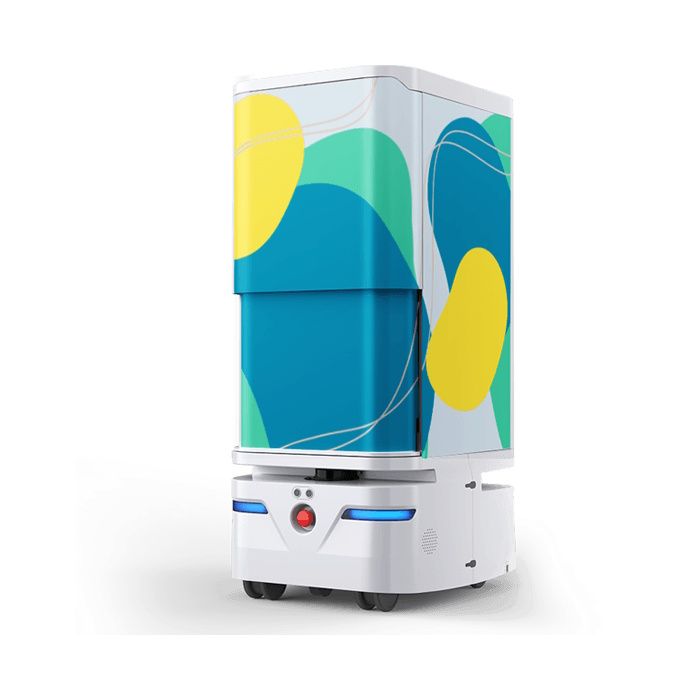
Yunji GOGO Delivery Robot (GOGO)
In stock
- VÖRUMERKI:
- YUNJI
- HLUTI #:
- GOGO
- ORIGIN:
- Kína
- AVAILABILITY:
- SUBJECT TO AVAILABILITY
- SKU:
- Yunji-GOGO
Yunji GOGO Delivery Robot (GOGO)
GOGO is positioned as a large-capacity, general-purpose delivery platform, with features aimed at practical deployment in real facilities—most notably multi-compartment storage, autonomous navigation, and elevator compatibility to support multi-floor workflows.
In typical deployments, delivery robots like GOGO help automate repetitive “last-50-meters” logistics: delivering amenities and room service in hotels, transferring small supplies in healthcare sites, or moving parcels and documents in campuses and offices. GOGO is associated with Beijing Yunji Technology Co., Ltd., a firm known for service-robot solutions aimed at hospitality and other indoor service environments.
Design and Features
Form factor and storage concept
A defining design element of GOGO is its two-compartment payload bay, intended to separate deliveries (for example, two rooms on one trip, or clean items vs. returns). A published configuration lists a total storage capacity of 71 L (upper compartment 41 L, lower compartment 30 L).
Human interaction and operational model
GOGO is typically operated through a simple on-device interface and/or facility workflows that allow staff to assign a destination (e.g., room number or drop-off point), place items into the compartment(s), and dispatch the robot. Some implementations emphasize remote calling/summoning, enabling staff to request the robot from a distance for flexible tasking.
Mobility and building practicality
Indoor delivery robots must safely handle crowded corridors, tight turns, and minor floor discontinuities. GOGO is described as supporting:
-
Narrow passage operation (a listed minimum passage width of 55 cm)
-
Inclines up to 13°
-
Small obstacles up to 2.5 cm and gaps up to 4 cm (site-dependent; always verify against facility flooring and safety requirements)
Elevator integration
Multi-floor delivery is a core value proposition for many service robots. GOGO is described as compatible with elevator retrofitting and operation with existing elevators from multiple manufacturers (integration approach depends on the building’s elevator model, access controls, and local safety rules).
Technology and Specifications
Key published specifications
-
Dimensions (L × D × H): 420 mm × 490 mm × 975 mm
-
Weight: 63 kg
-
Continuous operating time: 6–8 hours
-
Travel speed: 0.9–1.5 m/s
-
Load capacity: 20 kg
-
Storage capacity: 71 L total (41 L upper, 30 L lower)
-
Minimum passage width: 55 cm
-
Supported incline angle: 13°
-
Max obstacle height: 2.5 cm (or less)
-
Max gap width: 4 cm (or less)
-
Connectivity: SIM and Wi-Fi
-
Languages: Japanese, English, Chinese, and others
A separate product listing for GOGO also highlights a similar performance envelope (for example, speed up to ~1.5 m/s and payload up to ~15 kg), which suggests there may be multiple configurations or different published figures across markets. When quoting or deploying, confirm the exact model/variant and datasheet revision.
Autonomy stack (typical for indoor delivery robots)
While exact sensor and autonomy components can differ by model and region, commercial indoor delivery robots generally rely on:
-
SLAM-based mapping and localization for indoor navigation
-
Obstacle detection and avoidance for dynamic environments
-
Route planning optimized for corridors, doors, and service zones
-
Docking/charging behaviors for sustained operations
For context on how Yunji describes its indoor service robots more broadly (e.g., mapping, obstacle avoidance, elevator operation, and self-charging as an end-to-end workflow), see Yunji’s published materials for related delivery robots.
Applications and Use Cases
Hospitality (hotels and serviced residences)
Hotels are a common target environment for delivery robots because the workflow is repetitive, time-sensitive, and labor-intensive (amenities, towels, bottled water, room-service drop-offs, late-night deliveries). Elevator compatibility and narrow corridor operation are especially important in this setting.
Healthcare (hospitals and clinics)
Indoor delivery robots may support non-critical logistics such as transporting sealed supplies, linens, or documents along predefined safe routes. In healthcare environments, compliance, infection control, and site-specific safety assessments are essential; the robot’s compartments and access controls become significant operational considerations.
Offices, campuses, and mixed-use buildings
In larger facilities, robots can transport small parcels, documents, IT equipment, or pantry supplies between departments or towers, reducing time lost to “walking errands.” For mixed-use buildings, elevator and access-control integration often determines feasibility.
Retail and customer-facing venues
In some deployments, delivery robots are also used as an “experience layer” (novelty plus efficiency), particularly in malls, showrooms, and event venues—though throughput and safety still drive ROI.
Advantages / Benefits
Operational efficiency and staffing support
By automating repetitive runs, GOGO-type delivery robots can reduce staff time spent on routine transport, potentially allowing staff to focus on customer service and higher-value tasks.
Large-capacity, multi-drop potential
A two-compartment, 71 L storage design supports batching deliveries or separating items, which can reduce the number of trips compared with smaller single-bin robots.
Multi-floor service via elevators
Elevator retrofit/compatibility is a key differentiator for buildings where floor-to-floor logistics are frequent.
Building-friendly mobility
Published constraints—like minimum passage width and slope/obstacle tolerance—are relevant to real facilities with tight corridors, ramps, and thresholds.
FAQ Section
What is the Yunji GOGO Delivery Robot (GOGO)?
The Yunji GOGO Delivery Robot (GOGO) is an autonomous indoor delivery robot designed to transport items within buildings—often across multiple floors—using features like multi-compartment storage and elevator compatibility.
How does the GOGO delivery robot work?
In typical operation, staff load items into one of GOGO’s compartments, assign a destination (such as a room or service point), and the robot navigates autonomously to deliver the items. Published materials also describe remote calling/summoning and autonomous obstacle avoidance as part of its workflow.
Why is a delivery robot like GOGO important?
Delivery robots can reduce time spent on routine internal transport (amenities, supplies, parcels), support contactless workflows, and improve consistency—especially in facilities with frequent, repetitive deliveries.
What are the benefits of the GOGO delivery robot?
Commonly cited benefits include large storage capacity (71 L across two compartments), elevator retrofit compatibility, and mobility suited to real buildings (e.g., narrow passage width and incline/threshold handling within published limits).
Summary
The Yunji GOGO Delivery Robot (GOGO) is a large-capacity indoor delivery robot aimed at practical, multi-floor building logistics. With a two-compartment 71 L storage design, published 6–8 hour runtime, elevator compatibility, and building-oriented mobility constraints (narrow passages, ramps, small thresholds), GOGO targets real-world deployments in hospitality, healthcare, and commercial facilities where reliable internal delivery can improve service efficiency and consistency.