
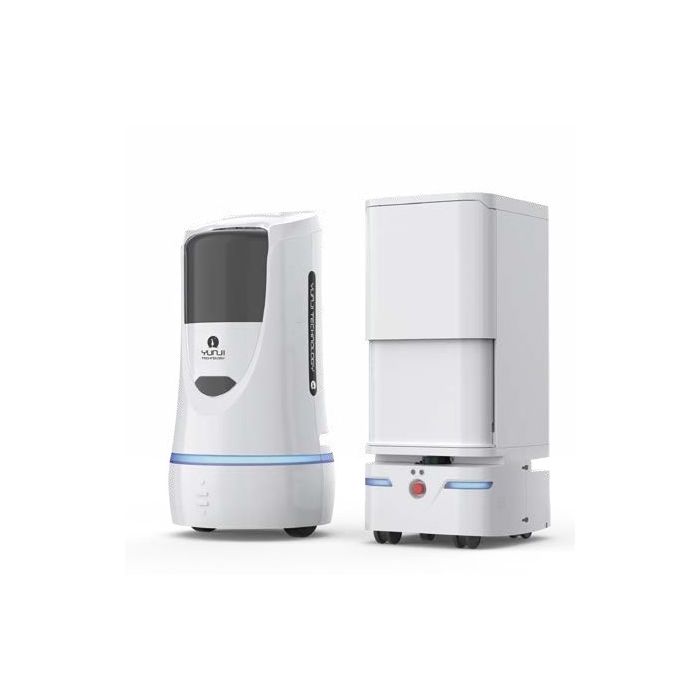
Yunji Hotel Delivery Robot - RUN (RUN)
In stock
- MERKI:
- YUNJI
- HLUTI #:
- RUN
- ORIGIN:
- Kína
- AVAILABILITY:
- SUBJECT TO AVAILABILITY
- SKU:
- Yunji-RUN
RUN is described in public materials as a “hotel robot” focused on last-meter logistics—transporting items such as amenities, towels, bottled water, or small parcels from staff areas to guest rooms—while also supporting wayfinding and information display in some deployments.
RUN belongs to a broader category of indoor delivery robots that operate in semi-structured buildings (hotels, serviced apartments, and office towers) and rely on autonomous navigation, obstacle avoidance, and building-system integration (notably elevators) to complete multi-floor tasks without continuous human supervision. Public reporting has tied the RUN model to hotel operations in China and to use cases such as room delivery, guiding guests, and reducing routine “runner” tasks for staff.
Design and Features
Form factor and hotel-oriented layout
Hotel delivery robots are typically designed around a compact, stable base to navigate corridors, corners, and elevator thresholds. The RUN product positioning emphasizes multi-scenario hotel workflows, with a focus on end-to-end delivery rather than single-point “shuttle” operation.
While detailed mechanical dimensions and payload ratings are not consistently published in the sources available publicly, the RUN model is presented as a goods-delivery platform intended for guest-room delivery and front-of-house logistics, including late-night requests when staffing may be limited.
Contactless delivery workflow
A commonly described RUN workflow is guest-initiated ordering via QR code scanning and mobile payment, followed by autonomous delivery to a guest room. In hospitality use, this is often paired with operational steps such as staff loading items into the robot, assigning a destination, and sending the robot to deliver and notify the recipient on arrival (notification methods vary by deployment and integration).
Elevator operation and multi-floor service
A defining requirement for hotel delivery is elevator interoperability. RUN is explicitly marketed as capable of independent elevator operation as part of hotel deployment (typically meaning it can call an elevator, ride to a destination floor, and exit). In practice, elevator operation in service robots is usually achieved through one of the following approaches (implementation varies by site):
-
Integration via elevator control interface modules approved by the building/elevator vendor
-
Network/API integration where supported
-
Site-specific access control coordination (e.g., floor permissions)
Public descriptions of Yunji’s hotel deployment process include site survey steps that reference route planning and elevator integration, reflecting the fact that building integration is a core determinant of feasibility and performance.
Autonomous recharging and continuous operation
RUN is presented as supporting autonomous recharging, returning to a dock without manual plugging. For hotels, this feature is operationally significant because it reduces staff overhead and supports overnight or off-peak service.
Technology and Specifications
Navigation and mapping
RUN is described as supporting “smart map generation” and “intelligent mapping,” which typically refers to a workflow where the robot builds or is configured with an indoor map of corridors, elevator lobbies, and service areas. In the broader robotics field, indoor delivery robots commonly use combinations of:
-
SLAM (simultaneous localization and mapping) to localize and map in GPS-denied indoor spaces
-
Sensor fusion (e.g., depth sensing, lidar, ultrasonic, or vision) to maintain a stable pose estimate
-
Route planning and corridor-following behaviors tuned for pedestrian environments
Public sources for RUN emphasize “intelligent obstacle avoidance,” consistent with service-robot requirements in busy lobbies and hallways.
Obstacle avoidance and human-safe behavior
Hotels present dynamic obstacles (luggage, housekeeping carts, guests, children). RUN is presented as having intelligent obstacle avoidance, which in practical terms usually includes reduced speed in congested areas, stop-and-wait behaviors, and re-planning around temporary blockages.
Task orchestration and dialing/notification
Some public descriptions list “autonomous dialing,” implying the robot can place calls or trigger notifications as part of delivery (for example, calling a room phone or placing an automated alert). The exact mechanism depends on hotel telephony/PMS integration and local configuration.
Published performance and operational claims
A reseller listing includes operational impact claims—such as reductions in labor requirements, coverage of annual travel distance, and the concentration of delivery requests during late-night hours—framed as outcomes observed in hotel operations. Because these figures are presented as marketing/operations claims rather than standardized technical benchmarks, they are best interpreted as contextual performance indicators that can vary by hotel size, guest volume, layout complexity, and integration quality.
Applications and Use Cases
Hotel room-service and amenities delivery
The core application is delivery of guest amenities (towels, water, toiletries, VIP gifts) to rooms with minimized face-to-face contact. This can be used for both operational efficiency (reducing staff walking time) and service differentiation (novelty and perceived modernity).
Concierge support and guest guidance
Public reporting also describes RUN as able to “show them the way” and provide basic information/promotion. In practice, this may be implemented through on-device UI prompts, pre-configured routes, or staff-triggered escort behaviors (capabilities depend on the specific software package and deployment).
Late-night operations
Hotels often experience a spike in small requests during evening and late-night hours. RUN is positioned as a tool to cover these requests when staffing is minimal, potentially allowing staff to focus on higher-value guest interaction rather than repetitive errands.
Other indoor venues
Although marketed for hotels, RUN is also described as applicable to buildings, galleries, and shopping malls—settings where indoor navigation and short-distance delivery are similarly valuable.
Advantages / Benefits
Operational efficiency
By automating routine delivery runs, a hotel can reduce time spent on repetitive walking routes between front desk, storage areas, and guest rooms. Public descriptions explicitly position RUN as a way to reduce “running errands” work for housekeeping and front-office teams.
Contactless service and privacy
Contactless delivery is frequently highlighted as a benefit, particularly for privacy and reduced face-to-face interaction (which can be relevant during high-demand periods or when minimizing disruption is desired).
Guest experience and brand signaling
Robots in hotel lobbies can function as experiential touchpoints. A public article notes claims (attributed to company materials) that robot adoption can increase guest engagement and reviews, emphasizing the “surprise element” of robotic service.
FAQ Section
What is the Yunji Hotel Delivery Robot RUN?
RUN is an autonomous indoor service robot designed mainly for hotels, where it delivers items to guest rooms and may also support guidance and basic information tasks.
How does the RUN hotel delivery robot work?
In a common described workflow, a guest orders via QR code, the robot is loaded with items, then it navigates through hallways (and potentially elevators) to deliver to the destination and notify the recipient.
Why is a hotel delivery robot like RUN important?
Hotels use delivery robots to reduce routine staff errands, offer contactless delivery, and support service coverage during off-peak hours. Public materials also frame robots as a way to improve guest experience and operational efficiency.
What are the benefits of the RUN delivery robot for hotels?
Frequently cited benefits include autonomous delivery, intelligent obstacle avoidance, elevator operation capability, autonomous recharging, and reduced face-to-face contact—aimed at lowering labor overhead and improving service consistency.
Summary
Yunji’s RUN is positioned as a hotel-focused autonomous delivery robot that supports contactless, multi-floor indoor logistics through mapping, obstacle avoidance, elevator operation, and autonomous docking. Public reporting links RUN to hotel deployments and guest-room delivery workflows, while commercial listings emphasize quote-based availability and operational benefits that vary by site.
Specifications
| HLUTI # | RUN |
|---|---|
| MERKI | YUNJI |