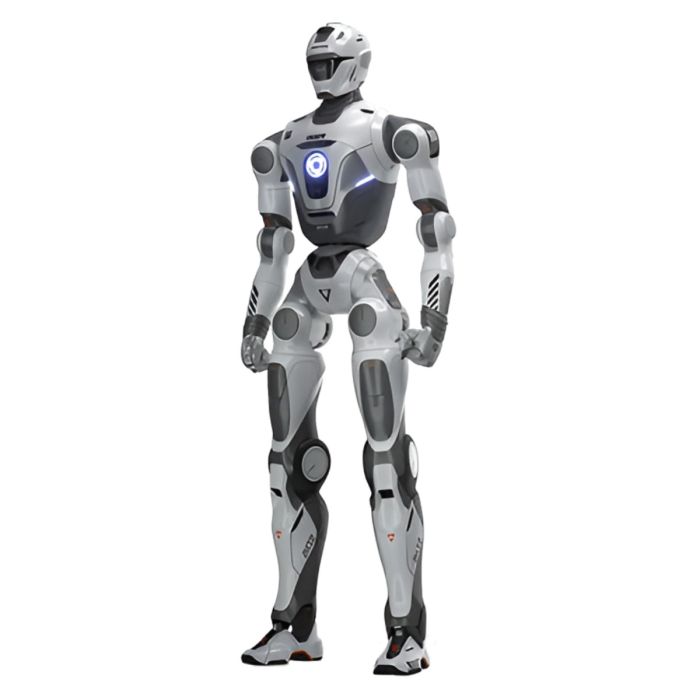
EngineAI T800 Basic Full-Size General-Purpose Humanoid Robot
In stock
- PREKĖS ŽENKLAS:
- ENGINE AI
- DALIS NR.:
- T800
- ORIGIN:
- Kinija
- AVAILABILITY:
- SUBJECT TO AVAILABILITY
- SKU:
- EngineAI-T800
EngineAI T800 Basic Full-Size General-Purpose Humanoid Robot
The EngineAI T800 Full-Size General-Purpose Humanoid Robot is a full-scale bipedal platform developed by EngineAI Robotics and positioned by the company as part of its general humanoid line, distinct from its earlier, smaller models. Public materials describe the T800 as a high-mobility machine built for practical tasks and robust demonstrations, with a launch campaign in late 2025 that leaned heavily on balance-intensive routines and martial-arts sequences intended to showcase control authority and mechanical durability. Media coverage places the platform in the roughly 173 cm height class, and the company states that the robot was developed full-stack in-house, spanning mechanics, actuation, control, and software. For organizations evaluating full-size humanoids for pilots, demonstrations, or research, the T800 is presented as a power- and mobility-focused entry in an increasingly competitive category.
Background
From compact platforms to a full-size general humanoid
EngineAI Robotics profiles the T800 as a step beyond its earlier, smaller robots and as the flagship of its general humanoid direction. The distinguishing choice is embodiment at adult human scale: a platform in the approximately 173 cm class operates within human geometry, which matters for doorways, workstations, reach envelopes, and interaction height. The company frames the robot's anthropomorphic joint design — 29 degrees of freedom across the body, excluding optional dexterous hands — as the basis for coordinated whole-body motion and smooth transitions between complex actions such as squats, directional changes, kicks, and rapid posture recoveries. EngineAI's broader general humanoid pages also reference goals such as a human-like walking gait and locomotion in the 2 m/s class, although those figures describe the product line's ambitions rather than a verified T800 datasheet value.
A launch built around public demonstrations
The T800 was introduced through a series of videos and event appearances in late 2025, and the launch attracted broad attention for its power-focused demonstrations. Company and third-party footage showed martial-arts routines, balance recoveries under disturbance, and high-torque kicks — including a widely discussed filmed kick delivered to the company's CEO, who wore protective gear, staged specifically to dispel speculation that the promotional clips were computer-generated. EngineAI has additionally released behind-the-scenes footage to underline that its videos are not sped up, composited, or otherwise manipulated. This demonstration-first launch style is notable in the humanoid sector, where buyers increasingly ask vendors to substantiate dynamic performance claims with unedited evidence rather than rendered concept media.
Technical Specifications
| Attribute | Publicly reported / claimed value |
|---|---|
| Category | Full-size, general-purpose humanoid robot |
| Developer | EngineAI Robotics |
| Height class | Approximately 173 cm (media-reported platform class) |
| Degrees of freedom | 29 DOF across the body, excluding optional dexterous hands |
| Perception | Multi-sensor suite referenced in coverage, including 360-degree LiDAR and stereo/RGB vision |
| Locomotion positioning | High mobility; company general humanoid pages cite human-like gait and 2 m/s-class goals |
| Demonstrated behaviors | Martial-arts sequences, balance recoveries, high-torque kicks, rapid posture transitions |
| Development approach | Full-stack in-house development of mechanics, actuation, control, and software (company claim) |
| Introduction | Late 2025, via videos and event appearances |
These values are drawn from company statements and third-party coverage rather than a complete published datasheet; figures may vary by configuration and should be confirmed against current manufacturer documentation during quotation.
How does the EngineAI T800 balance and move?
Mobility is the center of the T800's public identity. Launch footage emphasizes whole-body coordination: the robot squats, changes direction quickly, delivers kicks, and recovers posture after impacts and pushes. EngineAI attributes this to its anthropomorphic 29-DOF architecture and to control software developed alongside the mechanics and actuation, which the company argues allows tighter iteration between hardware and controller than a mixed-vendor stack would permit. The martial-arts routines serve a practical evaluation purpose beyond spectacle: they exercise torque reserves, timing accuracy, single-leg support phases, and disturbance rejection in ways that ordinary walking demonstrations do not.
What is known about the T800's sensing and autonomy?
EngineAI has not published a complete public bill of sensors for the T800. Third-party coverage of the platform consistently references a multi-sensor suite that includes LiDAR with 360-degree coverage and stereo/RGB vision, supporting environment awareness, obstacle avoidance, and footstep planning — a combination characteristic of modern humanoids targeting indoor navigation and autonomous behavior. Company messaging pairs this sensing description with an emphasis on reliable operation under disturbance. Because the sensing details originate largely from coverage rather than a formal specification sheet, buyers with perception-dependent use cases should confirm the exact sensor complement, compute platform, and autonomy software scope for the configuration being quoted.
Who is the EngineAI T800 for?
The T800 is aimed at organizations that need a full-size humanoid with demonstrated dynamic control rather than a compact education-class machine. Because the platform is early in its commercial life and several specifications remain configuration-dependent, it suits evaluators comfortable working closely with the manufacturer, rather than buyers expecting a fully commoditized, turnkey product.
What is the EngineAI T800 used for?
- Industrial and logistics pilots — walking in human-scaled spaces, perceiving obstacles, and interacting with objects in controlled, supervised trials such as factory-floor navigation and hand-off tasks.
- Public demonstrations and exhibitions — scripted martial-arts and balance routines for trade shows, corporate events, and technology outreach where repeatable, high-impact behaviors are valuable.
- Locomotion and balance research — benchmarking gaits, disturbance rejection, and whole-body motion planning on a full-size frame with realistic reach, step length, and interaction height.
- Perception-to-control research — exploring how LiDAR and stereo/RGB sensing feed footstep planning and obstacle avoidance in indoor environments, subject to confirmed sensor configuration.
- Platform evaluation and benchmarking — comparing the T800's control authority and mechanical robustness against other full-size humanoids during procurement or academic studies.
- Education and training at institutional level — advanced robotics instruction where a full-scale humanoid demonstrates control, actuation, and safety concepts beyond what desktop platforms can show.
Pricing and Availability
Pricing for the EngineAI T800 is provided on a quotation basis and depends on configuration, including optional dexterous hands, software scope, support, and delivery terms. Published pricing is not available, and availability is subject to manufacturer allocation. To receive a formal offer, submit a request for quotation with your intended use case, region, and configuration requirements, and our team will confirm current specifications, lead times, and commercial terms directly with the supply chain.
Frequently Asked Questions
What is the EngineAI T800?
The T800 is a full-size, general-purpose humanoid robot from EngineAI Robotics, launched in late 2025 and positioned as a high-mobility platform for practical tasks, demonstrations, and research, with company-claimed full-stack in-house development.
How tall is the EngineAI T800?
Public summaries and media reports place the platform in the approximately 173 cm class, comparable to an adult human. An official, configuration-specific dimension sheet should be confirmed during quotation.
How many degrees of freedom does the T800 have?
EngineAI states 29 degrees of freedom across the body, excluding optional dexterous hands. Hand options add further articulation and are specified at purchase time.
What sensors does the T800 use?
Coverage of the platform consistently references 360-degree LiDAR plus stereo/RGB vision for environment awareness, obstacle avoidance, and footstep planning. A complete public bill of sensors has not been published, so the exact suite should be verified per configuration.
Are the T800 demonstration videos real?
EngineAI has published behind-the-scenes footage and staged public tests — including a filmed kick delivered to the company's CEO wearing protective gear — specifically to show that its clips are not sped up, composited, or CGI.
Can the T800 be used in industrial settings?
Media and directory listings position the T800 for practical industrial roles in supervised pilots, such as navigating human-scaled spaces and interacting with objects. Suitability for any specific process should be validated in a controlled trial with the manufacturer's guidance.
Where can I buy EngineAI T800 Full-Size General-Purpose Humanoid Robot and what does it cost?
The T800 is available through our procurement channel on a request-for-quotation basis. Pricing is not published and depends on configuration, options, support, and delivery region; submit a quotation request and we will confirm current cost and availability.
Summary
The EngineAI T800 stands out among recent full-size humanoids for the directness of its launch: rather than concept renders, EngineAI released physical demonstrations of balance, impact tolerance, and whole-body control, backed by behind-the-scenes footage. With a roughly 173 cm frame, 29 body degrees of freedom, and coverage-referenced LiDAR and stereo vision, it targets industrial pilots, research benchmarking, and high-visibility demonstrations. Several specifications remain company-claimed or configuration-dependent, so a quotation-led conversation is the right way to firm up details — and for that evaluation, this page is the starting point.