UBTECH Walker Humanoid Robot
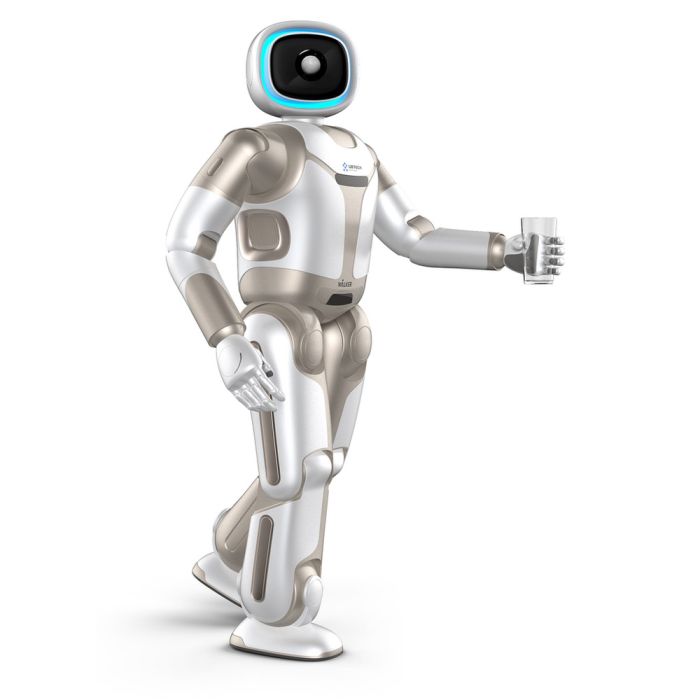
UBTECH Walker is a family of humanoid robots developed by UBTECH Robotics that targets human-centric environments—initially home and office assistance and later industrial and manufacturing scenarios. UBTECH describes the “Walker Robot” as a next-generation humanoid with 36 high-performance servo joints and multi-sensor perception (including force, vision, hearing, and spatial awareness) aimed at household and office use cases.
In stock
- PREKĖS ŽENKLAS:
- UBTECH
- DALIS NR.:
- Walker
- ORIGIN:
- Kinija
- AVAILABILITY:
- SUBJECT TO AVAILABILITY
- SKU:
- UBTECH-Walker
UBTECH Walker Humanoid Robot
The UBTECH Walker Humanoid Robot is a bipedal service robot developed by UBTECH as a step toward its stated goal of bringing robots into every home. Standing 145 cm tall and weighing 77 kg, the Walker combines 36 high-performance servo joints with sensory systems covering force, vision, hearing and spatial awareness. UBTECH positions the platform around two core competencies: smooth, fast walking and flexible, precise handling, both aimed at household and office scenarios. The robot carries its own compute onboard, runs a Linux-based software stack with ROS support, and ships with URDF and Gazebo simulation support so developers can validate behaviour in simulation before deploying it to hardware. This page consolidates the manufacturer's published information on the Walker into a single reference covering its background, specifications, capabilities, audience and procurement route.
Background
UBTECH is one of the more visible names in commercial humanoid robotics, and the Walker expresses a clear thesis: legged, human-shaped machines are a natural form factor for environments built around people. The programme reflects sustained work on actuation, balance and perception, packaged as a service robot rather than a research fixture.
From research platform to service humanoid
Many humanoid robots exist primarily as laboratory demonstrators. UBTECH frames the Walker differently — as a humanoid service robot intended for the spaces people actually occupy. The company describes the Walker as a step toward robots in every home, and the design decisions follow from that framing. Its 145 cm height keeps hands, cameras and torso at a scale compatible with tables, door handles and household objects, while its walking and manipulation systems are tuned for the cluttered, changeable layouts of homes and offices rather than structured factory floors. The emphasis throughout the official material is on usable competence: walking that is smooth and fast enough to be practical, and handling flexible and precise enough to matter.
An integrated full-body architecture
The Walker's 36 degrees of freedom are distributed the way a human's are: six joints per leg, seven per arm, four per hand and two in the neck. Each joint assembly integrates a frameless torque motor, harmonic reduction gearing, a drive controller and dual encoders. This servo architecture underpins the platform's advertised full-body flexibility, allowing coordinated whole-body motions in which legs, torso, arms and hands work together, and it supports the hand-eye coordination that guides the hands through manipulation tasks.
Technical Specifications
The table below summarises UBTECH's published Walker specifications.
| Attribute | Specification |
|---|---|
| Type | Humanoid service robot |
| Height | 145 cm |
| Weight | 77 kg |
| Total degrees of freedom | 36 (legs 6 x 2, arms 7 x 2, hands 4 x 2, neck 2) |
| Joint architecture | Frameless torque motor, harmonic reduction, drive controller, dual encoder |
| Single-arm load (extended) | 1.5 kg |
| Single arm span | 540 mm |
| Sensing | Force, vision, hearing, spatial awareness |
| Navigation | U-SLAM with autonomous path planning |
| Recognition | Face, object and scene recognition |
| Connectivity | Wi-Fi 802.11 a/b/g/n (5 GHz / 2.4 GHz), Ethernet RJ45, EtherCAT |
| Battery | Lithium iron phosphate, 54.6 V / 10 Ah, 6 kg |
| Charge time / usage time | 2 h charge, 2 h usage |
| Compute | Intel Core i7-7500U 2.7 GHz and Intel Core i5-6200U 2.3 GHz |
| Software stack | Ubuntu with Linux RT Preempt, ROS, Android |
| Simulation support | URDF model, Gazebo |
Specifications are drawn from the manufacturer's published materials and may change between hardware revisions; exact configuration should be confirmed during quotation.
How does the UBTECH Walker move and balance?
Locomotion is the Walker's defining discipline. Each leg's six joints are driven by integrated servo assemblies, while force sensing and spatial awareness help keep the robot stable as it walks. UBTECH highlights adaptive terrain capability — the Walker adjusts its gait to the surface underfoot instead of assuming a flat floor — and self-balancing with interference resistance, meaning the platform actively recovers its posture when pushed or bumped. These behaviours matter in homes and offices, where rugs, thresholds, cables and people complicate motion. Combined with U-SLAM navigation and autonomous path planning, the robot can map a space, choose its route and keep its footing along the way.
What can the Walker do with its hands?
Manipulation is the platform's second pillar. Each arm offers seven degrees of freedom with a 540 mm span, ending in a four-degree-of-freedom hand, and a single extended arm is rated for a 1.5 kg load. That envelope suits the light objects that dominate household and office work — cups, packages, switches and door handles — rather than heavy industrial payloads. Hand-eye coordination lets the vision system guide grasps and placements in real time, while full-body flexibility lets the torso and legs reposition to extend the arms' workspace. Face, object and scene recognition let the robot identify what it is looking at before acting on it, while multimodal interaction and smart home control extend its role into the connected environment.
Who is the UBTECH Walker Humanoid Robot for?
The Walker addresses buyers who need a complete, integrated humanoid rather than a collection of parts. Research institutions and university robotics departments are a natural audience: the platform pairs real hardware with Ubuntu, a real-time patched Linux kernel, ROS compatibility and URDF plus Gazebo simulation support — the toolchain academic teams already use. Corporate innovation and R&D groups evaluating humanoid robotics gain a working reference platform with documented specifications. Showrooms can field a walking, gesturing humanoid that demonstrates recognition and interaction live, and smart-building developers can use its device-control capability to prototype robot-integrated environments. It is a platform for organisations with technical capacity, not a plug-and-play consumer appliance.
What is the UBTECH Walker Humanoid Robot used for?
- Humanoid locomotion research, using the 36-joint platform to study bipedal gait, adaptive terrain response and balance recovery under real-world disturbance.
- Manipulation and hand-eye coordination development, exercising the seven-degree-of-freedom arms and four-degree-of-freedom hands on light household objects.
- Autonomous indoor navigation projects built on U-SLAM mapping and path planning in office and home-like layouts.
- Human-robot interaction studies that draw on face, object and scene recognition together with multimodal voice and vision interfaces.
- Smart home and smart office integration, where the robot acts as a mobile controller and physical agent for connected devices.
- Education, demonstrations and public engagement, presenting a full-size humanoid that walks, balances and interacts in front of an audience.
Pricing and Availability
Pricing for the UBTECH Walker Humanoid Robot is provided on a quotation basis rather than as a fixed list price. Configuration, accessories, logistics and support influence the final cost, so pricing and availability should be confirmed during quotation. Purchase details, quotation requests and configuration questions are handled on this page — submit an enquiry with your intended use case and location for a tailored offer.
Frequently Asked Questions
How tall and how heavy is the UBTECH Walker?
The Walker stands 145 cm tall and weighs 77 kg, dimensions chosen to suit human living and working spaces.
How many degrees of freedom does the Walker have?
It has 36 degrees of freedom in total: six per leg, seven per arm, four per hand and two in the neck, each using a frameless torque motor with harmonic reduction and dual encoders.
How long does the Walker run on a charge?
The lithium iron phosphate battery (54.6 V, 10 Ah, 6 kg) charges in about two hours and supports about two hours of usage per charge.
How much can the Walker carry in one hand?
A single arm is rated for a 1.5 kg load when extended, with a single arm span of 540 mm — suited to light household and office objects.
What software does the Walker run?
The platform runs Ubuntu with a Linux RT Preempt real-time kernel alongside ROS and Android, and ships with a URDF model and Gazebo simulation support.
Can the Walker navigate a building by itself?
Yes. U-SLAM navigation with autonomous path planning lets the robot map indoor spaces and plan its own routes, supported by adaptive terrain walking and self-balancing.
Where can I buy UBTECH Walker Humanoid Robot and what does it cost?
The Walker is available through this page. Pricing is quotation-based and depends on configuration and destination, so submit an enquiry here to receive current pricing and availability for your organization.
Summary
The UBTECH Walker Humanoid Robot packs 36 integrated servo joints, force and vision sensing, U-SLAM navigation and a ROS-ready Linux software stack into a single 145 cm, 77 kg service platform. It walks adaptively, balances against interference, manipulates light objects with coordinated hands and eyes, and controls the smart environment around it. For organizations comparing advanced humanoid platforms, this page is the starting point.