
Agilex Ranger Mini 3
In stock
- BRÄNDI:
- AGILEX
- OSA #:
- RANGER MINI 3
- ORIGIN:
- Kiina
- AVAILABILITY:
- SUBJECT TO AVAILABILITY
- SKU:
- AgileX-RANGER-MINI-3
Agilex RANGER MINI 3 (RANGER MINI 3)
The platform is commonly positioned as a “base” for autonomy projects (SLAM navigation, inspection, mobile manipulation, and sensor mapping) by providing a rugged chassis, standardized interfaces, and mechanical mounting points for payloads and sensor stacks. AgileX emphasizes rapid secondary development through modular expansion rails and CAN-bus connectivity, along with software resources intended for integration into larger robotics systems.
Design and Features
Omnidirectional, multi-mode mobility
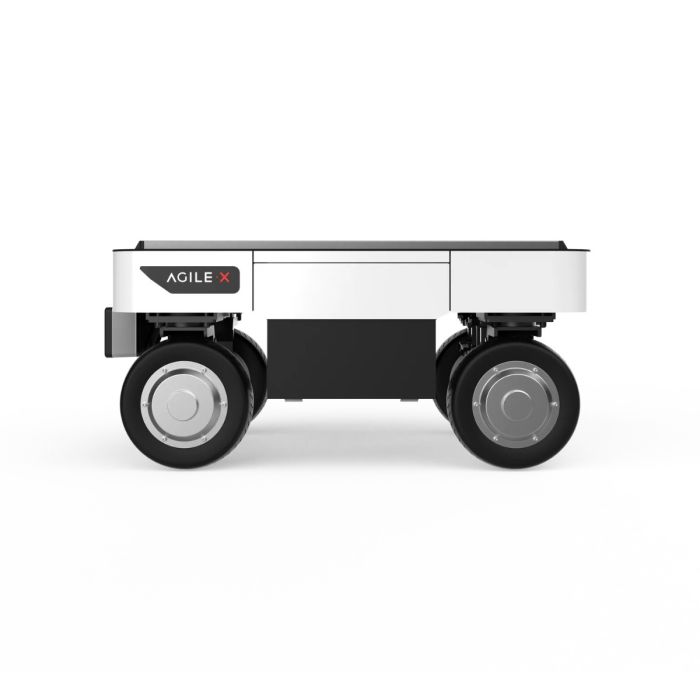
RANGER MINI 3’s core design feature is four-wheel independent steering + four-wheel drive, enabling multi-modal movement beyond standard Ackermann steering. Commercial listings describe modes including Spin mode (zero-radius), Traverse mode (sideways), Diagonal mode, and “Double Ackermann”-style steering for stable travel.
Industrial chassis and mounting provisions
AgileX markets the chassis for industrial use and highlights aluminum T-slot rails for mounting external sensors, compute modules, or payload kits. Some resellers also describe a robust, largely metal construction and protection for challenging environments, with dust-proofing and temperature performance claims included in marketing materials.
Suspension and terrain handling
The platform uses independent suspension (often described as a swing-arm / independent suspension design) to improve stability and traction across uneven surfaces. AgileX also positions it as capable across indoor/outdoor terrains, noting maneuverability and safety improvements on slopes.
Serviceability and hot-swappable power
A notable operational feature is hot-swapping support, intended to allow battery replacement without fully shutting down the system, improving uptime for continuous experiments or field work.
Technology and Specifications
Public reseller specs for Ranger Mini 3.0 commonly cite the following baseline parameters (values can vary by configuration, battery option, and region):
-
Payload: ~100 kg (often stated as the primary payload class)
-
Runtime: up to ~8 hours (marketing claim), with some listings stating 7–8 hours
-
Top speed: ~2.0 m/s (≈7.2 km/h)
-
Dimensions (L×W×H): 720 × 500 × 345 mm
-
Weight: ~75 kg
-
Ground clearance: ~105 mm
-
Gradeability: ~15° under load (commonly cited)
-
Ingress protection: IP54 is frequently listed by distributors for Ranger Mini 3.0
-
Battery: distributor specs commonly list 48V 24Ah LiFePO₄ (lithium iron phosphate)
-
Interfaces: CAN bus is highlighted for integration and expansion
AgileX also explicitly promotes development enablement through CAN bus support, “open-source SDK” references, and secondary development resources that align with typical robotics workflows (sensor fusion, autonomy stacks, and fleet management prototypes).
Applications and Use Cases
Research and education (ROS / autonomy development)
RANGER MINI 3 is often used as a research UGV platform for SLAM, perception, navigation, and motion planning—especially where an omnidirectional base improves corridor navigation, docking experiments, or tight turning behavior. Universities and labs commonly deploy platforms like this for:
-
LiDAR or RGB-D mapping and localization
-
ROS/ROS 2 navigation experiments
-
Multi-sensor calibration and benchmarking
-
Reinforcement learning and dataset collection (indoor/outdoor)
Industrial inspection and monitoring
Industrial positioning focuses on mobile inspection tasks such as:
-
Route-based facility inspections (warehouses, plants, campuses)
-
Environmental monitoring payloads (air quality, thermal, acoustic)
-
Security patrol prototypes and teleoperation
The chassis’s payload class and mounting rails support integration of heavier sensor heads, compute enclosures, or inspection payloads compared with hobby-grade bases.
Mobile manipulation and “base for a robot arm”
Because the platform is designed as a development base, it is frequently paired with a small robotic arm or custom end-effector payload to create a mobile manipulator for R&D demonstrations—e.g., pick-and-place trials, remote handling, or lab logistics prototypes (where permitted by the integration’s safety design).
Advantages and Benefits
RANGER MINI 3’s value proposition is typically described in terms of chassis capability and integration readiness:
-
High maneuverability: multi-mode steering enables motion patterns that simplify docking, aisle navigation, and precise repositioning.
-
Industrial payload class: “~100 kg” payload positioning supports heavier sensor stacks and prototype payloads than many small UGV bases.
-
Development-friendly expansion: T-slot rails and CAN connectivity support structured integration of sensors and kits.
-
Operational uptime features: hot-swapping support is marketed to reduce downtime in continuous operations.
-
Outdoor-capable design cues: IP54 listings and temperature claims appear in distributor and manufacturer materials.
Ranger Mini 3.0 vs other small UGV bases
Compared with simpler skid-steer or differential-drive bases, an omnidirectional 4-wheel-steer platform tends to prioritize precision maneuvering and kinematic flexibility over minimal complexity. AgileX explicitly frames Ranger Mini as blending agility and robustness for mixed environments.
FAQ
What is the AgileX RANGER MINI 3?
The AgileX RANGER MINI 3 (Ranger Mini 3.0) is a compact, omnidirectional UGV mobile robot chassis designed for industrial and research applications, providing multi-mode mobility, payload capacity, and integration interfaces for autonomy development.
How does the RANGER MINI 3 work?
It uses four-wheel independent steering and drive-by-wire control, enabling multiple steering modes (including zero-radius rotation and lateral movement). This architecture supports precise maneuvers and stable indoor/outdoor travel when paired with appropriate control software.
Why is the RANGER MINI 3 important?
It functions as a ready-to-integrate robotics base—reducing the time required to prototype inspection robots, autonomy research platforms, and mobile manipulation systems. Features like expansion rails, CAN bus support, and marketed hot-swapping are intended to support iterative development and higher uptime.
What are the benefits of the RANGER MINI 3?
Commonly cited benefits include omnidirectional maneuverability, an approximately 100 kg payload class, up to ~8 hours runtime claims, and integration-focused design (T-slot rails and CAN bus), making it suitable for indoor/outdoor R&D and industrial prototyping.
Summary
AgileX RANGER MINI 3 is a compact omnidirectional UGV platform built around four-wheel independent steering, aiming to combine tight-space maneuverability with an industrial payload class. With widely cited specs around 100 kg payload, ~8 hours runtime, ~2.0 m/s speed, CAN bus connectivity, and expansion-friendly mechanical rails, it is positioned as a practical base for ROS/ROS2 autonomy development, inspection prototypes, and mobile robotics research.
Specifications
| OSA # | RANGER MINI 3 |
|---|---|
| ROBOT TYPE | UNMANNED GROUND VEHICLE |
| ROBOT USE | INDUSTRIAL |
| BRÄNDI | AGILEX |