
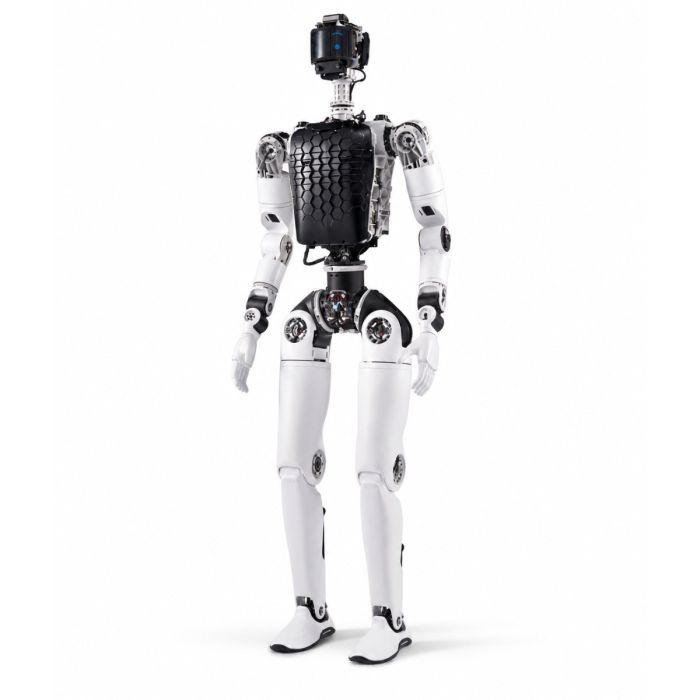
FF Futurist Full-Size Humanoid Robot
In stock
- MERKKI:
- Faraday Future
- MALLI:
- FUTURIST
- ORIGIN:
- Yhdysvallat
- AVAILABILITY:
- PRE-ORDER
- SKU:
- FF-Futurist
FF Futurist
Read it as a résumé and the machine makes sense. Height: five foot eight. Weight: 121 pounds. Endurance: a six-hour shift without a break. Athletics: a genuine run at 11 miles per hour — not the cautious shuffle most of the category calls locomotion. Continuing education: new abilities acquired by download. The FF All-New Futurist is Faraday Future's full-size humanoid presented exactly this way — as an "all-in-one professional expert," a hire rather than a gadget — and the June 2026 launch gave the claims numbers. A new T-shaped structural architecture cuts 14 percent of its predecessor's weight while improving stability and producing a more natural, human-like walking posture; 31 degrees of freedom articulate the body before the hands are counted; the knees deliver 320 newton-metres of peak torque — the reserve that separates running, climbing and recovering from merely balancing; each arm lifts around five kilograms; and a 1,152-watt-hour dual-battery system triples the previous generation's endurance to roughly six hours of continuous work. Its motion intelligence is a declared American first: the Futurist natively runs NVIDIA's SONIC whole-body motion control system as its cerebellum, and the Futurist Ultra, arriving with NVIDIA Jetson Thor computing and autonomous charging, extends the platform into complex, long-duration, high-intensity professional missions with enhanced real-time reasoning, multi-sensor fusion and autonomous task execution.
The FF Futurist is available for purchase internationally through this page, with delivery, customs clearance and after-sales support arranged for buyers across the Americas, Europe, the Middle East, Asia-Pacific and worldwide.
Background
An EV company's idea of a humanoid
The Futurist is what a humanoid looks like when a vehicle manufacturer designs it. Faraday Future — the NASDAQ-listed Los Angeles company behind the FF 91 — brought automotive engineering habits to the platform: battery architecture treated as a headline system (hence the dual-pack, six-hour figure in a category where two hours is common), structural weight attacked the way carmakers attack it (the 14-percent reduction with increased stability), and drive torque specified with margin rather than minimum (320 newton-metres at the knee). The same company's "Device, Data, EAI Brain" flywheel supplies the software side: every delivered Futurist contributes operating data that trains the shared brain, capabilities return to the fleet as downloadable Skills, and developers build on the open platform through the SDK, APIs and tools FF launched alongside the robot. Demonstrations have been pointedly practical — sorting supermarket shelves stocked with objects of different shapes, weights and materials, the unglamorous variety problem that decides whether humanoids are useful.
Two trims, one platform
FF ships the platform in a working pair. The standard All-New Futurist, with SONIC as its motion cerebellum, is the accessible professional machine — full-size, full-speed, bundled at launch with a premium Skills package, and aimed squarely at research groups, integrators and commercial operators building their first serious humanoid programmes. The Futurist Ultra is the endurance professional: NVIDIA Jetson Thor computing raises onboard reasoning and multi-sensor fusion for autonomous task execution, and self-directed charging removes the human from the energy loop, suiting deployments where the robot works long, complex and unattended. The pair share the body, the ecosystem and the Skills library — a programme can start on the standard trim and scale into Ultra missions without changing platforms.
Technical Specifications
| Parameter | FF All-New Futurist |
|---|---|
| Type | full-size professional EAI humanoid robot |
| Launched | June 2026 (specification debut 16 June; commercial launch at Automate Chicago, 22 June) |
| Height | ~5 ft 8 in (~173 cm) |
| Weight | ~121 lb (~55 kg); ~14% lighter than previous generation |
| Structure | new T-shaped architecture — improved stability, human-like walking posture |
| Degrees of freedom | 31 across the body, excluding hands |
| Peak knee-joint torque | 320 N·m |
| Top speed | ~11 mph (~17.7 km/h) — true running capability |
| Arm capacity | ~11 lb (~5 kg) per arm; dual-arm coordination for heavier or delicate tasks |
| Battery | 1,152 Wh dual-battery system |
| Runtime | up to ~6 hours continuous (3× previous generation) |
| Motion control | native NVIDIA SONIC whole-body motion control ("cerebellum") — cited U.S. first for a full-size humanoid |
| Ultra variant | NVIDIA Jetson Thor compute; autonomous charging; enhanced real-time reasoning, multi-sensor fusion, autonomous task execution |
| Software ecosystem | downloadable Skills packages; open developer platform with SDK/API and developer tools |
| Intended applications | academic research, commercial applications, real-world deployment |
Hand configurations, sensor details and further engineering figures are confirmed against the current datasheet at quotation; Ultra availability follows its release event.
Why does running matter?
Because it is the honest test of everything underneath. A humanoid that only walks can hide weak torque, marginal balance and conservative control inside a careful gait; a humanoid that runs at 11 miles per hour cannot hide anything — flight phases, impact absorption and recovery demand exactly the 320-newton-metre knees, the lightweight rigid structure and the whole-body coordination the Futurist specifies. For buyers the speed itself is rarely the point; the headroom is. A platform with running-grade dynamics walks with margin: it recovers from bumps and slips that topple timid machines, carries loads without gait degradation, and executes fast, confident transitions in real environments. Pair that physical reserve with SONIC's motion intelligence and six hours of battery, and the Futurist's professional framing stops being marketing — it is a machine specified to keep working through conditions that end a demonstration robot's day.
Who is the FF Futurist for?
For university and institutional research groups, the draw is the stack: a full-size, running-capable platform with native SONIC control, an open SDK and a data-connected brain is a whole-body-control and manipulation laboratory delivered assembled — with FF's education ecosystem, developer tools and foundation-model work layered above it. For commercial operators — venues, brands, retail and service pilots — the Futurist offers full human presence with the endurance to hold a six-hour engagement and a Skills library that converts new use cases into downloads rather than development projects. For integrators and early industrial adopters, the shelf-sorting lineage and the Ultra's autonomous-charging, Thor-powered configuration point at real task deployment. And for North American buyers specifically, it carries a rare passport: a full-size professional humanoid from a U.S.-listed, California-based manufacturer, sold and supported as an American product. Buyers sizing downward will find FF's Master and Nova humanoid lines beside it; buyers needing wheels-and-arms industrial work, the Faber manipulators.
What is the FF Futurist used for?
- Academic research: whole-body motion control, manipulation and embodied-AI development on a SONIC-native, SDK-open platform.
- Commercial service and presence: full-size hosting, demonstration and engagement roles with six-hour working endurance.
- Task and manipulation pilots: varied-object handling programmes in retail, logistics and light industry — dual-arm work up to human-parcel weights.
- Autonomous professional missions: long-duration, high-intensity deployments on the Jetson Thor-powered, self-charging Futurist Ultra.
- Skills and application development: building, testing and distributing capabilities through FF's open developer platform and Skills marketplace.
- Education programmes: flagship hardware within FF's robotics education ecosystem, from university labs to institutional training.
Pricing and Availability
The FF Futurist is available for purchase and international delivery through this page, from single research units to multi-robot commercial and institutional programmes, with the Futurist Ultra quoted as its release schedule opens. The platform is list-priced by the manufacturer with a bundled premium Skills package, and final pricing, configuration, software and Skills provisioning, training and delivery timeline are confirmed by individual quotation; delivery, customs clearance and after-sales support are arranged worldwide. Purchase enquiries, datasheets and availability details for the FF Futurist are available on this page.
Frequently Asked Questions
What is the FF Futurist?
Faraday Future's full-size professional humanoid robot — the All-New Futurist — launched in June 2026: approximately 173 centimetres and 55 kilograms, with 31 body degrees of freedom, true running capability and up to six hours of continuous operation, positioned as an "all-in-one professional expert" for research, commercial and real-world deployment.
How fast and how strong is it?
It runs at up to about 11 miles per hour on knees producing 320 newton-metres of peak torque, lifts roughly five kilograms per arm — with both arms coordinating on heavier or more delicate work — and carries its 55-kilogram frame on a T-shaped structure engineered for stability and a natural gait.
How long does it operate?
Up to around six hours of continuous work from its 1,152-watt-hour dual-battery system — triple the previous generation — with the Futurist Ultra adding autonomous charging so the robot manages its own energy cycles.
What is special about its motion control?
It is the first full-size humanoid in the United States to natively support NVIDIA's SONIC whole-body motion control system, which serves as the robot's cerebellum — coordinating balance, gait and full-body movement beneath the higher-level AI.
What does the Ultra version add?
NVIDIA Jetson Thor high-performance computing and autonomous charging — raising real-time reasoning, multi-sensor fusion and autonomous task execution for more complex, longer-duration and higher-intensity professional applications, with its release following later in the year.
How does it learn new tasks?
Through Faraday Future's Skills ecosystem: capabilities developed once — by FF or by the open developer community through the SDK and APIs — are distributed as downloadable Skills packages, and fleet operating data continuously trains the shared EAI brain behind every unit.
Where can I buy the FF Futurist and what does it cost?
The FF Futurist is available through this page, with delivery, customs clearance and after-sales support arranged for buyers worldwide. As a list-priced platform with bundled Skills provisioning and an Ultra variant pending release, buyers should request an individual quotation. All purchasing details are available on this page.
Summary
The FF Futurist reads like a job application and performs like one accepted: full adult height on a lightened, stiffened frame, knees with sprint-grade torque, a genuine 11-mile-per-hour run, five-kilogram hands at the end of coordinated arms, and a six-hour battery that treats work as a shift rather than a demo. NVIDIA SONIC gives it an American-first cerebellum, the Skills marketplace gives it a career path, and the Ultra — Thor-powered, self-charging — gives the platform its professional ceiling. Built by a listed California vehicle company that specifies robots the way it specified cars, it is the U.S. market's clearest answer to the question of what a working full-size humanoid should cost in effort to own: less every month. For labs, venues and operators hiring their first full-size professional, this page is the starting point.