Kepler Humanoid Robot (Humanoid Robot)
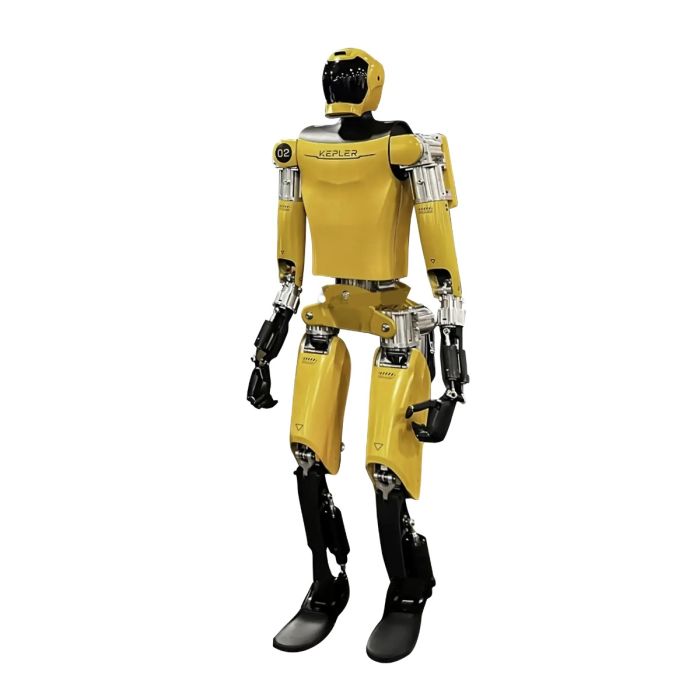
In stock
- VÖRUMERKI:
- KEPLER
- HLUTI #:
- Humanoid Robot
- ORIGIN:
- Kína
- AVAILABILITY:
- SUBJECT TO AVAILABILITY
- SKU:
- Kepler-Humanoid-Robot
Kepler Humanoid Robot (Humanoid Robot)
Humanoid Robot (Humanoid Robot)
Kepler’s humanoid strategy emphasizes a combination of human-like manipulation (dexterous, sensorized hands), full-body mobility, and an AI/software approach that blends embodied control with data-driven learning methods (imitation learning and reinforcement learning) to acquire task skills for defined scenarios.
Design and Features
Humanoid form factor aimed at “blue-collar” tasks
Across press releases and media reporting, Kepler’s K2 line is consistently framed as “industrial-first”—designed for repeatable work in structured environments rather than purely demonstrative robotics.
This typically prioritizes:
-
robust actuation and maintainability
-
long duty-cycle operation
-
consistent manipulation performance (grasping, carrying, handling)
Dexterous hands with tactile sensing
A signature capability highlighted in independent coverage is the K2’s five-finger hands and fingertip sensing. Reporting describes “rope-driven” five-digit hands with 11 degrees of active and passive freedom and tactile sensor arrays at the fingertips (reported as 96 contact points per fingertip in one account).
This design is intended to support grasp stability, object handling, and interaction tasks common in logistics and production-line workflows.
Maintainability and modularity considerations
New Atlas notes design choices such as a star-shaped wiring layout to simplify upgrades and maintenance, and mentions improved rigidity and manufacturability in the arms and legs relative to earlier iterations.
These are typical engineering priorities for robots intended to move from prototypes toward broader deployment.
Technology and Specifications
Because “Kepler Humanoid Robot” is an umbrella term used across models and variants, specifications are most consistently published for the Forerunner K2 and the K2 “Bumblebee” variant as described in press materials and coverage.
Core size and kinematics
Multiple sources report K2 variants with:
-
52 degrees of freedom (DOF) across the body
-
K2 “Bumblebee”: 175 cm tall, 75 kg weight, and “more than 80 integrated sensors” (press/coverage descriptions)
Separately, Kepler’s own product page for the Forerunner series mentions a “highly bionic humanoid structure and motion control” and states “up to 40 degrees of freedom in the whole body” for the referenced product page, suggesting that different models/configurations may be marketed with different DOF counts.
Payload and manipulation capacity
New Atlas reports that each hand “can heft up to 15 kg (33 lb)” for the Forerunner K2, a figure frequently repeated in broader discussion of the platform’s strength-oriented positioning.
(As with most humanoids, achievable payload depends on reach, pose, grasp quality, and motion profile; buyers typically validate against the exact configuration and safety limits for the intended task.)
Power system and duty cycle
A widely cited figure for the Forerunner K2 is a 2.33 kWh battery and up to 8 hours of per-charge operation in the context of shift-style usage.
This aligns with Kepler’s overall industrial narrative: long duty cycles and practical facility use.
Compute and autonomy positioning
For the K2 “Bumblebee,” press materials describe onboard compute up to 100 TOPS, intended to support autonomous execution of task sequences in structured environments.
Public reporting also highlights improvements to “vision system and navigation software” and positions the K2 as capable of rapidly reacting in complex environments.
Learning and control approach
Kepler’s K2 is explicitly described as combining a cloud-based cognitive model with an embodied control system, using both imitation learning and reinforcement learning for skill acquisition—framed as a pathway to autonomous completion of tasks in specific scenarios and to human–robot cooperation.
Applications and Use Cases
Warehousing and logistics
Kepler’s stated and reported target domains for the Forerunner K2 include warehousing and logistics operations, where humanoid manipulation can be applied to handling bins, parcels, and materials—especially in facilities designed around human-scale tools and workflows.
Intelligent manufacturing and production-line support
Coverage positions K2 as “destined for production lines” and highlights customer-site evaluations involving materials handling and quality-control-related activities.
Typical pilot tasks in this category can include part transfer, kitting, workcell assistance, and structured assembly steps (subject to integration and safety engineering).
High-risk inspection and maintenance
Media reporting lists high-risk inspections/maintenance as a target application area, reflecting a common motivation for humanoids: reducing human exposure in hazardous or hard-to-access operational contexts.
Research, education, and embodied AI development
Both independent reporting and press materials position K2 variants for research and education, especially where teams want a full-size humanoid to evaluate perception, grasp planning, human–robot interaction, and skill learning under real-world constraints.
Advantages / Benefits
Human-compatible manipulation in human-built spaces
A key rationale for humanoid platforms is that many workplaces—shelves, tools, carts, fixtures—are designed for human proportions and grasp patterns. Kepler’s emphasis on dexterous hands and tactile sensing is aligned with that goal.
Industrial emphasis on duty cycle and maintainability
Claims around an 8-hour duty cycle on a 2.33 kWh battery, along with design notes about easier maintenance and wiring/layout choices, signal an effort to move beyond demos toward operational pilots.
Skill acquisition approach for scaling task libraries
Kepler’s published framing around imitation + reinforcement learning suggests a strategy of building reusable “skills” that can be tuned for specific workflows and gradually generalized—an approach many robotics teams use to scale deployments across similar facilities.
FAQ Section
What is Kepler Humanoid Robot?
Kepler Humanoid Robot generally refers to the humanoid robots developed by Kepler Robotics, especially the Forerunner K-series (including K2 and K2 “Bumblebee”), designed for industrial work such as logistics, manufacturing assistance, and research.
How does Kepler Humanoid Robot work?
Kepler’s K2 line combines a humanoid body (reported 52 DOF) with dexterous, tactile hands and an autonomy approach that blends an embodied control system with a cloud-based cognitive model, using imitation learning and reinforcement learning to learn task skills for specific scenarios.
Why is Kepler Humanoid Robot important?
It targets practical automation in human-designed environments—warehouses and production lines—where dexterous manipulation and human-compatible reach can reduce manual handling and enable new forms of flexible automation. Kepler’s published positioning emphasizes industrial settings and autonomous task execution in structured environments.
What are the benefits of Kepler Humanoid Robot?
Reported benefits include dexterous, tactile manipulation (hands with tactile sensor arrays), industrial-oriented design updates for maintainability, and a duty-cycle narrative (2.33 kWh battery, up to ~8 hours) aimed at shift-style operation.
How strong is the Kepler K2 humanoid?
Independent reporting describes the K2’s tactile manipulators as capable of lifting up to 15 kg (33 lb) per hand, positioning it as a strength-forward humanoid for commercial pilots.
Summary
Kepler Humanoid Robot is best understood as the Forerunner humanoid line from Kepler Robotics, with public attention focused on the Forerunner K2 and the K2 “Bumblebee” industrial variant. Reporting and press materials describe a humanoid platform built for commercial deployment—combining dexterous, tactile hands, a body with 52 DOF (for K2 variants), and an AI approach that uses imitation and reinforcement learning to develop task skills for structured industrial settings.
Specifications
General
What's included
Related Products
Out of stock