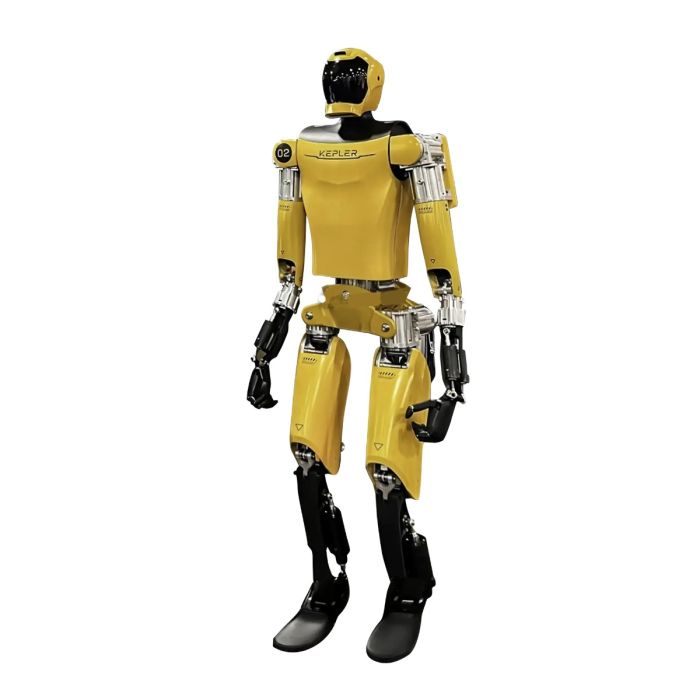
Kepler K2 Hornet Humanoid Robot
In stock
- VÖRUMERKI:
- KEPLER
- HLUTI #:
- K2 Hornet
- ORIGIN:
- Kína
- AVAILABILITY:
- SUBJECT TO AVAILABILITY
- SKU:
- Kepler-K2-Hornet
Kepler K2 Hornet Humanoid Robot
K2 Hornet Humanoid Robot (K2 Hornet)
Positioned as a general-purpose, full-size humanoid for industrial and commercial environments, the K2 platform is presented as suitable for tasks such as materials handling, inspection/patrol workflows, and structured operations in manufacturing and logistics settings. Company announcements emphasize both deployment readiness and an approach that combines on-robot control with cloud-supported learning and planning for embodied intelligence.
Design and Features
Humanoid form factor and industrial orientation
The K2 platform is described as “purpose-built” for real-world industrial integration, including navigation in complex spaces (e.g., factory floors and logistics centers) and repeatable task execution. Its demonstrations at major robotics and technology events are frequently framed around workplace applicability rather than entertainment or consumer use.
Dexterous hands and tactile sensing
A central feature of the K2 platform is its rope-driven five-finger hands, described as tactile manipulators intended for grasping and manipulation. Public descriptions report up to 11 degrees of freedom per hand (active and passive) and tactile sensing at the fingertips with up to 96 contact points per fingertip, which is presented as improving fine manipulation and contact-rich tasks (e.g., handling objects with varying shapes and stiffness).
Maintainability-oriented layout
Coverage and releases describe design choices aimed at servicing and upgrades, including a star-shaped wiring layout intended to simplify routing and connections and improve maintainability in production contexts.
Technology and Specifications
Because “K2 Hornet” appears as a commercial listing name while broader media and company releases often use “Forerunner K2” or “K2 Bumblebee,” the most consistently reported specifications are tied to the K2 platform generally.
Mobility, actuation, and gait
Company communications describe a hybrid actuation approach combining roller screw linear actuators with rotary actuators, and highlight a more “human-like” straight-knee gait as part of its mobility strategy. This architecture is positioned as relevant to stability, precision, and industrial durability.
Degrees of freedom and manipulation capacity
Multiple reports describe the K2 platform as having 52 degrees of freedom across the body, supporting complex whole-body motions and coordinated manipulation.
For load handling, official and media coverage commonly reports:
-
Up to 15 kg payload per arm/hand (often expressed as “single-hand load capacity”)
-
Up to 30 kg dual-arm payload for carrying/loading/unloading tasks in industrial workflows
Power and endurance
The K2 platform is widely reported to use a 2.33 kWh battery and to target up to 8 hours of operation per charge, aligning with the “full shift” framing used in workplace automation. Support for direct and automated charging is also cited in coverage and releases.
Perception, navigation, and embodied intelligence software
Company announcements describe improvements in:
-
visual perception and autonomous navigation, intended to support real-time scene understanding and fast reactions in complex environments
-
dynamic perception, task planning, coordinated control, and autonomous learning, including skill acquisition via imitation learning and reinforcement learning
Later communications also reference a developer-oriented direction (including platform tooling and simulation/digital twin concepts) aimed at accelerating application development and deployment.
Applications and Use Cases
Manufacturing and production support
The K2 platform is positioned for structured industrial tasks such as material movement, handling, and assistance on production lines, where repeatability and safety controls are critical. Company materials reference tasks like sorting and assembly as representative examples of semantic-command-driven execution.
Warehousing and logistics
Logistics and warehousing are among the most frequently cited target domains, emphasizing navigation in crowded facilities, carrying/transfer tasks, and workflow integration (e.g., loading/unloading and internal transport).
High-risk operations and inspection
Public descriptions also place the K2 platform in high-risk inspection/maintenance scenarios, where a humanoid form may be beneficial for navigating human-built spaces, using tools, or operating around infrastructure designed for people.
Research, education, and demonstrations
Alongside industrial use, the robot is discussed for research and education, especially where developers may want a full-size embodied system for manipulation, locomotion, and human–robot interaction studies.
Advantages / Benefits
Human-compatible workspace access
A key rationale for full-size humanoids in industry is their potential to work in environments already optimized for human workers—stairs, doors, corridors, and tool stations—without requiring a complete redesign of facilities.
Dexterous manipulation with tactile feedback
The emphasis on multi-DOF hands and fingertip tactile sensing supports use cases where object variability (shape, friction, compliance) makes rigid grippers less capable, particularly for mixed-item handling or delicate operations.
Shift-length endurance targets
The combination of a reported 2.33 kWh battery and “up to 8 hours” endurance aligns the platform with shift-based planning and reduces operational friction compared to shorter-duration robots that require frequent charging pauses.
Commercialization and scaling narrative
Company announcements emphasize a move toward broader commercial rollout, including pricing claims and large framework agreements, signaling an intent to compete on cost and scale (though real-world pricing varies by region, configuration, and support terms).
FAQ Section
What is the Kepler K2 Hornet Humanoid Robot?
The Kepler K2 Hornet is a commercial listing name associated with Kepler’s K2 humanoid robot platform (also referred to publicly as Forerunner K2 or K2 “Bumblebee”), designed for industrial and commercial tasks such as logistics handling, manufacturing support, and inspection workflows.
How does the K2 Hornet humanoid robot work?
The K2 platform combines whole-body motion control with perception and task software described as “embodied intelligence,” including dynamic perception, planning, and skill learning using imitation and reinforcement learning. Hardware descriptions emphasize hybrid actuation (roller screw linear plus rotary actuators) and dexterous, tactile-sensing hands for manipulation.
Why is the K2 Hornet important for industrial automation?
Humanoid robots like the K2 are promoted as a way to automate tasks in human-built facilities—factories, warehouses, and service corridors—without fully redesigning the environment. The K2 platform specifically highlights payload capacity (reported up to 15 kg per arm; 30 kg dual-arm) and shift-length operation targets as key enablers for practical deployment.
What are the benefits of the Kepler K2 Hornet humanoid robot?
Commonly cited benefits of the K2 platform include dexterous hands with tactile sensing (reported up to 96 contact points per fingertip), shift-oriented endurance targets (often reported up to 8 hours), and industrial payload claims (up to 15 kg per arm; 30 kg dual-arm), aimed at practical workflows like carrying, sorting, and assisted operations.
Summary
The Kepler K2 Hornet (K2 Hornet) is best understood as a sales name associated with Kepler’s K2 humanoid robot platform, which is publicly presented as an industrial, general-purpose humanoid for logistics, manufacturing, inspection, and research. Reported highlights include 52 degrees of freedom, tactile, multi-DOF hands, up to 15 kg per arm (30 kg dual-arm) payload claims, and an up to 8-hour operating target supported by a 2.33 kWh battery—features intended to make humanoid automation viable in real commercial environments.
Specifications
General
What's included
Related Products
Out of stock