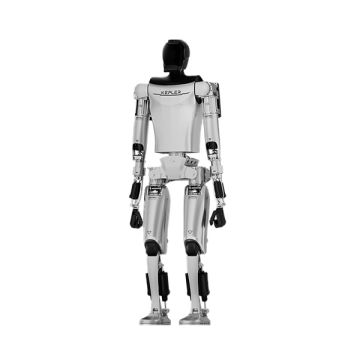
The Kepler K2 Hornet Wheeled (often listed as “K2 Hornet Wheeled Humanoid Robot”) is a wheeled humanoid robot configuration associated with Shanghai Kepler Robotics Co., Ltd.’s K2 humanoid product line. Public information indicates that “Hornet” is used as a model name within the K2 family, while the “Wheeled” variant refers to a configuration that emphasizes stable, energy-efficient mobility on a wheeled base rather than bipedal walking.
In general terms, Kepler’s K2 humanoids have been presented as commercial and industrial humanoid robots intended for tasks such as logistics handling, sorting, production-line assistance, inspections, and research/education—with the K2 introduced publicly at technology exhibitions and in media coverage describing its industrial orientation and high-payload manipulation.
Design and Features
Wheeled humanoid architecture
Wheeled humanoid robots combine a human-like upper body (for manipulation and tool use) with a wheeled base optimized for stability, simpler balancing requirements, and efficient indoor movement. This form factor is commonly chosen when the operating environment is primarily flat (warehouses, factories, campuses) and when uptime and predictable mobility are more important than stair-climbing.
The “K2 Hornet Wheeled” name used by multiple distributors explicitly categorizes the robot as a WHEELED HUMANOID, indicating this architectural emphasis.
Industrial positioning: payload and work-cycle focus
Media coverage of Kepler’s K2 emphasizes industrial task execution, including manipulation strength and long shift-style operation. For example, reporting on the K2 family highlights payload capacity per hand and describes the robot as intended for production lines and logistics environments.
Separately, event reporting and industry roundups describing the “K2 Hornet” messaging emphasize fast charging and long working duration (commonly framed as “charge for one hour, work for eight hours”), suggesting a design goal of shift-length deployments in controlled commercial scenarios.
Learning and control approach: cloud + on-robot execution
Public descriptions of Kepler’s K2 positioning repeatedly reference an AI stack that blends cloud-based cognition/planning with on-robot control, and the use of imitation learning and reinforcement learning to acquire task skills.
In practice, these approaches are typically used to (1) collect demonstrations, (2) train policies in simulation or controlled environments, and (3) deploy validated behaviors on physical robots for repetitive tasks.
Technology and Specifications
Because the “K2 Hornet Wheeled” variant is often sold via quotation, public spec detail is uneven. However, reputable coverage of the K2 family includes the following reference points:
Core physical characteristics (K2 family reference)
-
Height: commonly reported around ~178 cm (5'10") for the K2 humanoid family.
-
Mass: media and catalog references vary (often ~85 kg reported).
Manipulation and payload (K2 family reference)
-
Media coverage describes the K2 as capable of lifting roughly 33–35 lb (~15–16 kg) per hand in demonstrations/claims, positioning it as a higher-strength humanoid in its class.
Power and duty cycle (K2 family reference)
-
Reporting has described a 2.33 kWh battery pack and a target of up to ~8 hours of operation per charge in certain contexts, aligned with “shift-length” messaging.
-
Industry/event summaries associated with “Hornet” branding echo “fast charge + long runtime” claims (e.g., “1 hour charging, 8 hours continuous work”).
Actuation approach (K2 family reference)
-
Kepler’s K2 line is frequently associated in coverage with planetary roller screw actuators (and related industrial actuator choices) intended to deliver high torque, precision, and robustness for commercial tasks.
What is confirmed specifically for “K2 Hornet Wheeled”?
Distributor pages confirm the model naming and category (“wheeled humanoid”), but do not consistently publish detailed technical tables (payload, DOF, sensors, compute) on the product listing itself.
For procurement, the most reliable path is typically an official quotation package or datasheet tied to the exact Hornet Wheeled SKU.
Applications and Use Cases
Logistics handling and sorting pilots
Kepler’s K2 demonstrations and industrial messaging frequently focus on logistics tasks—moving items, sorting parcels, and handling loads in controlled warehouse-like spaces.
A wheeled K2 variant is especially aligned with logistics facilities where aisles are flat and navigation is structured.
Manufacturing support and workcell assistance
A wheeled humanoid can be used as a flexible “mobile operator” for tasks such as:
-
fetching tools and parts,
-
tending fixtures,
-
moving bins between stations,
-
assisting with staged assembly steps.
This fits the broader K2 framing as a commercial humanoid destined for production environments.
Hazardous-area and inspection workflows
General K2 positioning also includes use in higher-risk settings where a remotely supervised robot can reduce human exposure—though actual suitability depends on safety features, certification, and environmental protection ratings that are not consistently disclosed publicly for the Hornet Wheeled variant.
Research and embodied AI development
Like other humanoid platforms, K2 variants are often evaluated as embodied AI testbeds: collecting real-world interaction data, training manipulation skills, and benchmarking perception + control stacks on a full-size robot.
Advantages / Benefits
Efficient mobility on flat terrain
A wheeled base typically delivers higher runtime per battery, smoother indoor navigation, and simpler stability constraints compared with biped walking—useful for facilities with ramps and flat floors.
Strong industrial emphasis
K2 media coverage highlights meaningful load handling and a design goal of industrial work, making the platform relevant for pilots where payload and reliability are prioritized.
Scalable “skills” approach
The use of imitation learning + reinforcement learning and cloud-linked training narratives indicates a roadmap toward scaling task libraries—particularly relevant in repetitive industrial scenarios where narrowly defined skills can provide early ROI.
FAQ Section
What is the Kepler K2 Hornet Wheeled Humanoid Robot?
The Kepler K2 Hornet Wheeled is a wheeled humanoid robot listed as part of Kepler’s K2 humanoid family, intended for commercial scenarios such as logistics, industrial pilots, and robotics R&D.
How does the Kepler K2 Hornet Wheeled work?
It uses a wheeled base for stable mobility and a humanoid upper body for manipulation, aligning with a common “mobile manipulation” approach. Kepler’s K2 line is publicly described as combining AI training methods (imitation learning and reinforcement learning) with an autonomy/control stack intended for task execution in defined scenarios.
Why is the K2 Hornet Wheeled important?
Wheeled humanoids are important because they can deliver humanoid-style manipulation while remaining energy-efficient and stable for indoor facilities. This makes them practical candidates for early-stage commercialization in warehouses, factories, and structured campuses.
What are the benefits of the K2 Hornet Wheeled?
Key benefits associated with the wheeled K2 concept include stable indoor navigation, potential longer duty-cycle operation compared to biped-only approaches, and positioning toward industrial manipulation tasks (handling, sorting, moving items) highlighted in K2 coverage.
How long can it run, and how fast does it charge?
Public “Hornet” messaging around the K2 line emphasizes fast charging and long runtime (commonly framed as “charge for one hour, work for eight hours”), though exact runtime depends on configuration, task intensity, and environment and should be verified for the Hornet Wheeled variant.
Summary
The Kepler K2 Hornet Wheeled is best understood as a wheeled humanoid configuration tied to Kepler’s K2 industrial humanoid line—aimed at mobile manipulation in structured indoor environments such as logistics and manufacturing. Public sources consistently confirm the model naming and wheeled category, while broader K2 coverage emphasizes industrial task execution, strength-oriented manipulation, and shift-length runtime goals. For procurement or deployment planning, the most important next step is obtaining an official specification sheet and configuration quote for the exact “Hornet Wheeled” SKU to confirm payload, sensors, compute, safety features, and support terms.