
Noetix HOBBS Bionic Robot (HOBBS)
In stock
- MERKI:
- NOETIX
- HLUTI #:
- HOBBS
- ORIGIN:
- Kína
- AVAILABILITY:
- SUBJECT TO AVAILABILITY
- SKU:
- Noetix-HOBBS
HOBBS Bionic Robot (HOBBS)
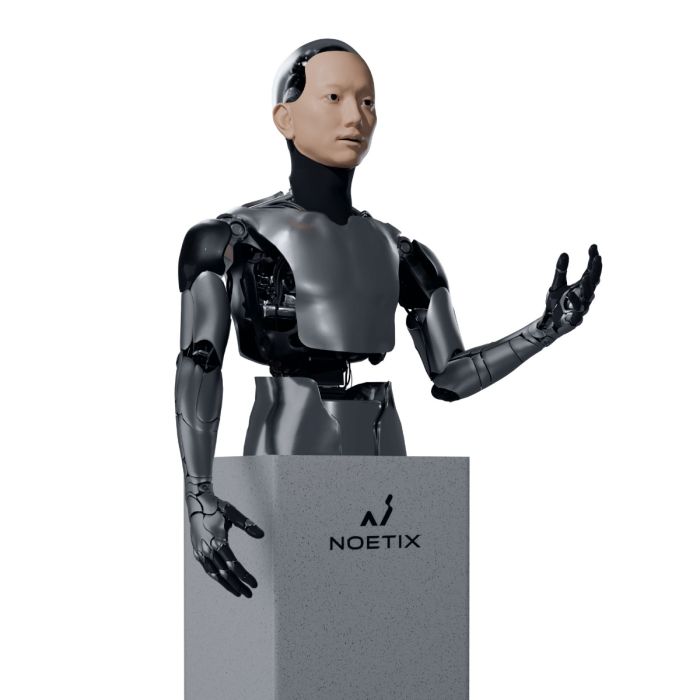
Noetix positions HOBBS as a “China’s first bionic robot head with high degree of freedom and immersive interaction,” intended for human-facing environments such as entertainment, guided tours, companionship, and therapeutic settings.
In public institutional coverage, HOBBS is described as one of the company’s three core product lines (alongside the E1 and N2 humanoids), underscoring its role as a flagship “bionic face” and interaction device rather than a full mobile humanoid.
Design and Features
Bionic head architecture and realism
HOBBS is marketed as a high-realism bionic head built around an “ultra-bionic” mechanical structure and a multimodal AI model, aimed at producing lifelike expressions and responsive interaction. An official product introduction document describes the system as enabling “immersive interaction” and explicitly targets use cases such as entertainment guiding, service companionship, and psychological therapy.
Materials are part of the realism strategy. Noetix’s product introduction specifies platinum silicone as the “skin” material and characterizes realism as “wax-figure level,” reflecting a design goal of photorealistic appearance and expressive subtlety.
Degrees of freedom and expressive motion
A defining feature of HOBBS is its high DOF facial and neck system. Noetix’s product page states the platform has 54 degrees of freedom, with 32 DOF attributed to the face and neck.
The official product introduction also describes two main configurations—single-head and half-body platform—listed as 29 DOF and 54 DOF respectively, suggesting modularity based on the intended deployment and integration requirements.
Neck articulation and developer-style controls
Noetix publishes practical motion details for head pose and staging. The Chinese product page lists neck pitch of 35°, neck roll (side tilt) of 25°, and neck yaw (pan) of 90°, which are useful metrics for reception-style interactions (turning to face a visitor, nodding, and reacting to conversational cues).
The same page notes “backend debugging” support to control facial points, implying a workflow where expressions can be calibrated or scripted for demonstrations and application development.
Technology and Specifications
Physical specifications (published)
Noetix’s official pages publish compact head-scale dimensions:
-
Product size: 40 × 30 × 60 cm
-
Weight: 18 kg
The product introduction PDF presents a broader footprint for the platform (notably 60 × 40 × 90 cm) and clarifies that the single head is ~3 kg within the overall listed weight, indicating that different configurations or mounts may be included depending on how HOBBS is packaged and deployed.
Sensing and perception
Noetix describes a camera + microphone array approach for perception and interaction. The product introduction lists:
-
Perception system: RGB camera + microphone array
The Chinese product page further specifies RGB “pupil” cameras ×2, consistent with stereoscopic framing, gaze behavior, or robust face-to-face interaction sensing.
On-device computing and software environment
HOBBS is presented as a device with a Linux-style software stack and on-device compute suitable for responsive interaction:
-
Control system: Ubuntu (product introduction)
-
Main control (published on product page): 2.4 GHz 8-core processor and 6 TOPS NPU
-
Edge computing power (English product page): 8GB GPU ×2
Because these figures appear across different official pages and may reflect different BOMs or revisions, buyers typically confirm the exact compute configuration during quotation and integration planning.
“Embodied interaction” positioning
Noetix repeatedly frames HOBBS as an embodied interaction device: a physical face capable of expressive motion combined with low-latency conversation and multimodal AI. The company’s own “about/history” page describes the bionic robot head as achieving a technical breakthrough within a standard head size, supporting multi-DOF facial expression and low-latency dialogue via a self-developed multimodal model.
Applications and Use Cases
Entertainment, exhibitions, and guided tours
Noetix’s official product introduction highlights entertainment guiding and exhibition performance among key scenarios. In these settings, HOBBS can function as a visually compelling “character” that speaks, reacts, and emotes—features that are often more impactful than a screen-only avatar for attracting attention and sustaining audience engagement.
Service companionship and wellness-oriented interaction
The product introduction also lists service companionship and psychological therapy as target use cases. In practice, these applications generally involve structured dialog, empathetic expression, and consistent persona behavior—areas where expressive facial motion, eye contact cues, and natural audio input can improve perceived social presence when compared with non-facial service robots.
Research and HRI (Human–Robot Interaction)
HOBBS’ published “backend debugging” controls and high DOF face/neck system make it relevant for HRI research, including experiments on social cues, gaze behavior, emotion expression, and user trust. Its camera and microphone array architecture supports typical lab workflows such as recording interaction sessions and iterating on perception + response behaviors.
Advantages / Benefits
High expressive bandwidth in a compact device
Compared with screen-based “social robots,” a bionic head can convey nuanced nonverbal signals (micro-expressions, gaze shifts, head tilts) that humans naturally interpret. Noetix explicitly emphasizes high DOF and immersive interaction as core differentiators for HOBBS.
Modular configurations for different deployments
The presence of single-head and platform configurations (29 DOF vs 54 DOF) suggests the product can be deployed as a standalone bionic head, integrated into kiosks, or mounted into more complex humanoid upper-body demonstrations depending on budget and scenario.
Practical developer and maintenance considerations
Published specifications such as neck rotation ranges, explicit compute figures, and “backend debugging” support indicate a product intended for repeatable deployment and iterative tuning—important for organizations that need consistent demos or run long-term pilot programs.
FAQ Section
What is the Noetix HOBBS Bionic Robot (HOBBS)?
HOBBS is a bionic robot head from Noetix Robotics designed for lifelike facial expression and immersive human–robot interaction, targeting entertainment, guiding, companionship, and therapy-style scenarios.
How does HOBBS work?
HOBBS combines a high-DOF face/neck mechanism (up to 54 DOF) with camera + microphone array sensing and an on-device computing stack (Ubuntu-based control with published CPU/NPU and GPU options) to perceive users and generate expressive responses.
Why is HOBBS important?
HOBBS represents an effort to move beyond screen-based “robot faces” by offering a compact, high-expressivity bionic head intended to improve social presence in reception, exhibition, and companionship applications.
What are the benefits of HOBBS?
Published benefits include high facial freedom (54 DOF), compact head-scale dimensions (40 × 30 × 60 cm), dual pupil RGB cameras, microphone-array sensing, and materials aimed at high realism (platinum silicone).
Summary
The Noetix HOBBS Bionic Robot (HOBBS) is a high-DOF bionic robot head built to deliver realistic facial expression and immersive interaction in compact form. With published specs including 54 DOF (32 in face+neck), dual pupil RGB cameras, microphone-array sensing, an Ubuntu-based control environment, and realism-oriented materials like platinum silicone, HOBBS is positioned as a specialized platform for human–robot interaction, guided entertainment, companionship-style deployments, and research-driven social robotics.
Specifications
| HLUTI # | HOBBS |
|---|---|
| MERKI | NOETIX |