
Wonik Robotics Allegro Hand V4
In stock
- ZNAČKA:
- Wonik Robotics
- MODEL:
- Allegro Hand V4
- ČÁST #:
- Allegro Hand V4
- Warranty:
- 12 MĚSÍCŮ
- AVAILABILITY:
- SUBJECT TO AVAILABILITY
- SKU:
- Wonik-Allegro-Hand-V4
Wonik Robotics Allegro Hand V4
Overview of the Wonik Robotics Allegro Hand V4
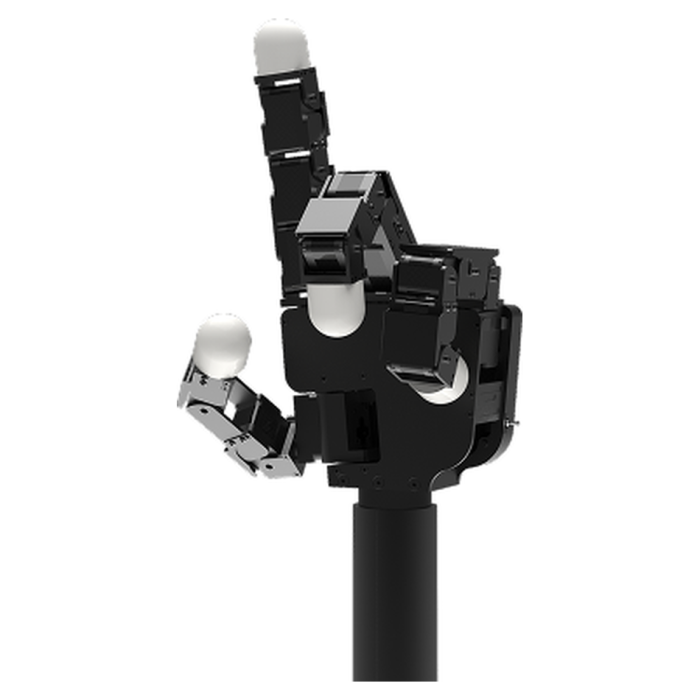
The Wonik Robotics Allegro Hand V4 is a multi-fingered robotic hand presented by its manufacturer as a cost-effective and highly adaptive platform for grasp and manipulation research and education. The hand is built around four fingers, arranged as three fingers plus one opposing thumb, and provides sixteen independent torque-controlled joints. Each of the four fingers carries four actuated joints, which is how the hand reaches its stated sixteen active degrees of freedom. The official page identifies grasp and manipulation research and education as intended areas of use.
Watch the manufacturer product demonstration
According to the manufacturer, the Allegro Hand V4 is presented as a platform for grasp and manipulation research and education. Its published specification sheet concentrates on the characteristics that matter most to researchers: joint torque, joint speed, position sensing, communication interface, weight, payload, and power requirements. This page summarizes those verified figures and places the hand in the context of the academic work in which the manufacturer states it has been used.
Design and Mechanical Layout
The Allegro Hand V4 follows an anthropomorphic layout consisting of three fingers and one thumb. Each digit contains four actuated joints driven by DC motors, and all sixteen joints are independently torque-controlled. The actuation chain uses a gear ratio of 1:369. The manufacturer lists a maximum torque of 0.70 Nm and a maximum joint speed of 0.11 seconds per 60 degrees of joint travel, figures that describe the balance the design strikes between output force and movement speed at the joint level.
The manufacturer publishes both digit-level and total hand weights. Each finger weighs 0.17 kg, the thumb weighs 0.19 kg, and the complete hand has a total weight of 1.08 kg. A low overall mass matters when the hand is mounted on a robot arm, because the hand consumes part of the arm's payload budget. The manufacturer states a payload of 5 kg for the hand itself.
Joint Sensing
Joint positions on the Allegro Hand V4 are measured with potentiometers, and the manufacturer specifies a nominal resolution of 0.002 degrees for this measurement. Position feedback of this kind is the basis for closed-loop joint control and for recording joint trajectories during experiments.
Verified Specifications
The table below reproduces the specifications published by the manufacturer for the Allegro Hand V4.
| Specification | Value |
|---|---|
| Number of fingers | 3 fingers + 1 thumb = 4 |
| Degrees of freedom | 4 fingers x 4 = 16 (active) |
| Actuation type | DC motor |
| Gear ratio | 1:369 |
| Maximum torque | 0.70 Nm |
| Maximum joint speed | 0.11 sec/60 degrees |
| Weight (finger) | 0.17 kg |
| Weight (thumb) | 0.19 kg |
| Weight (total) | 1.08 kg |
| Joint resolution measurement | Potentiometer |
| Resolution (nominal) | 0.002 deg |
| Communication type | CAN |
| Communication frequency | 333 Hz |
| Payload | 5 kg |
| Power requirement | 24 V / 100 W |
Control and Communication
The defining characteristic of the Allegro Hand V4 is torque control. All sixteen joints are described by the manufacturer as independently torque-controlled, meaning the control interface operates at the level of joint torque rather than only joint position. In research practice, torque-level access to each joint is valued because it allows laboratories to implement and compare their own control strategies for grasping and manipulation.
Communication with the hand takes place over a CAN interface operating at a frequency of 333 Hz. The manufacturer specifies a CAN communication frequency of 333 Hz; detailed command and feedback timing should be checked in the technical documentation. The electrical supply requirement is 24 V at 100 W, which indicates the class of power supply an integrating laboratory needs to provision.
Research Context
The manufacturer's product page lists a series of application references in which the Allegro Hand V4 appears. These include work at EPFL, among them a demonstration of catching a water bottle, as well as references associated with the LASA laboratory, KITECH, and SNU. The page also cites research on modeling grasp type to improve learning-based grasp planning, and a public demonstration in which the hand played rock-paper-scissors at a technology exposition.
Taken together, these references indicate the role the hand occupies in the research community: a shared hardware platform on which grasping studies, learning-based grasp planners, and dynamic manipulation demonstrations have been built.
Integration Considerations
Before adopting the Allegro Hand V4, an integrating team should verify several practical points against its own setup. These are items to check rather than guaranteed outcomes:
- Confirm that a suitable CAN interface is available on the control computer and that the 333 Hz communication rate fits the intended control architecture.
- Confirm that a 24 V power supply capable of delivering 100 W can be provisioned for the hand.
- Check the mechanical mounting arrangement between the hand and the intended robot arm, including any adapter requirements, with the manufacturer or distributor.
- Evaluate whether the stated 5 kg payload is appropriate for the objects and grasp types planned in the intended experiments.
- Review software and driver requirements for the laboratory's operating environment against the manufacturer's technical documentation.
- Account for the hand's 1.08 kg total weight within the payload budget of the carrying robot arm.
Frequently Asked Questions
How many fingers and joints does the Allegro Hand V4 have?
The Allegro Hand V4 has four fingers in total, arranged as three fingers plus one thumb. Each finger carries four actuated joints, giving sixteen independent torque-controlled joints, which the manufacturer states as sixteen active degrees of freedom.
How is the Allegro Hand V4 actuated?
Each joint is driven by a DC motor through a 1:369 gear ratio. The manufacturer specifies a maximum torque of 0.70 Nm and a maximum joint speed of 0.11 seconds per 60 degrees, and all joints are independently torque-controlled.
What communication interface does the Allegro Hand V4 use?
The hand communicates over a CAN interface at a stated frequency of 333 Hz. Integrators should confirm that their control computer provides a compatible CAN connection and that this update rate suits their planned control software.
How much does the Allegro Hand V4 weigh and what is its payload?
Each finger weighs 0.17 kg and the thumb weighs 0.19 kg, for a total hand weight of 1.08 kg. The manufacturer states a payload of 5 kg, which users should evaluate against their intended objects and grasp configurations.
Who is the Allegro Hand V4 intended for?
The manufacturer positions the hand as a cost-effective and highly adaptive platform for grasp and manipulation research and education. Its referenced uses are academic, including work associated with EPFL, LASA, KITECH, and SNU, as well as learning-based grasp planning research.
What power supply does the Allegro Hand V4 require?
The published power requirement is 24 V at 100 W. A laboratory integrating the hand should provision a supply of this class and confirm wiring and connector details with the manufacturer's documentation.
Summary
The Wonik Robotics Allegro Hand V4 is a four-finger, sixteen-joint robotic hand built for grasp and manipulation research and education. Its verified characteristics include independent torque control on all sixteen joints, DC motor actuation with a 1:369 gear ratio, 0.70 Nm maximum torque, 0.11 sec/60 degrees maximum joint speed, potentiometer joint sensing with a nominal 0.002 degree resolution, CAN communication at 333 Hz, a total weight of 1.08 kg, a stated 5 kg payload, and a 24 V / 100 W power requirement. Supported by a series of academic application references, it serves as a documented hardware platform for laboratories working on robotic grasping and manipulation.
Request a quotation to confirm configuration, pricing and availability. Catalog stock status is not confirmation of physical inventory or immediate shipment.