
AgiBot D1 Max Wheeled Quadruped Robot Dog: Complete Guide
This hybrid wheel-leg design gives the D1 Max a top speed significantly higher than purely legged D1 variants — cited in product demonstrations at approximately 8 meters per second — making it one of the fastest commercially positioned quadruped robots in AgiBot's portfolio. The speed and energy advantage on flat ground makes the D1 Max particularly well suited for indoor logistics environments, large facility patrol routes, and warehouse operations where flat surfaces predominate and the ability to move rapidly between locations is operationally valuable.
Design and Physical Features
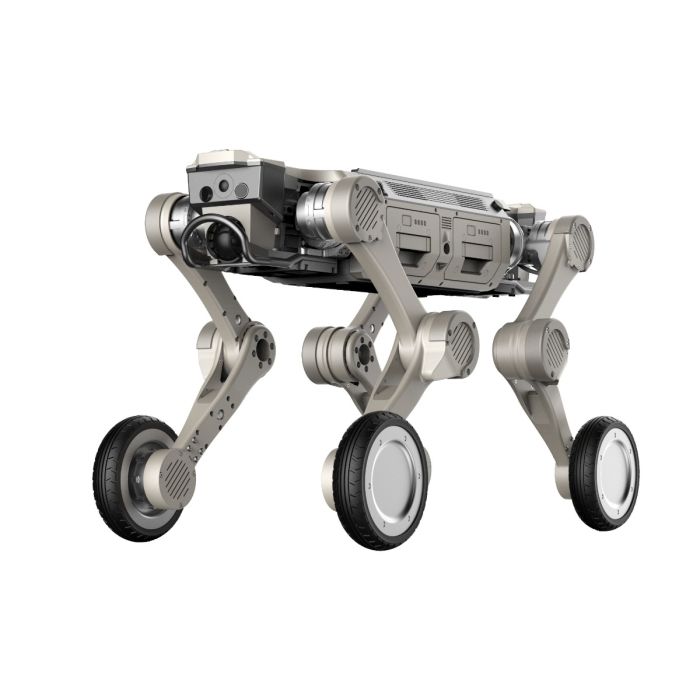
Hybrid Wheel-Leg Architecture
The D1 Max's defining hardware feature is the integration of wheels into its quadruped leg structure. On flat surfaces, the robot transitions to wheeled rolling, allowing all four legs to work together to propel the body forward using wheel traction rather than the stance-and-swing walking gait of purely legged operation. When the robot encounters stairs, obstacles, curbs, or rough terrain, it transitions to legged walking, using the full range of leg motion to step over, climb, or negotiate the obstacle.
The transition between wheeled and legged modes is described as seamless in demonstration footage — the robot continuously assesses its terrain and selects the most efficient locomotion mode for the current surface without operator intervention. On flat ground, this produces the flowing, rapid movement that characterizes the D1 Max's demonstrations; on mixed terrain, it produces a natural stepping-and-rolling transition that reflects the contextual intelligence of the underlying locomotion controller.
This wheel-in-leg design approach — distinct from robots that have separate wheel modules attached as accessories — means the wheels are structurally integrated into the leg terminations, preserving the robot's compact footprint and avoiding the mechanical complexity of separate wheel-deployment actuators.
Speed and Flat-Ground Efficiency
The D1 Max's hybrid locomotion enables a top speed of approximately 8 meters per second on flat surfaces — substantially faster than the pure-legged D1 Ultra's 3.7 m/s maximum and the D1 MaxPro's approximately 3.5 m/s. At 8 m/s, the D1 Max covers ground at approximately 28.8 kilometers per hour, enabling rapid traversal of large indoor facilities, quick response to alerts during security patrol, and efficient service loops in warehouse environments where minimizing transit time directly impacts operational productivity.
The energy efficiency advantage of wheeled locomotion also extends operational endurance on flat-ground missions compared to equivalent legged-only operation at the same speed, since wheel rolling requires less actuator effort per meter of distance than the cyclic contact-and-lift motions of legged walking.
Form Factor and Build
The D1 Max belongs to the larger D1 series variants, heavier and more structurally capable than the compact D1 Pro/Edu (approximately 15 kilograms). The D1 Series as a whole spans a weight range of approximately 8 to 20 pounds (approximately 4 to 9 kilograms) in the lightest configurations, to substantially heavier in the Max/MaxPro industrial variants. The D1 Max's specific body mass has not been independently published to high precision in available commercial materials, and buyers should confirm exact dimensions and weight through an enterprise quotation from AgiBot or authorized distributors.
Locomotion Versatility
While the D1 Max prioritizes flat-surface speed through its wheel-leg hybrid, the leg structure preserves the fundamental capability of quadruped locomotion for terrain transitions. The robot can step over obstacles, climb curbs, and handle surface irregularities that would stop a purely wheeled robot. This versatility makes the D1 Max more broadly deployable than a conventional wheeled AMR (Autonomous Mobile Robot) in facilities with mixed floor conditions — the presence of loading dock ramps, threshold transitions between floor types, or occasional debris on otherwise flat routes does not prevent the D1 Max from completing its mission.
Technology and Specifications
Hybrid Locomotion Control System
The D1 Max's locomotion control manages the transition between wheeled and legged modes through onboard sensor fusion and terrain classification. The controller continuously integrates data from the robot's inertial measurement unit, joint torque sensors, and camera or LiDAR perception to characterize the terrain ahead and behind the robot, enabling proactive mode selection before the robot reaches a terrain transition rather than reacting after encountering an obstacle.
The underlying locomotion AI is built on the same reinforcement learning foundations that AgiBot applies across the D1 Series. RL-trained controllers for wheel-leg hybrid robots are more complex than purely legged or purely wheeled alternatives, as they must learn not only how to walk and how to roll, but when and how to transition between modes safely while maintaining body stability during the mode switch itself.
Navigation and Perception
The D1 Max is compatible with standard sensor payload modules from the D1 Series ecosystem, supporting integration of LiDAR units for spatial mapping and obstacle detection, depth cameras for visual perception, and communication modules including 4G and 5G for remote monitoring and connectivity. The robot's onboard perception system enables autonomous patrol navigation, obstacle avoidance, and route following without requiring operator joystick input during established patrol cycles.
The D1 Series' shared payload interface standard — covering Ethernet, USB, UART, and SBUS data connections alongside 12V and 24V power outputs — applies to the D1 Max, allowing organizations that have invested in sensor modules for other D1 variants to reuse the same hardware on the D1 Max platform.
AgiBot D1 Series Core Specifications Context
While the D1 Max's specific published specification sheet is not comprehensively available in public commercial materials as of April 2026, it shares the D1 Series' foundational technology stack including:
- Reinforcement learning-based locomotion control
- High-torque joint actuation (the D1 Series uses approximately 48 Newton-meters of peak joint torque in the legged components, consistent with D1 Ultra data)
- Compatible with 3D LiDAR, depth cameras, RGB cameras, RTK positioning, and 4G/5G communications modules
- URDF modeling support for simulation in NVIDIA Isaac Sim and MuJoCo
- Autonomous patrol and environmental perception modules
The D1 Max's distinctive top speed of approximately 8 m/s on flat surfaces is confirmed from product demonstration coverage. Buyers should obtain formal technical specifications through direct enterprise quotation to confirm exact weight, battery capacity, endurance, protection rating, and compatible payload interfaces for the D1 Max configuration.
Applications and Use Cases
Warehouse Automation and Logistics
The D1 Max's combination of high flat-ground speed, hybrid terrain capability, and sensor payload compatibility makes it well suited for large warehouse environments. A robot capable of moving at 8 m/s between pick stations, storage aisles, and loading docks covers the traversal distances in a large distribution center far more efficiently than purely legged alternatives or slower wheeled AMRs. The leg structure enables it to handle the ramps, dock leveler transitions, and occasional floor irregularities typical of industrial logistics environments.
In warehouse contexts, the D1 Max can serve as a mobile inventory verification platform — rapidly traversing aisles while carrying a camera and barcode scanning payload — or as a monitoring and security sweep robot covering the perimeter and interior of a facility in a fraction of the time a slower legged robot would require.
Indoor Security Patrol
Large commercial and industrial facilities — airports, shopping centers, corporate campuses, manufacturing sites — require security patrol coverage across floor areas that can extend to tens of thousands of square meters. The D1 Max's speed advantage over purely legged alternatives means a single unit can cover more ground per shift than comparable legged patrol robots, or that a smaller fleet of D1 Max units can achieve the same patrol frequency as a larger fleet of slower robots.
The transition to legged walking for doorway thresholds, elevator boarding, and occasional surface transitions maintains continuity of patrol routes through the mixed terrain typical of large buildings without requiring separate robot types for different floor zones.
Infrastructure and Facility Inspection
In flat-floor industrial facilities — manufacturing plants, data centers, server farms, semiconductor cleanrooms — the D1 Max's wheeled speed enables rapid inspection traversal while its legged capability handles threshold transitions and raised floor sections. Sensor payloads for thermal imaging, LiDAR mapping, or gas detection are compatible through the D1 Series' standard interface, enabling the D1 Max to serve the same inspection data collection function as the D1 Ultra on comparable flat-floor industrial sites with a significantly faster transit profile.
Last-Mile Delivery and Transport Support
Within large campus environments — university campuses, corporate parks, hospital complexes, military bases — the D1 Max's hybrid locomotion supports last-mile transport of packages, supplies, or equipment at speeds that make the service practically competitive with human transport while navigating the sidewalks, ramps, and threshold transitions of campus environments. The robot's ability to move rapidly across open flat areas and then navigate curbs or steps at delivery destinations extends its operational range beyond what flat-wheeled AMRs can reliably access.
Research and Education
For robotics research teams studying hybrid wheel-leg locomotion, the D1 Max provides a commercially available platform with an integrated wheel-leg system, AgiBot's RL locomotion stack, and URDF model support for simulation. Research questions around mode-switching control, energy optimization between locomotion modes, and mixed-terrain planning can be explored using the D1 Max as the physical substrate without requiring custom robot construction.
Advantages and Benefits
Industry-Leading Speed for a Commercial Quadruped: At approximately 8 m/s on flat surfaces, the D1 Max's wheeled locomotion achieves speeds substantially above the purely legged D1 Ultra (3.7 m/s) and D1 MaxPro (approximately 3.5 m/s), enabling logistics and patrol applications where transit time directly constrains operational effectiveness.
Energy Efficiency Through Wheeled Flat-Ground Travel: Wheeled locomotion on smooth surfaces is substantially more energy-efficient per meter than legged walking at equivalent speeds. This efficiency advantage translates to longer effective mission endurance on flat-floor facility deployments compared to a legged robot at the same operational speed.
Legged Capability Preserved for Terrain Transitions: Unlike purely wheeled AMRs, the D1 Max retains the ability to step over obstacles, climb curbs, negotiate ramps, and handle surface irregularities through its legged locomotion mode. This versatility extends the robot's deployability across the mixed terrain of real facilities without requiring separate platforms for different floor conditions.
Seamless Autonomous Mode Transition: The robot's onboard terrain classification and locomotion controller handles the transition between wheeled and legged modes autonomously without operator input, enabling uninterrupted mission execution across varying floor conditions during a single patrol or logistics route.
Shared D1 Series Sensor Ecosystem: The D1 Max is compatible with the same sensor and communications payload modules used across the D1 Series, allowing organizations with existing investments in D1 Ultra or D1 MaxPro sensor hardware to extend compatible payloads to the D1 Max without new sensor procurement.
Comparison with Related Platforms
AgiBot D1 Max vs. AgiBot D1 MaxPro: The D1 MaxPro is the legged-only variant designed for heavy-payload outdoor field missions, with up to 100 kilograms of payload capacity, up to 5.5 hours of endurance, and a -20°C to 55°C operating range for year-round industrial field deployment. The D1 Max is the wheeled-leg hybrid designed for flat-floor indoor environments, achieving 8 m/s versus the MaxPro's approximately 3.5 m/s but without the MaxPro's extreme payload headroom or terrain aggressiveness for fully unstructured outdoor environments. The two variants serve genuinely different use cases: D1 Max for indoor speed and efficiency, D1 MaxPro for outdoor heavy-field endurance and payload.
AgiBot D1 Max vs. AgiBot D1 Ultra: The D1 Ultra is the compact inspection quadruped, approximately 15 kilograms, with IP54 protection, Open SDK developer access, and a top speed of 3.7 m/s in purely legged operation. The D1 Max adds wheeled locomotion for substantially higher flat-ground speed but is heavier and lacks the D1 Ultra's explicit developer-oriented open SDK positioning. The D1 Ultra is better for outdoor unstructured environments and research development contexts; the D1 Max is better for indoor logistics speed and large-area patrol efficiency.
AgiBot D1 Max vs. Unitree B2-W: The Unitree B2-W is a direct competitor in the wheeled quadruped segment — a heavy industrial quadruped with wheel-leg hybrid design, IP67 protection rating, up to 120 kilograms standing payload, top speed of approximately 20 km/h (5.6 m/s), and endurance up to 50 kilometers with a 40-kilogram load. The Unitree B2-W has established global distribution through Unitree's mature network and a detailed published specification sheet. The AgiBot D1 Max at approximately 8 m/s (28.8 km/h) offers higher top speed, while the B2-W offers stronger IP67 weatherproofing and a more mature international distribution infrastructure. Buyers evaluating both should request formal specifications and quotations from each vendor to compare configurations against their specific operational requirements.
Key differentiators covered:
| Feature | D1 Max | D1 MaxPro | D1 Ultra |
|---|---|---|---|
| Locomotion | Hybrid wheel-leg | Legged only | Legged only |
| Top Speed | ~8 m/s (28.8 km/h) | ~3.5 m/s | 3.7 m/s |
| Payload | TBC via quote | 100 kg | ~3-5 kg effective |
| Endurance | TBC via quote | 5.5 hours | ~1 hour |
| Best For | Indoor speed/logistics | Outdoor heavy field | Research/inspection |
Frequently Asked Questions (FAQ)
What is the AgiBot D1 Max? The AgiBot D1 Max is a wheeled quadruped robot in AgiBot's D1 Series that uses a hybrid wheel-leg design combining integrated wheels within a quadruped leg structure. On flat surfaces, the robot rolls for high-speed, energy-efficient locomotion — reaching approximately 8 meters per second — while retaining the ability to switch to legged walking for stairs, curbs, and uneven terrain. It is designed for indoor logistics, large-facility security patrol, and inspection applications where flat-surface speed and terrain versatility are both required.
How does the AgiBot D1 Max's hybrid locomotion work? The D1 Max integrates wheels into its quadruped leg structure, allowing each leg to function either as a rolling wheel (on smooth surfaces) or a stepping leg (on obstacles and uneven terrain). An onboard terrain classification system fuses data from the robot's sensors to autonomously select the appropriate locomotion mode and manage smooth transitions between wheeled rolling and legged walking without operator intervention. On flat ground the robot rolls for maximum speed and energy efficiency; on mixed or rough terrain the legs step to maintain stability and navigate obstacles.
What is the AgiBot D1 Max's top speed? The AgiBot D1 Max reaches a top speed of approximately 8 meters per second (approximately 28.8 km/h) in wheeled rolling mode on flat surfaces. This is approximately twice the top speed of the legged D1 Ultra (3.7 m/s) and D1 MaxPro (approximately 3.5 m/s), making the D1 Max the fastest quadruped variant in AgiBot's D1 Series on flat-floor environments.
What is the difference between the AgiBot D1 Max and the D1 MaxPro? The D1 Max is a wheeled quadruped using a hybrid wheel-leg design for high-speed indoor flat-surface locomotion, with a top speed of approximately 8 m/s. The D1 MaxPro is a legged-only quadruped designed for heavy outdoor field missions, with up to 100 kilograms of payload capacity, up to 5.5 hours of endurance, and a -20°C to 55°C operating range. The D1 Max prioritizes speed and efficiency for indoor structured environments; the D1 MaxPro prioritizes payload capacity and terrain versatility for outdoor industrial inspection and emergency response. The MaxPro's comparison note from AgiBot's own literature explicitly distinguishes them: "Max provides wheeled efficiency on smooth floors; MaxPro retains legged all-terrain capability for stairs and debris."
What applications is the AgiBot D1 Max best suited for? The D1 Max is best suited for indoor high-speed applications including warehouse logistics and rapid material transport, large-area security patrol in facilities with predominantly flat floors, indoor infrastructure and facility inspection requiring fast traversal between inspection points, and campus or complex last-mile delivery support where flat-ground speed and limited terrain versatility are the primary operational requirements. For outdoor field missions, heavy-payload inspection, or fully unstructured terrain, the D1 MaxPro's legged-only architecture is more appropriate.
Summary
The AgiBot D1 Max Wheeled Quadruped Robot Dog represents a practical and commercially positioned solution to one of the fundamental trade-offs in mobile robotics: legged platforms provide terrain versatility but sacrifice speed and energy efficiency on flat ground, while wheeled platforms achieve speed and efficiency but cannot handle the terrain transitions common in real facilities. By integrating wheels into a quadruped leg structure, the D1 Max reaches approximately 8 m/s on flat surfaces while preserving legged capability for stairs, curbs, and rough terrain — enabling deployment in large indoor logistics, security patrol, and inspection scenarios that benefit from rapid transit without surrendering the terrain adaptability that makes legged robots valuable. Positioned clearly above the compact D1 Pro/Ultra for indoor speed-critical applications and complementary rather than competing with the outdoor-focused D1 MaxPro, the D1 Max rounds out AgiBot's quadruped lineup as the platform of choice for enterprises that need the fastest practical quadruped robot for structured indoor environments.