
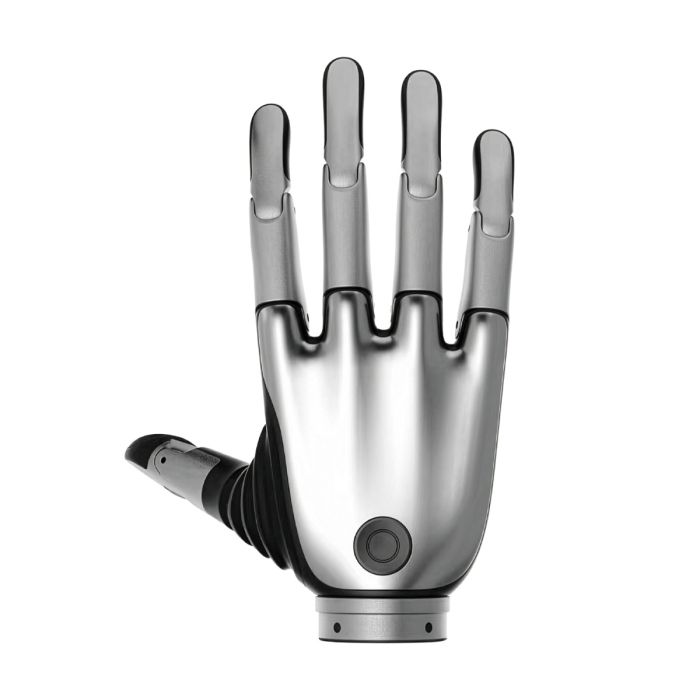
BrainCo Revo 2 Pro Dexterous Left Hand (XEL)
En stock
- MARQUE:
- BRAINCO
- MODÈLE:
- REVO 2 PRO
- NUMÉRO DE PIÈCE #:
- XEL
- ORIGIN:
- Chine
- AVAILABILITY:
- SUBJECT TO AVAILABILITY
- SKU:
- BrainCo-Revo-2-Pro-Left
BrainCo Revo 2 Pro Dexterous Hand
Biomimetic Scale: The Average Adult Female Hand
BrainCo's official launch announcement notes: "At just 16 cm long — similar in size to an average adult female hand — Revo2 weighs only 383 grams, about the weight of six eggs, which is 20% lighter than the industry average." This human-scale form factor is not merely aesthetic: a hand sized to human anatomy can grasp objects designed for human hands without anthropometric mismatch, reach into spaces designed for human finger clearance, and perform hand-to-hand interactions with human interlocutors without scale mismatch.
At 160 × 76 mm, the Revo 2 Pro is dimensioned for deployment on the lightweight robot arms of compact and mid-size humanoid platforms — including the Unitree G1 (132 cm), the R1 EDU series (121 cm), and similar compact humanoid arms where full human-scale hands would be oversized and overly heavy.
383 Gram Ultra-Lightweight Construction
The 383-gram mass of the Revo 2 Pro is its single most commercially significant specification. Revo2 weighs only 383 grams, about the weight of six eggs, which is 20% lighter than the industry average. At this weight, the hand adds approximately 383 grams to each arm's distal mass — a figure that matters significantly for robot arm dynamics, because distal mass increases the arm's effective inertia for any given joint torque, reducing the arm's achievable acceleration and speed.
The lightweight construction is achieved through aerospace-grade aluminum alloy structural components paired with food-grade polymer shell elements. The aluminum alloy provides structural rigidity and impact resistance; the food-grade polymer reduces mass at the exterior surfaces while enabling safe contact with food and human skin.
11 Degrees of Freedom: Full Hand Coverage
The Revo 2 Pro's 11 total degrees of freedom are distributed with specific kinematic intent, confirmed from BrainCo's official specification document:
Thumb: Two active degrees of freedom for abduction/adduction (the lateral opposition motion) and one passive degree of freedom for flexion/extension. The active opposition DOF is the most critical single joint in human hand kinematic capability — without it, precision grasps requiring thumb opposition to specific finger positions are impossible.
Each of the four remaining fingers: One active degree of freedom for flexion/extension (the primary closing/opening motion) and one passive degree of freedom for flexion/extension. Four fingers × 2 DOF = 8 finger DOF.
Total: 3 (thumb) + 8 (four fingers) = 11 DOF, of which 6 are independently motor-actuated (active) and 5 are passive (mechanical compliance).
This distribution concentrates active control on the joints that matter most for grasp configuration — the thumb opposition and individual finger flexion — while passive joints at the distal phalanges allow natural conformation to object surfaces without requiring independent actuation.
Anti-Collision Finger Design
American Satellite's product listing highlights the "anti-collision finger design" as a key feature. In robotic manipulation contexts, finger collision — where a finger contacts an unintended surface or object during the approach phase — can damage both the finger mechanism and the target object, and can cause the robot arm to lose its planned trajectory. The Revo 2 Pro's anti-collision design provides structural and control-layer protection against finger damage during unexpected contact events, extending operational reliability in unstructured manipulation environments.
≤50 dB Operating Noise
BrainCo confirms operating noise of ≤50 dB at 50 cm — roughly equivalent to a quiet office environment or library. This acoustic specification matters for deployment in human-shared environments where robot noise creates disturbance, and for research environments where audio sensing (microphone arrays) would be degraded by loud mechanical actuation noise. Most commercially available robotic hands operate at higher noise levels due to gear whine and motor switching noise; the Revo 2 Pro's sub-50 dB specification reflects the same low-damping, high-quality drive train that contributes to its performance characteristics.
Technology and Specifications
Full BrainCo Revo 2 Pro (XEL) Specifications
| Specification | Revo 2 Basic | Revo 2 Pro (XEL/XER) | Revo 2 Touch |
|---|---|---|---|
| Weight | 383 g | 383 g | 383 g |
| Hand Length | 160 mm | 160 mm | 160 mm |
| Hand Width | 76 mm | 76 mm | 76 mm |
| Total DOF | 11 | 11 | 11 |
| Active Joints | 6 | 6 | 6 |
| Power Grasp Force | 50 N | 50 N | 50 N |
| Finger Pinch Force | 15 N | 15 N | 15 N |
| Active Grip Force (American Satellite) | — | 5 kg | — |
| Static Load | 20 kg | 20 kg | 20 kg |
| Grip-to-Weight Ratio | ~52.6 | ~53 | ~52.6 |
| Open/Close Time | ≤0.65 s | ≤0.65 s | ≤0.65 s |
| Repeat Accuracy | 0.1° | 0.1° | 0.1° |
| Operating Noise | ≤50 dB | ≤50 dB | ≤50 dB |
| Voltage | 9–28 V | 9–64 V | 9–64 V |
| Communication | RS-485, CAN-FD | RS-485, CAN-FD, EtherCAT | RS-485, CAN-FD, EtherCAT |
| Max Communication Rate | 1 kHz | 1 kHz | 1 kHz |
| Tactile Sensing | None | None | Multi-modal |
| Tactile Resolution | — | — | 0.01 N |
| Control Algorithm | Position/Speed/Current | Adaptive Impedance Control | Adaptive Compliance + Tactile Control |
| Materials | Aerospace-grade Al + food-grade polymer | Same | Same |
| SDK | Python/C, ROS, Windows/Linux | Python/C, ROS, Windows/Linux | Same |
| Protocols | Modbus, Protobuf | Modbus, Protobuf | Same |
| OTA Updates | Yes | Yes | Yes |
The Pro's Defining Upgrade: Adaptive Impedance Control
The Revo 2 Pro's most significant technical differentiation from the Basic is its Adaptive Impedance Control algorithm. Standard position or velocity control moves the hand's fingers to a commanded position or at a commanded speed, but does not adjust to contact forces — if an object is harder or softer than expected, the position controller applies the same motion regardless of the force response. Impedance control adds a dynamic stiffness model: the controller regulates the relationship between force and displacement at the contact surface, allowing the hand to "give" appropriately when it contacts objects with unexpected compliance while maintaining the planned grasp configuration.
Adaptive Impedance Control extends this with a real-time adaptation layer: the controller updates its impedance model based on the contact force history during each grasp, learning the specific compliance profile of the object being manipulated and adjusting the grip dynamics accordingly. This enables more reliable grasping of objects with variable or uncertain compliance — deformable packaging, soft fruit, compressible materials — where the exact compliance profile at grasp time is unknown.
This control upgrade is what separates the Pro from the Basic: buyers who need to handle a wide range of object compliances with high reliability should select the Pro; buyers whose application involves predominantly rigid or well-characterized objects may find the Basic's position control sufficient.
EtherCAT: Industrial Fieldbus Integration
The Revo 2 Pro's addition of EtherCAT alongside RS-485 and CAN-FD is the second key differentiation from the Basic. EtherCAT (Ethernet for Control Automation Technology) is the industry-standard real-time Ethernet protocol for industrial automation — used in precision machine tools, semiconductor manufacturing equipment, and industrial robot controllers. RS-485 and CAN-FD are common in research and embedded systems; EtherCAT is the standard in production-grade industrial controllers.
For industrial deployment contexts — where the robot controller and factory control system communicate over EtherCAT — the Revo 2 Pro's EtherCAT support enables direct integration without custom communication bridges. This is the practical reason the Pro is positioned above the Basic for industrial deployment rather than just research.
The 9–64V voltage range (versus the Basic's 9–28V) also enables direct connection to higher-voltage industrial power systems without step-down converters.
Grip-to-Weight Ratio of 53: Industry-Leading Power Density
American Satellite's listing highlights the grip-to-weight ratio of 53 as a key selling point. To understand why this matters: a conventional industrial parallel-jaw gripper might weigh 400 grams and produce 50N grip force — a grip-to-weight ratio of 50N / 0.4kg = 125. But conventional grippers have one DOF; the Revo 2 Pro achieves a similar force at 53:1 ratio across 11 DOF and five fingers, with the complexity penalty of multi-finger kinematics included. The BrainCo PR Newswire announcement frames this as "a remarkable grip-to-weight ratio of 52.6 that leads the industry" for the dexterous hand category specifically.
Applications and Use Cases
Adaptive Grasping of Variable-Compliance Objects
The Revo 2 Pro's Adaptive Impedance Control is specifically designed for manipulation contexts where object compliance varies — production lines handling mixed products, service robots dealing with diverse household items, healthcare settings where patients' limbs and medical equipment have very different compliance profiles. The adaptation layer allows the hand to successfully grasp soft fruit alongside rigid containers within the same workflow without changing control parameters.
Industrial Integration via EtherCAT
Manufacturing facilities that have standardized on EtherCAT-based motion control infrastructure — common in European and Asian precision manufacturing — can integrate the Revo 2 Pro directly without the protocol translation layers required for RS-485 or CAN-FD-only alternatives. This direct integration simplifies the PLC/robot controller software stack and enables synchronization with other EtherCAT devices (servo drives, I/O modules) at the network level.
Humanoid Robot Manipulation Deployment
The Revo 2 Pro is used in Unitree's G1 EDU humanoid robot lineup (as the hand in some upper-tier EDU configurations) and in multiple other humanoid platforms. For humanoid robots deployed in service, logistics, or manufacturing contexts where object handling involves varying compliance and reliable grasp quality is operationally important, the Adaptive Impedance Control of the Pro provides the grasp reliability advantage over the Basic's position-only control.
Striking a Match: Precision Low-Force Manipulation
BrainCo's PR Newswire announcement specifically cites matchstick striking as a demonstration of the Revo 2's precision capability: the hand must apply a controlled lateral force to the match head at a specific contact angle with sufficient but not excessive force — a task that requires both multi-finger positioning accuracy and contact force regulation that position control alone cannot reliably achieve. This demonstration establishes the Revo 2 as a benchmark for fine manipulation tasks requiring both kinematic precision and controlled contact.
Research, STEM Education, and AI Training Data Collection
AlphaGeo UK identifies: "Perfect for students, educators, and developers who need precise, responsive robotic hand control for general research and integration tasks." The SDK compatibility (Python/C, ROS, Windows/Linux), Modbus/Protobuf protocol support, and OTA update capability make the Revo 2 Pro accessible to research labs and education programs without specialized hardware expertise.
Advantages and Benefits
383g at 50N/20kg — Best-in-Class Power Density for Dexterous Hands: The grip-to-weight ratio of 53 is described by BrainCo as industry-leading for the dexterous hand category — providing robotic arms with maximum grip capability at minimum distal mass penalty.
Adaptive Impedance Control for Compliant Object Reliability: The Pro's control upgrade enables reliable grasping across the full compliance spectrum from rigid to soft objects, addressing the grasp failure mode that position-control-only hands encounter with deformable or variable objects.
EtherCAT for Industrial Integration: Enabling direct connection to industrial PLC systems and EtherCAT-networked machine controllers, the Revo 2 Pro supports production-grade industrial deployment without custom protocol adaptation.
Five-Year Product Iteration from Prosthetics Heritage: BrainCo's stated "five years of product iteration and professional production lines" reflects a manufacturing maturity that reduces the quality inconsistency risk associated with early-stage robotic hand products.
Free Shipping Through American Satellite: American Satellite (americansatellite.us) provides the Revo 2 Pro (XEL left / XER right) with free shipping to qualifying buyers, confirmed in the product listing.
OTA Updates for Control Algorithm Improvements: Over-the-air firmware updates enable BrainCo to push improved control algorithms, gesture libraries, and protocol enhancements post-delivery without requiring hardware replacement.
Comparison: Revo 2 Pro vs. Basic vs. Touch
| Feature | Revo 2 Basic | Revo 2 Pro (XEL/XER) | Revo 2 Touch |
|---|---|---|---|
| Control Algorithm | Position/Speed/Current | Adaptive Impedance | Adaptive Compliance + Tactile |
| Communication | RS-485, CAN-FD | + EtherCAT | + EtherCAT |
| Voltage | 9–28 V | 9–64 V | 9–64 V |
| Tactile Sensing | No | No | Yes |
| Tactile Resolution | — | — | 0.01 N |
| Best For | Research, education | Industrial + adaptive grasping | Tactile research, fragile objects |
Frequently Asked Questions (FAQ)
What is the BrainCo Revo 2 Pro Left Hand (XEL)? The BrainCo Revo 2 Pro Left (XEL) is the advanced-tier left-hand configuration of BrainCo's Revo 2 bionic dexterous hand family. It weighs 383 grams at 160 × 76 mm, features 11 total degrees of freedom (6 active), delivers 50 N power grasp force and 15 N pinch force with 20 kg static load capacity, closes in under 0.65 seconds, and achieves a repeat accuracy of 0.1 degrees. Key upgrades over the Basic: Adaptive Impedance Control algorithm, EtherCAT communication interface (in addition to RS-485 and CAN-FD), and 9–64V voltage range. Priced at $6,744.38 with free shipping from American Satellite. Ships in 7 to 14 business days.
What makes the Revo 2 Pro different from the Revo 2 Basic? The Revo 2 Pro adds three capabilities over the Basic: (1) Adaptive Impedance Control algorithm — enabling reliable grasping of objects with variable compliance (soft, deformable, uncertain materials) that position control alone handles poorly; (2) EtherCAT communication interface — enabling direct integration with industrial PLC and motion control systems; and (3) 9–64V voltage range — versus the Basic's 9–28V, supporting higher-voltage industrial power systems. Physical specifications (383g, 11 DOF, 50N/20kg) are identical between the Basic and Pro.
How does the Revo 2 Pro's Adaptive Impedance Control work? Adaptive Impedance Control models the dynamic stiffness relationship between the hand's finger positions and the contact forces they generate during grasping. Where standard position control moves to a commanded angle regardless of contact force, impedance control adjusts the effective stiffness allowing the finger to yield appropriately when contacting a soft or compressible object. The "adaptive" component updates this stiffness model in real time based on contact force history, learning the specific compliance of the object being grasped and adjusting accordingly. This adaptation enables reliable grasp quality across a wide range of object materials without requiring per-material parameter tuning.
What communication interfaces does the Revo 2 Pro support? The Revo 2 Pro supports three communication interfaces: RS-485, CAN-FD, and EtherCAT, with a maximum communication rate of 1 kHz. Protocol support includes Modbus and Protobuf. SDK support covers Python, C, and ROS on Windows and Linux. This three-interface design with EtherCAT being the key upgrade over the Basic's RS-485 and CAN-FD only — enables the Pro to integrate with industrial PLC systems, research embedded platforms, and robot operating system environments without custom protocol bridges.
Summary
The BrainCo Revo 2 Pro Dexterous Left Hand (XEL) is the advanced-tier configuration in BrainCo's Revo 2 bionic dexterous hand family — combining the series' foundation of 383-gram lightweight construction, 11-degree-of-freedom five-finger articulation, 50 Newton grip force, and 20-kilogram single-hand payload with the Adaptive Impedance Control algorithm and EtherCAT industrial communication interface that distinguish the Pro tier from the Basic. Priced at $6,744.38 with free shipping from American Satellite in a 7 to 14 business day lead time, the Revo 2 Pro is positioned for industrial deployment requiring EtherCAT integration and reliable grasping of variable-compliance objects, as well as research programs that need adaptive contact control beyond position-only manipulation.
Specifications
General
Physical
Mobility
Performance
Connectivity
Software
Hand
Feature
1. High quality and stability – five years of product iteration and professional production lines.
2. Lightweight (383 grams), with 5 kg active grip force, 20 kg single-hand load capacity, and a grip-to-weight ratio of 53.
3. Ergonomic Bionic Design – supports curved surface grasping with anti- collision finger design.
4. Multi-dimensional tactile perception – pressure, friction, direction, proximity, and surface texture.
5. High Sensitivity Tactile Perception – max resolution of 0.01N.
6. Wide voltage support – 64V.
7. Universal Interfaces – RS485 & CAN-FD, and EtherCAT.
8. Standard Protocols and SDKs – Modbus & Protobuf protocols, SDKs for Python / C / ROS.