
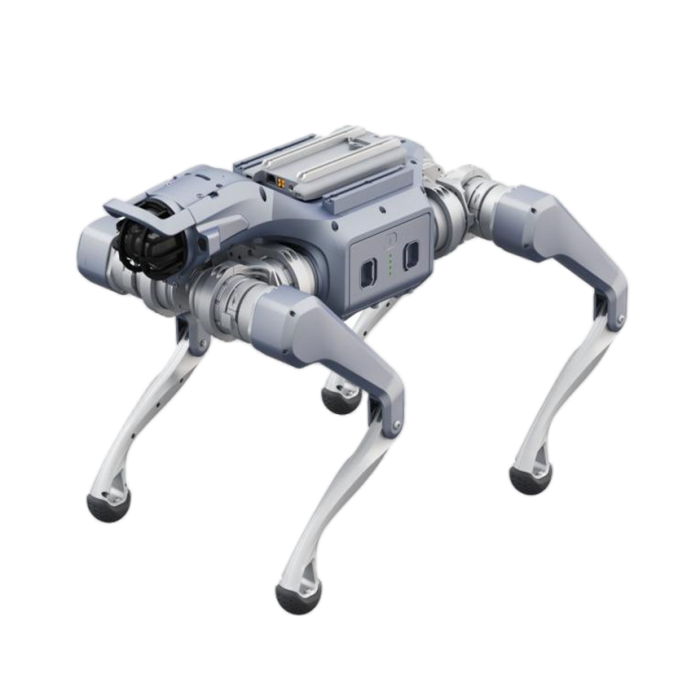
Unitree AS2 EDU Plus Robot Dog
En stock
- MARQUE:
- UNITREE ROBOTICS
- MODÈLE:
- AS2 EDU PLUS
- NUMÉRO DE PIÈCE #:
- As2 EDU-U2
- ORIGIN:
- Chine
- Warranty:
- 12 MOIS
- AVAILABILITY:
- SUBJECT TO AVAILABILITY
- SKU:
- Unitree-AS2-EDU-U2
Buy now, pay later
Unitree AS2 EDU Plus Robot Dog
The Plus is the step that matters most in the EDU ladder, because it changes two things at once: compute rises from 40 to 100 TOPS and a Livox MID-360 3D LiDAR is added. That combination is what makes autonomous navigation and 3D SLAM practical on the robot rather than on a tether.
What it is
The Unitree AS2 EDU Plus is a configuration of Unitree's compact industrial quadruped in its development tier: about 20 kg with a standing payload of up to 65 kg and a running payload of 15 kg, industrial 64 to 128 line built-in LiDAR, IP54 ingress protection, a 648 Wh battery giving over four hours unloaded, and SDK-level development access. This configuration carries nvidia orin nx, 100 tops and adds a livox mid-360 3d lidar.
Twenty kilos, carrying sixty-five
This is the number that defines the AS2 and it is worth stating plainly: the robot weighs about 20 kg and the EDU tier will stand under a load of up to 65 kg. That is more than three times its own weight, on a machine small enough to fold into 776 × 378 × 233 mm and carry to site.
Standing payload and running payload are different questions and both matter. Standing load is what the legs and joints will hold; running load is what the robot can carry while actually moving, which is far lower and is the figure to plan a job around. Unitree describes the AS2 as "compact size, industrial capability" with dynamic performance roughly twice that of the Go2, and the joint modules are industrial-grade units rated to 95 N·m peak.
The three AS2 tiers
Air, Pro and EDU share one body. What separates them is payload, sensing and — on the EDU — development access.
| Tier | Standing payload | Running payload | LiDAR | Ingress protection |
|---|---|---|---|---|
| AS2 Air | Up to 45 kg | 10 kg | Unitree L2 | — |
| AS2 Pro | Up to 55 kg | 13 kg | Industrial 64 to 128 line | IP54 |
| AS2 EDU | Up to 65 kg | 15 kg | Industrial 64 to 128 line | IP54 |
The EDU tier then splits into four configurations — Standard, Plus, Smart and Ultimate — which differ in compute and sensing rather than in the body. Those are set out below.
The four AS2 EDU configurations
All four share the EDU body, its 65 kg standing payload and its industrial 64 to 128 line built-in LiDAR. The step changes are compute and added sensing.
| Configuration | AI compute | Added sensing | Typical work |
|---|---|---|---|
| EDU Standard (U1) | NVIDIA Orin Nano, 40 TOPS | Built-in LiDAR only | Programming, teaching, first embodied-AI projects |
| EDU Plus (U2) | NVIDIA Orin NX, 100 TOPS | Adds a Livox MID-360 3D LiDAR | Autonomous navigation, localisation, 3D SLAM |
| EDU Smart (U3) | NVIDIA Orin NX, 100 TOPS | MID-360 3D LiDAR plus depth camera | Autonomous navigation and perception research |
| EDU Ultimate (U4) | NVIDIA Orin NX, 100 TOPS | MID-360 3D LiDAR plus three depth cameras | 3D mapping and advanced LiDAR perception |
The largest single step is Standard to Plus, because it changes two things at once: compute goes from 40 to 100 TOPS and a Livox MID-360 3D LiDAR is added. Above that, you are buying depth cameras. Published sources differ slightly on the exact camera count at the Plus and Smart tiers, so ask us to confirm the sensor list for your configuration in writing before ordering.
Unitree AS2 EDU Plus specifications
| Specification | Value |
|---|---|
| Weight | About 20 kg |
| Dimensions, standing | 720 × 378 × 457 mm |
| Dimensions, folded | 776 × 378 × 233 mm |
| Joint torque | Up to 95 N·m peak, industrial-grade joint modules |
| Climbing | 40-degree slopes; stairs up to 25 cm |
| Connectivity | Wi-Fi 6, Bluetooth 5.2 |
| Tier | AS2 EDU Plus (U2) |
| Standing payload | Up to 65 kg |
| Running payload | 15 kg |
| AI compute | NVIDIA Orin NX, 100 TOPS |
| Built-in LiDAR | Industrial grade, 64 to 128 line |
| Added sensing | Adds a Livox MID-360 3D LiDAR |
| Ingress protection | IP54 |
| Operating temperature | -20 to 50 degrees Celsius |
| Battery | 648 Wh (15,000 mAh) — over 4 hours unloaded, more than 20 km; over 2.5 hours under heavy load |
| Development | SDK-level access for secondary development |
Figures follow published specifications for the AS2 EDU tier and vary by production batch. Published sources differ slightly on the exact depth-camera count at the Plus and Smart configurations, so confirm the sensor list for your configuration on your quotation before ordering.
Who buys it
- Autonomous navigation and localisation research
- 3D SLAM and mapping work
- Onboard perception and policy inference
- Teaching programmes moving beyond basic programming
- Field autonomy trials
How to choose
Buy the Plus if you need autonomous navigation, localisation or 3D SLAM. Save money with the Standard if your models run on a workstation and the built-in LiDAR is sufficient. Step up to the Smart or Ultimate for depth cameras on top of the MID-360. Compare the whole field in our robot dogs and quadrupeds category.
Safety and handling
A quadruped is easier to be around than a full-size humanoid, but the AS2 is not a toy. It moves at several metres per second, weighs 20 kg and can be loaded well beyond that. It is research and industrial equipment, and the industrial robot safety standards do not cover it, so the duty of care sits with the operator.
Keep a trained operator with the controller and the stop function within reach whenever the robot is powered. Keep bystanders clear of its path, particularly at speed and particularly on stairs, where a fall takes the robot and its payload down together. Complete a written risk assessment before operating anywhere the public can reach, and check what your insurance covers if the robot is carrying a load. Lithium batteries are regulated dangerous goods in transit, which affects how spares ship and how quickly.
Deployment and running costs
Budget for at least one spare battery — field work is where a quadruped earns its keep, and that is precisely where you cannot wait for a charge. Plan for the terrain honestly: 40-degree slopes and 25 cm stairs are real capabilities, but repeated hard use wears feet and joints, so factor spares into a multi-year programme. If the robot is going outdoors regularly, note which tiers carry IP54 protection. Related parts are listed under robot accessories. International buyers should add duty and import charges.
Import and delivery
Units ship from the manufacturer and lead times follow production batches rather than a fixed schedule. Lithium batteries restrict some routes and add documentation, though at about 20 kg folded into a compact case this is one of the easier robots in the range to ship. Tell us the destination country when you enquire and we will confirm delivered cost, a realistic lead time and the paperwork required before you commit.
Support before and after the sale
Before you buy, our team will work through payload, sensing and ingress protection against the work you actually intend to do, and put the sensor list in writing on your quotation. On this range the running payload and the IP rating are the two figures people most often read too optimistically. After delivery, we help with training, set up and ongoing support.
Where to buy
This configuration is listed above with current price and availability, alongside the rest of the AS2 range so you can compare before committing. Order directly, or contact our team for a formal quotation including delivery to your country. Universities and institutions buying against a purchase order or a grant should request a written quotation first.
Frequently asked questions
How much does a Unitree AS2 EDU Plus cost?
Current pricing is shown on the listing above. Request a quotation for delivered pricing or quantities.
What compute does this configuration have?
NVIDIA Orin NX, 100 TOPS.
What sensing does it add?
Adds a Livox MID-360 3D LiDAR. Published sources differ slightly on the exact camera count at the Plus and Smart tiers, so ask us to confirm the sensor list for your configuration in writing before ordering.
What does the EDU tier add over the Pro?
SDK-level development access, a higher running payload of 15 kg, and the four compute and sensing configurations. Both share the industrial LiDAR and IP54 rating.
How much can the AS2 carry?
It depends on the tier and on whether the robot is standing or moving. Standing payload runs up to 45 kg on the Air, 55 kg on the Pro and 65 kg on the EDU; running payload is 10, 13 and 15 kg respectively. Plan a job around the running figure.
How heavy is the robot itself?
About 20 kg, so the EDU tier stands under more than three times its own weight.
What terrain can it handle?
40-degree slopes and stairs up to 25 cm. Repeated hard use wears feet and joints, so plan spares into a long programme.
Is it weatherproof?
The Pro and EDU tiers are IP54 rated and specified from -20 to 50 degrees Celsius. Confirm the rating for your exact configuration before deploying outdoors.
How long does the battery last?
On the EDU, a 648 Wh (15,000 mAh) pack gives over four hours unloaded, covering more than 20 km, or over two and a half hours under heavy load. The Air uses a smaller 8,000 mAh pack at about two hours.
How fast is it?
Between 3 m/s and over 5 m/s depending on tier and configuration.
Do you ship internationally?
Yes. Lithium batteries affect routing and lead time, so confirm the destination country when you enquire.