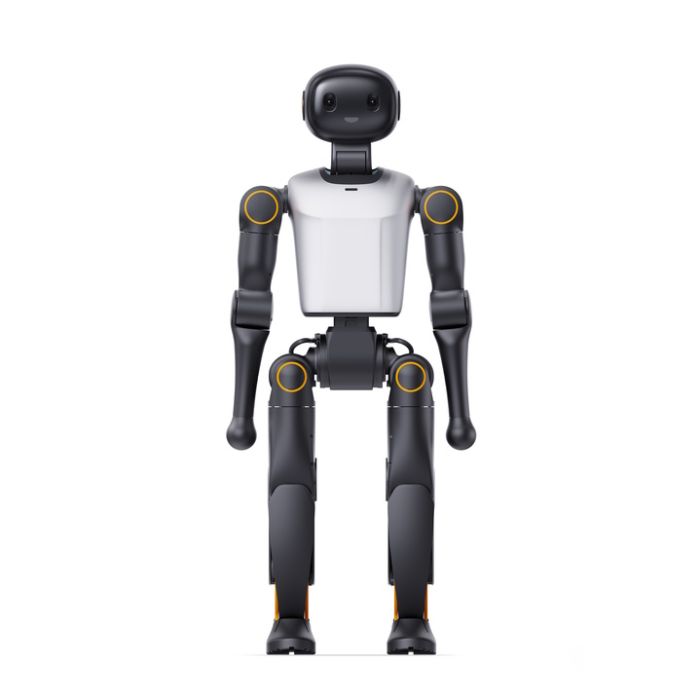
Booster K1 EDU Humanoid Robot
In stock
- ΜΆΡΚΑ:
- BOOSTER ROBOTICS
- ΜΟΝΤΈΛΟ:
- BOOSTER K1
- ORIGIN:
- Κίνα
- Warranty:
- 12 ΜΗΝΕΣ
- AVAILABILITY:
- SUBJECT TO AVAILABILITY
- SKU:
- Booster-K1
Booster K1 EDU Humanoid Robot
The Booster K1 EDU Humanoid Robot is a compact, education-oriented bipedal humanoid from Booster Robotics that packs a full research-grade control stack into a platform roughly 0.9 m tall. Rather than being a fixed-function demonstration toy, it exposes low-level joint and sensor interfaces alongside high-level motion APIs, so the same robot can serve a first-year classroom exercise and a graduate locomotion research project.
Background
Booster Robotics is a China-based humanoid robotics company that builds developer-focused bipedal platforms, and the K1 line represents its compact tier aimed squarely at education, research, and robot-sports applications. Vendor listings for this model identify the brand as Booster Robotics, the model as Booster K1, and the intended uses as education, research, and sports.
The K1 platform in the Booster lineup
Within the Booster catalog, the K1 sits below the larger T1 family as a smaller, lighter humanoid intended to lower the barrier to entry for embodied-AI work. Catalog specifications describe a robot of approximately 0.9 m in height, with vendor listings citing a height of about 95 cm and a weight of roughly 19.5 kg, light enough for a single person to handle and transport in the included case. Its 22 degrees of freedom are distributed as six per leg, four per arm, and two in the head, with generous joint travel: the hip joint offers pitch from -170° to 100°, roll from -23° to +90°, and yaw of ±60°, while the knee moves from 0° to 130° and the ankle provides -50° to 20° of pitch and ±20° of roll. That movement envelope is what allows the K1 to walk, balance, and recover in ways that fixed-base classroom robots cannot.
Why an EDU edition exists
The EDU designation reflects packaging and positioning for teaching institutions and structured learning environments. Third-party education-channel listings position this configuration for university labs, STEM classrooms, and serious embodied-AI development, and vendor listings indicate a 12-month warranty. The core value for an education buyer is the combination of a real force-controlled humanoid with a documented software path: ROS2 communication, published robot models, simulation interfaces including Isaac Sim, and a mobile app for network configuration and remote operation, so a course can move from simulation to real hardware without changing toolchains.
Technical Specifications
The table below consolidates the catalog specification for the Booster K1 EDU Humanoid Robot.
| Attribute | Specification |
|---|---|
| Brand / model | Booster Robotics / Booster K1 (EDU) |
| Height | Approximately 0.9 m (vendor listings cite ~95 cm) |
| Weight | Approximately 19.5 kg (per vendor listings) |
| Degrees of freedom | 22 total (legs 6 x 2, arms 4 x 2, head 2) |
| Hip joint range | P -170° to 100°, R -23° to +90°, Y ±60° |
| Knee joint range | 0° to 130° |
| Ankle joint range | P -50° to 20°, R ±20° |
| Processor | NVIDIA Jetson Orin NX 8GB, 117 TOPS AI compute |
| Sensors | RGBD camera, microphone array, speaker, 9-axis IMU |
| Joints | Full-force-controlled, mixed torque/velocity/position control, dual-encoder modules |
| Battery life | Approximately 40 minutes (catalog figure; third-party listings vary) |
| Software | Secondary development interfaces, ROS2 compatible, Isaac Sim support, mobile app |
| Included accessories | Remote control, charger, robot transport case |
Specifications above are drawn from catalog and vendor listings; figures such as runtime, weight, and joint ranges can vary by production batch and configuration, so confirm exact values during quotation.
How open is the Booster K1 EDU for development?
Openness is the K1 EDU's defining trait. The software system explicitly supports secondary development, exposing two distinct layers: low-level interfaces to individual joints and sensors, and high-level motion interfaces for whole-body behaviors. Booster also provides robot models and simulation interfaces supporting environments such as Isaac Sim, which means locomotion policies, perception pipelines, and manipulation experiments can be validated virtually before touching hardware. The full-force-controlled joints, with dual encoders and mixed torque, velocity, and position control, additionally make the K1 EDU suitable for compliance and whole-body control research rather than position-only playback.
What sensing and compute does the Booster K1 EDU carry onboard?
The onboard computer is an NVIDIA Jetson Orin NX 8GB module delivering 117 TOPS of AI computing performance, enough to run modern perception networks, speech pipelines, and reinforcement-learning policies directly on the robot without a tethered workstation. Perception hardware includes an RGBD depth camera for vision and spatial awareness, a microphone array and speaker for voice interaction experiments, and a 9-axis IMU for balance and state estimation. A companion mobile app handles network configuration and remote control, while the bundled handheld remote provides direct teleoperation for demonstrations and safe testing.
Who is the Booster K1 EDU Humanoid Robot for?
The K1 EDU is aimed at university robotics and AI laboratories, STEM and vocational classrooms, research groups working on bipedal locomotion or human-robot interaction, and robot-sports teams competing in humanoid leagues. It also suits corporate innovation teams that want an affordable-class humanoid testbed before committing to a full-size platform. Buyers who need heavy payload handling or industrial deployment should look to larger platforms; the K1 EDU is a learning, research, and prototyping machine first.
What is the Booster K1 EDU Humanoid Robot used for?
Typical applications reported for this class of platform include:
- Teaching robotics fundamentals such as kinematics, dynamics, and control on real force-controlled hardware.
- Embodied-AI research, including reinforcement learning for locomotion trained in simulation and deployed via ROS2.
- Computer-vision and speech-interaction projects using the onboard RGBD camera, microphone array, and speaker.
- Robot-sports participation and demonstrations, an application area explicitly listed for the K1 platform.
- Simulation-to-real workflows, with Isaac Sim-compatible models used to validate behaviors before hardware runs.
- Outreach, exhibitions, and recruitment events where a walking humanoid makes robotics programs tangible.
Pricing and Availability
Pricing for the Booster K1 EDU Humanoid Robot is provided on a quotation basis, and final cost depends on configuration, accessories, shipping destination, and any institutional or multi-unit arrangements. The package includes the robot, remote control, charger, and transport case, and vendor listings indicate a 12-month warranty. To receive current pricing, lead time, and delivery details for your region, submit a request for quotation through the product page and a specialist will respond with a tailored offer.
Frequently Asked Questions
How tall is the Booster K1 EDU and how much does it weigh?
The catalog lists a height of approximately 0.9 m, with vendor listings citing about 95 cm and a weight of roughly 19.5 kg, making it compact enough for one person to carry in the included transport case.
How many degrees of freedom does the K1 EDU have?
It has 22 degrees of freedom in total: six per leg, four per arm, and two in the head, all implemented as full-force-controlled joints with dual-encoder modules.
What computer does the K1 EDU use?
It runs an NVIDIA Jetson Orin NX 8GB module providing 117 TOPS of AI computing power, sufficient for onboard perception and learned control policies.
Does the Booster K1 EDU support ROS2 and simulation?
Yes. The software stack is compatible with the ROS2 communication protocol, exposes low-level and high-level interfaces for secondary development, and provides robot models and simulation interfaces supporting environments such as Isaac Sim.
How long does the battery last?
The catalog specification states approximately 40 minutes of battery life. Some third-party listings cite longer walking endurance for K1 configurations, so confirm the runtime of the exact configuration during quotation.
What is included in the box?
The standard package includes the Booster K1 EDU robot, a handheld remote control, a charger, and a robot transport case, plus access to the mobile app for network setup and remote control.
Where can I buy the Booster K1 EDU Humanoid Robot and what does it cost?
The Booster K1 EDU is available to order through this store on a request-for-quotation basis. Pricing is not published because it depends on configuration and destination; submit a quotation request and you will receive current pricing, warranty terms, and lead-time information.
Summary
The Booster K1 EDU Humanoid Robot condenses the essentials of modern humanoid research — force-controlled joints, serious onboard AI compute, rich sensing, and an open ROS2 development path — into a sub-meter platform sized and packaged for classrooms and labs. Its 22 degrees of freedom and wide joint travel support genuine bipedal locomotion work, while Isaac Sim compatibility and documented interfaces keep the simulation-to-hardware loop short. For institutions evaluating their first humanoid, or teams adding an accessible development unit alongside larger robots, this page is the starting point.