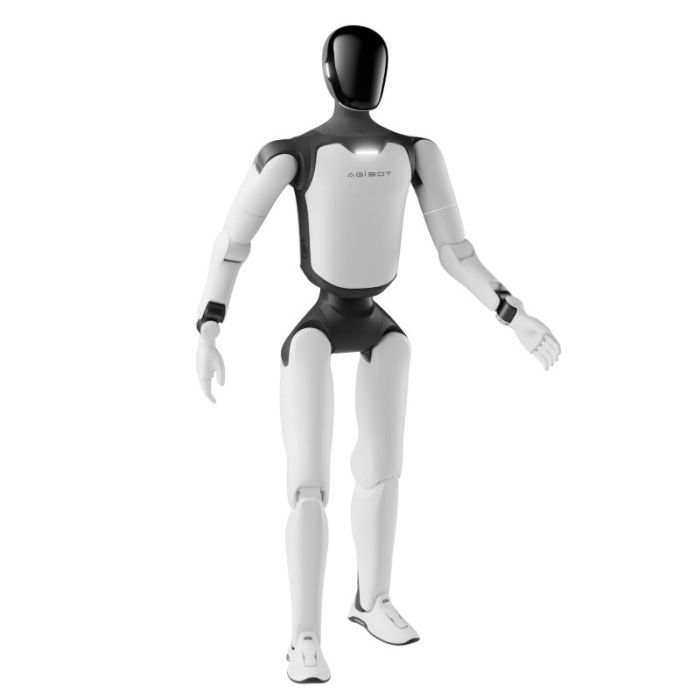
Agibot A3 Dual-Battery Interactive Service Humanoid Robot
The AgiBot Expedition A3 is a full-size bipedal humanoid robot engineered specifically for high-frequency, audience-facing environments. Retail showrooms, live entertainment events, brand activations, and exhibition halls are among its primary intended settings. What set the robot apart at its launch was a series of demonstrations showing it execute martial arts maneuvers including aerial flying kicks, consecutive mid-air strikes, and cyclone spinning movements.
In stock
ΜΆΡΚΑ:
AGIBOT
ΜΟΝΤΈΛΟ:
A3
ORIGIN:
Κίνα
Warranty:
12 ΜΗΝΕΣ
AVAILABILITY:
USUALLY SHIPS IN 7-14 BUSINESS DAYS
SKU:
AgiBot-A3
63.374,27 €
Χωρίς ΦΠΑ:63.374,27 €
Χωρίς ΦΠΑ:
Free Shipping
Loading...
Agibot A3 Interactive Service Humanoid Robot
The Agibot Expedition A3 is a full-size humanoid robot, built to approximate human proportions and move in ways that feel natural and legible to human observers. Its body incorporates what AgiBot describes as highly anthropomorphic full-body degrees of freedom, including a flexible waist joint engineered to mirror the rotational and lateral range of motion found in the human torso. This waist articulation is a key differentiator from earlier humanoid designs that treated the torso as a rigid block. The Expedition A3 is the company's most agility-focused model to date and marks a new chapter in the emerging category of performance and service-oriented humanoid robotics.
Design and Features
Physical Form and Structure
The leg structure uses a lightweight exoskeleton-style frame that prioritizes both explosive movement and stable landings. This design choice allows the robot to generate the kind of dynamic acceleration required for jumping and aerial maneuvers without sacrificing the balance control needed to land and recover cleanly. Engineers optimized the leg geometry specifically for high-frequency motion sequences rather than purely for load-bearing industrial tasks, which distinguishes the A3 mechanically from AgiBot's own A2 and G2 models.
The robotic arms are capable of handling payloads of up to 3 kilograms, with a tool center point speed reaching 2 meters per second. This arm speed is particularly relevant in performance and interactive contexts where gesture expressiveness and responsive motion contribute to how audiences perceive the robot's behavior.
Interaction and Sensory Design
The Agibot A3 features multimodal interaction capabilities that allow it to respond to voice commands, physical contact, and visual cues. An end-to-end large AI model supports natural conversation without the need for a traditional wake word — users can also activate the robot through a shoulder tap, making the interaction feel more intuitive in public settings.
The robot's sensory array includes cameras and perception hardware that support real-time environmental mapping and obstacle awareness. This allows the A3 to navigate shared human spaces — corridors, event floors, retail aisles — with awareness of people and objects in its path. The system continuously adjusts balance and posture in response to terrain changes, which is essential in environments where flooring surfaces, lighting conditions, and crowd densities vary unpredictably.
Power and Endurance
A dual-battery system embedded in the robot's torso extends its operating time to up to eight hours per charge cycle, a significant practical advantage in deployment settings such as full-day trade shows, retail operations, or multi-session entertainment events. This embedded dual-battery architecture is notably distinct from earlier designs that required dedicated charging breaks, and it reflects AgiBot's growing emphasis on operational uptime as a commercial priority.
Technology and Specifications
AI Architecture
The Agibot Expedition A3 runs on AgiBot's proprietary "Embodied Intelligent Brain" architecture, a hierarchical AI system that the company has developed and refined across its full product lineup. This architecture is divided into four functional layers: the Cloud Superbrain (handling mission-level planning), the Main Brain (managing skills and task orchestration), the Sub-brain (processing real-time instructions), and the Brainstem (controlling servo-level actuation).
At the mission level, AgiBot's self-developed multimodal large language model — called WorkGPT — enables the robot to understand intent from spoken language, interpret environmental context through vision, and sequence actions across complex tasks. WorkGPT's underlying training draws on the AgiBot World dataset, one of the largest proprietary robotics training datasets in operation, originally built through a network of tele-operated robots generating embodied AI training data at AgiBot's AIDEA Giga Data Factory.
In March 2025, AgiBot introduced GO-1, its first generalist embodied foundation model, which now underpins the AI behavior of robots across the company's lineup, including the A3. The robot is also integrated into AgiBot's partnership with NVIDIA as part of the Isaac GR00T ecosystem — a collaboration announced at GTC 2026 that places AgiBot alongside Boston Dynamics, Figure, Agility Robotics, and NEURA Robotics.
Motion Control
The A3's motion control system is built around real-time balance algorithms capable of maintaining stable posture through rapid acceleration, airborne phases, and impact recovery. The robot's demonstrated ability to execute aerial flying kicks, back-to-back airborne strikes, and controlled mid-air transitions reflects what engineers describe as a control architecture centered on whole-body coordination rather than isolated limb control. Each joint works in concert with the others through a continuous feedback loop that adjusts torque, timing, and center-of-mass position dozens of times per second.
The Expedition A3 was explicitly designed for retail guidance and brand promotional environments. Its athletic mobility and expressive motion make it well-suited for drawing crowds and creating memorable moments in flagship stores, product launches, and trade show floors. Compared to static or slow-moving service robots, the A3's ability to perform dynamic movements within a controlled sequence gives brand teams a new tool for live engagement.
Live Entertainment and Performance
Perhaps the most striking application is live performance. The A3's debut during "AGIBOT Night" on February 7–8, 2026 — a 60-minute gala in Shanghai in which more than 200 robots performed music, dance, comedy, and martial arts sequences — demonstrated that the robot can sustain high-intensity performance across an extended event without degradation in coordination or timing. The dual-battery design supports this use case directly. Synchronized group performance, where multiple A3 units operate in coordination, represents a particularly novel deployment scenario that has no direct equivalent among competing platforms.
Exhibition Halls and Public Demonstrations
Exposition centers, science museums, cultural events, and corporate demonstrations benefit from the A3's combination of dynamic movement and conversational ability. The robot can function as both an interactive guide — answering visitor questions through natural dialogue — and as a kinetic exhibit in its own right, capable of scheduled demonstration runs that attract and retain audience attention.
Promotional and Hospitality Events
Hotels, convention centers, and large-scale hospitality environments can deploy the A3 for front-of-house interaction. Its shoulder-tap activation and wake-word-free conversation make initial contact feel natural, reducing the social friction that often accompanies interactions with service robots. Its appearance — upright, proportionally human, and capable of expressive motion — helps position it as a memorable element of premium guest experiences.
Advantages and Benefits
Athletic agility with practical utility. Most humanoid robots in the service category prioritize conversational ability and basic navigation. The A3 adds a dimension of physical expressiveness and dynamic motion that allows it to function as both a useful assistant and a compelling spectacle, expanding the range of scenarios in which a humanoid robot creates genuine value.
Extended operational time. The embedded dual-battery system providing up to eight hours of operation is practically meaningful for deployment in full-day retail, exhibition, or event contexts. Operators do not need to schedule charging downtime during business hours.
Natural interaction design. Wake-word-free conversation and shoulder-tap activation lower the threshold for human-robot interaction, making the robot approachable even in environments where users have not been briefed on how to engage with it. This design philosophy reflects AgiBot's broader emphasis on service robots that can operate in genuinely public-facing roles.
Manufacturer credibility at scale. AgiBot's position as the world's leading humanoid robot shipper by volume in 2025 provides meaningful assurance about production infrastructure, supply chain maturity, and the company's ability to support deployed units. The A3 benefits from the same organizational foundation that produced and delivered more than 5,168 humanoid units across eight industries.
AI ecosystem integration. Membership in the NVIDIA Isaac GR00T partner network provides access to an expanding set of simulation tools, pre-trained models, and developer resources that can accelerate capability improvements over the A3's operational life.
Frequently Asked Questions
What are the main use cases for the AgiBot Expedition A3?
The A3 is designed for retail customer engagement, live entertainment performances, brand promotional events, exhibition hall demonstrations, hospitality environments, and any setting where dynamic human-robot interaction is a priority. Its eight-hour battery life and natural interaction design support full-day deployments in public-facing contexts.
Is the AgiBot A3 safe to operate in public environments?
AgiBot designs its humanoid robots with human-robot coexistence as a priority. The A3's sensory systems support real-time environment awareness and obstacle detection for safe navigation in shared spaces. AgiBot's broader safety architecture, applied across its product lineup, includes multiple layers of hardware and software protection. However, specific safety certifications for the A3 had not been publicly confirmed as of early 2026; the A2 model achieved China, US, and EU certification in May 2025.
Summary
The AgiBot Expedition A3 Interactive Service Humanoid Robot represents a meaningful evolution in what humanoid robots can offer in public-facing commercial environments. Built by the company that shipped more humanoid units than any other manufacturer in 2025, the A3 combines genuine athletic agility — demonstrated through real-world martial arts maneuvers filmed without CGI — with an AI system capable of natural conversation, environmental awareness, and eight-hour continuous operation. Priced at approximately $110,000 and targeted at retail, entertainment, and live event settings, the A3 occupies a unique position in the humanoid robotics market: technically credible, commercially accessible, and distinctly oriented toward performance and human engagement. As AgiBot scales production toward tens of thousands of units annually and expands its global distribution and rental infrastructure, the Expedition A3 stands as a compelling entry point for organizations exploring the frontier of interactive service robotics.
Specifications
ΈΩΣ 10 ΏΡΕΣ
Runtime
General
ΜΆΡΚΑ
AGIBOT
ΜΟΝΤΈΛΟ
A3
ΤΎΠΟΣ ΡΟΜΠΌΤ
ΑΝΘΡΩΠΟΕΙΔΈΣ
ΧΡΉΣΗ ΡΟΜΠΌΤ
ΨΥΧΑΓΩΓΊΑ, ΈΚΘΕΣΗ, ΞΕΝΟΔΟΧΕΊΟ, ΑΘΛΗΤΙΣΜΌΣ
Physical
ΎΨΟΣ
173 cm
ΒΆΡΟΣ
55.0 kg
Battery + Power
ΧΡΌΝΟΣ ΕΚΤΈΛΕΣΗΣ
ΈΩΣ 10 ΏΡΕΣ
What's included
Agibot A3 Interactive Service Humanoid Robot (A3)
Videos
Product Questions
The AgiBot Expedition A3 is a full-size bipedal humanoid robot developed by Shanghai-based AGIBOT and unveiled in February 2026. It is designed for interactive service environments such as retail stores, live entertainment events, brand activations, and exhibition halls, and is notable for its ability to perform dynamic martial arts-style movements — including aerial kicks and mid-air maneuvers — in real-world conditions without CGI.
The A3 operates using AgiBot's proprietary "Embodied Intelligent Brain" AI architecture, a layered system that handles everything from high-level mission planning (via the WorkGPT multimodal model) to servo-level motor control. Real-time balance algorithms coordinate across all body joints to maintain stability during dynamic motion sequences. Users can interact with it through natural speech (no wake word required) or physical contact such as a shoulder tap.
Write a Review
Related Products
Navigating through the elements of the carousel is possible using the tab key. You can skip the carousel or go straight to carousel navigation using the skip links.
Press to skip carousel
Χρησιμοποιούμε cookies για να βελτιώσουμε την εμπειρία σας, να αναλύσουμε την επισκεψιμότητα και να εξατομικεύσουμε τις διαφημίσεις. Μπορείτε να αποδεχτείτε όλα τα cookies, να απορρίψετε τα μη απαραίτητα ή να διαχειριστείτε τις προτιμήσεις σας. Πολιτική cookies
Προτιμήσεις cookies
Απολύτως απαραίτητα (Πάντα ενεργά)
Απαραίτητα για τις βασικές λειτουργίες του ιστότοπου, όπως το καλάθι, η ολοκλήρωση αγοράς και η ασφάλεια.
Μας βοηθούν να κατανοήσουμε πώς οι επισκέπτες χρησιμοποιούν τον ιστότοπό μας (Google Analytics).
Χρησιμοποιούνται για τη μέτρηση και τη βελτίωση της αποτελεσματικότητας των διαφημίσεών μας (Google Ads).