Booster T1 Standard Humanoid Robot
In stock
- MARCA:
- BOOSTER ROBOTICS
- MODEL:
- BOOSTER T1 STANDARD
- ORIGIN:
- China
- Warranty:
- 12 LUNI
- AVAILABILITY:
- SUBJECT TO AVAILABILITY
- SKU:
- Booster-T1-Standard
- Buy 2 for 31.082,39 EUR 31.082,39 EUR each and save 1%
Booster T1 Standard Humanoid Robot
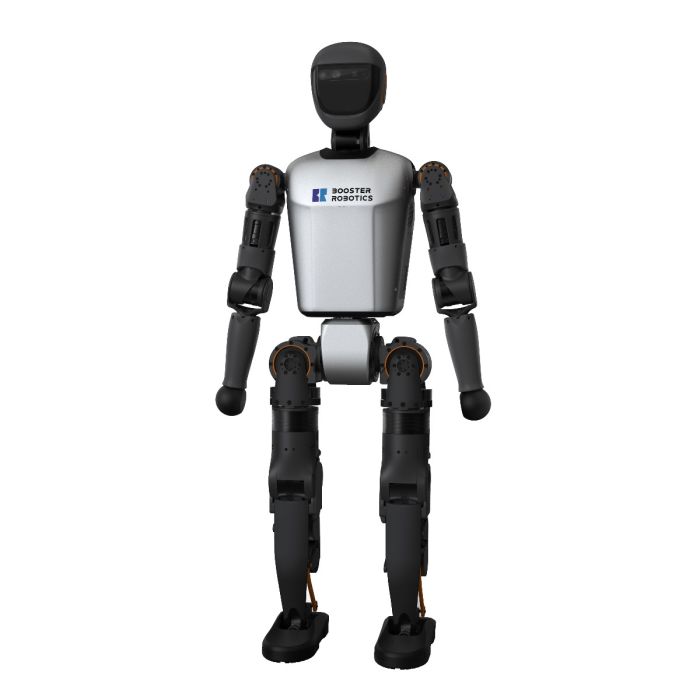
The Booster T1 Standard Humanoid Robot is Booster Robotics' developer-focused mid-size humanoid: an approximately 1.2 m bipedal platform with 23 force-controlled degrees of freedom, dual onboard computers delivering 200 TOPS of AI performance, and a software stack built for secondary development over ROS2. The T1 line has earned real competitive credentials — Booster's own materials identify the T1 as the championship-winning model of the 2025 RoboCup Soccer AdultSize category and note its adoption by dozens of top global robotics teams and research institutes — making the Standard configuration a proven choice for laboratories that need a durable, programmable humanoid rather than a demonstration prop.
Background
Booster Robotics Technology Co., Ltd. is a Chinese humanoid robotics company whose stated focus is building robots "made for developers," with comprehensive API interfaces and open-source tooling. The T1 is its flagship developer platform, offered in multiple configurations including Basic, Standard, and Customized tiers.
A platform hardened by competition
Few specification sheets say as much about a humanoid as a soccer pitch does. According to the manufacturer, the T1 won the 2025 RoboCup AdultSize soccer category and is the preferred platform of more than fifty leading robotics teams and research institutes worldwide. Competitive robot soccer punishes fragile machines: robots fall, collide, get back up, and keep playing. The manufacturer characterizes the T1 family as lightweight, flexible, and durable — around 1.2 m and roughly 30 kg per its published overview — with an extra-large joint movement space that supports dynamic recovery. Third-party robot databases list the T1 as introduced in 2024 and describe it as a lightweight, high-performance humanoid for developers and researchers with ROS2 compatibility and advanced simulation support.
The Standard configuration
The Standard tier documented here carries 23 degrees of freedom: six per leg, four per arm, one in the waist, and two in the head. The waist joint, with ±58° of travel, distinguishes the T1 from smaller humanoids by enabling torso rotation for reaching, balance, and more human-like whole-body motion. Manufacturer materials note the broader T1 family spans 23 to 41 degrees of freedom across configurations, so the Standard sits at the accessible end of that range while sharing the family's actuation architecture: full-force-controlled joints with dual encoders and mixed torque, velocity, and position control. Catalog specifications state omnidirectional walking — forward, backward, sideways, and turning — with forward speed above 0.5 m/s, and a one-year warranty is provided.
Technical Specifications
The catalog specification for the Booster T1 Standard Humanoid Robot is summarized below.
| Attribute | Specification |
|---|---|
| Brand / model | Booster Robotics / T1 Standard |
| Height | Approximately 1.2 m |
| Weight | Approximately 30 kg (per manufacturer overview) |
| Degrees of freedom | 23 (legs 6 x 2, arms 4 x 2, waist 1, head 2) |
| Waist joint range | ±58° |
| Hip joint range | P ±118°, R -21° to 88°, Y ±58° |
| Knee joint range | 0° to 123° |
| Ankle joint range | P -50° to 20°, R ±25° |
| Processors | Intel i7-1370P + NVIDIA Jetson AGX Orin 32GB, 200 TOPS AI compute |
| Sensors | RGBD camera, microphone array, speaker, 9-axis IMU |
| Joints | Full-force-controlled, dual-encoder modules, mixed torque/velocity/position control |
| Locomotion | Omnidirectional walking; forward speed above 0.5 m/s |
| Battery life | More than 1 hour in motion (catalog; manufacturer materials cite longer endurance) |
| Software | Secondary development, ROS2 protocol, Isaac Sim simulation interfaces, mobile app |
| Warranty | One year |
Specifications are compiled from catalog and manufacturer materials; endurance, mass, and DoF counts vary across T1 configurations and production revisions, so confirm exact figures for your configuration during quotation.
Why does the Booster T1 Standard use two onboard computers?
The T1 Standard pairs an Intel i7-1370P x86 processor with an NVIDIA Jetson AGX Orin 32GB module, together rated at 200 TOPS of AI computing power. This dual-compute architecture mirrors how modern humanoid software is actually structured: the GPU-accelerated Jetson handles perception and neural workloads — vision from the RGBD camera, audio from the microphone array, learned locomotion policies — while the x86 processor runs general-purpose software, middleware, and developer code in a familiar environment. For researchers, the practical benefit is headroom: perception networks and control stacks can run simultaneously onboard, untethered, without offloading to an external workstation.
How developer-friendly is the T1 Standard in practice?
Booster positions the entire T1 line around developer experience, and the catalog specification backs this up concretely. The software system supports secondary development at two levels — direct interfaces to low-level joints and sensors, and high-level motion interfaces for composed behaviors — and communicates over the ROS2 protocol, so standard robotics tooling works out of the box. Robot models and simulation interfaces support environments such as Isaac Sim, enabling sim-first development and policy transfer to hardware. The manufacturer additionally describes comprehensive APIs alongside an open-source framework and tools. A mobile app covers network configuration and remote control, keeping routine operation simple even for teams whose focus is research code rather than robot administration.
Who is the Booster T1 Standard Humanoid Robot for?
The T1 Standard targets university research groups, corporate R&D labs, and advanced education programs that need a full-featured, mid-size humanoid for locomotion, perception, and interaction research. Its competition pedigree makes it a natural pick for RoboCup and robot-sports teams, while its 200 TOPS of compute suits embodied-AI groups deploying learned policies onboard. Organizations seeking industrial payload handling or commercial service deployment at scale should evaluate task-specific platforms; the T1 Standard is fundamentally a development and research machine, and that is where it excels.
What is the Booster T1 Standard Humanoid Robot used for?
Documented and representative applications include:
- Bipedal locomotion research, exploiting the waist joint, wide joint ranges, and force-controlled actuation for dynamic whole-body control.
- Robot soccer and competitive robotics, the arena in which the T1 family won the 2025 RoboCup AdultSize championship.
- Embodied-AI development, running perception and reinforcement-learning policies on the 200 TOPS dual-compute stack.
- ROS2-based software research and teaching, from navigation and manipulation planning to human-robot interaction with the onboard audio system.
- Simulation-to-real workflows using Isaac Sim-compatible models to validate behaviors before hardware deployment.
- Service, retail, entertainment, and social-interaction prototyping, use cases associated with the T1 platform in industry databases.
Pricing and Availability
The Booster T1 Standard Humanoid Robot is sold on a request-for-quotation basis, and pricing is not published on this page because final cost depends on configuration tier, options, destination, and institutional terms. A one-year warranty is included per the catalog specification. To obtain current pricing, availability, and delivery timelines for your region, submit a request for quotation through this product page and a specialist will prepare a tailored offer.
Frequently Asked Questions
How big is the Booster T1 Standard?
It stands approximately 1.2 m tall, with the manufacturer's platform overview citing a weight of roughly 30 kg — large enough for meaningful whole-body research, small enough for a lab to handle safely.
What degrees of freedom does it have?
The Standard configuration has 23 DoF: six per leg, four per arm, one waist joint with ±58° of travel, and two in the head. Other T1 configurations extend the family up to 41 DoF per the manufacturer.
How fast can it walk?
The catalog specifies omnidirectional walking — forward, backward, sideways, and turning — with a forward speed above 0.5 m/s.
What is the battery endurance?
The catalog states more than one hour of operation in motion. Manufacturer materials for the T1 family cite longer walking and standing endurance figures, so confirm the runtime of your exact configuration during quotation.
Which computers and sensors are onboard?
An Intel i7-1370P and an NVIDIA Jetson AGX Orin 32GB provide 200 TOPS of AI compute, alongside an RGBD camera, microphone array, speaker, and 9-axis IMU.
Is the T1 Standard suitable for research and custom software?
Yes. It supports secondary development with low-level joint/sensor and high-level motion interfaces, is ROS2 compatible, and provides simulation models supporting environments such as Isaac Sim.
Where can I buy the Booster T1 Standard Humanoid Robot and what does it cost?
It is available to order through this store via a request for quotation. Pricing depends on configuration and destination and is confirmed during the quotation process, together with warranty and lead-time details.
Summary
The Booster T1 Standard Humanoid Robot combines competition-proven mechanics, 23 force-controlled degrees of freedom including a true waist joint, and a 200 TOPS dual-computer brain into a platform expressly built for developers. Its RoboCup championship pedigree signals durability under real dynamic loads, while ROS2 compatibility, open development interfaces, and Isaac Sim support keep research velocity high from simulation to hardware. For any team evaluating a serious mid-size humanoid for research, education, or competition, this page is the starting point.
Specifications
General
What's included
Robot Accessories:
- Remote Control
- Charger
- Robot Vertical Stand
- Robot Transport Case