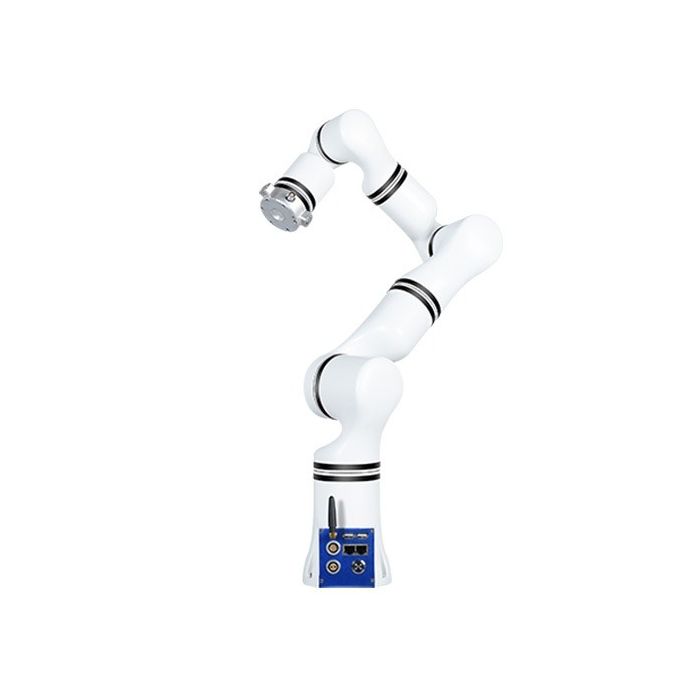
Realman Robotics Ultra-Lightweight Robotic Arm (RM75-B)
In stock
- VÖRUMERKI:
- REALMAN
- HLUTI #:
- RM75-B
- AVAILABILITY:
- SUBJECT TO AVAILABILITY
- SKU:
- Realman Robotics-RM75-B
Realman Robotics Ultra-Lightweight Robotic Arm (RM75-B)
Realman Robotics RM75-B Ultra-Lightweight Humanoid Robotic Arm (RM75-B)
The RM75-B is part of RealMan’s RM-series lightweight manipulators and is commonly deployed as a standalone tabletop arm or as a payload on mobile robot platforms.
RealMan Intelligent Technology (Beijing) Co., Ltd. (often associated with the RealMan Robotics brand and website) is listed as a Beijing-based company in industrial automation directories, and it has been reported as opening a data training center for humanoid robotics in Beijing aimed at accelerating real-world deployment of humanoid systems.
Design and Features
Lightweight architecture and compact form factor
A defining characteristic of the RM75-B is its low arm mass relative to typical collaborative robot arms. In RealMan’s published specifications, the RM75-B body weight is listed at about 7.8 kg, supporting portability and integration on mobile bases, carts, or compact workcells.
Integrated controller concept and simplified deployment
The RM75-B is commonly described as integrating core control components in a way that reduces external cabinet complexity. Product listings describe an “integrated controller,” with multiple I/O and networking options intended for direct integration with PCs, embedded computers, or robot base controllers.
Teaching and control modes
RealMan’s RM75-B documentation and listings describe multiple operator and developer workflows, including:
-
Drag/hand-guiding (drag teaching) for quick waypoint capture and demonstration-style programming
-
Teaching pendant operation for manual jogging and setup
-
API-oriented control (including JSON-oriented interfaces in official materials) for software-driven integration
Technology and Specifications
Core kinematics and performance
-
Degrees of freedom (DoF): 7
-
Rated payload: 5 kg
-
Reach / working radius: approximately 610 mm
-
Repeatability: ±0.05 mm
-
Arm mass (body weight): about 7.8 kg
Power and environmental rating
-
Supply voltage: DC range listed as 20–30 V, with 24 V commonly referenced as nominal
-
Power consumption: RealMan materials list ≤200 W maximum and ≤100 W typical/average
-
Ingress protection: IP54
Joint motion ranges and speeds
RealMan specifications provide joint ranges and speed limits suitable for general manipulation (examples include broad rotation ranges on most joints and a continuous-rotation seventh joint). RealMan also publishes speed figures in degrees per second for joint groups (with faster limits on distal joints).
Connectivity and software integration
RealMan’s RM75-B materials list a mix of wired and wireless connectivity options (commonly including networking and serial-style interfaces) and multiple control pathways intended for both teaching and programmatic control.
Retail listings additionally emphasize robotics software compatibility, often highlighting ROS-based workflows (including ROS toolchains used in research such as motion planning frameworks) and simulation-friendly integration.
Applications and Use Cases
Mobile manipulation and field robotics
Because the RM75-B combines a relatively low arm mass with a mid-range reach, it is frequently marketed for mobile manipulation—mounting the arm on an AMR/AGV or research rover to enable tasks like button pushing, sample pickup, tool handling, or light-duty servicing. These setups often pair the arm with perception sensors and ROS-based autonomy stacks.
Research and education
In universities and labs, 7-DoF arms are commonly used for experimentation in:
-
motion planning and redundancy resolution (using the extra DoF for obstacle avoidance),
-
imitation learning and demonstration capture (supported by drag teaching),
-
grasping research with cameras and tactile sensors,
-
human–robot interaction prototypes.
The RM75-B’s combination of published repeatability and software-forward positioning makes it relevant to these workflows.
Service robotics and light industrial automation
Typical light industrial or service use cases include:
-
pick-and-place for small parts,
-
lab automation (moving containers, trays, instruments),
-
inspection assistance (positioning cameras or sensors),
-
kiosk/retail demonstrations and guided interactions.
Advantages / Benefits
7-DoF dexterity for constrained spaces
A 7-DoF structure can provide redundancy, enabling configurations that avoid obstacles or keep an end-effector oriented while “elbowing” around fixtures—useful in mobile bases, cluttered benchtops, and human-centric environments.
Weight-to-capability balance
With a published body weight around 7.8 kg and a rated payload of 5 kg, the RM75-B targets a practical middle ground for labs and integrators building compact systems that still need meaningful payload and reach.
Developer-oriented control and integration
RealMan’s published control modes (including API-based control and structured data interfaces) and reseller-described ROS compatibility align with modern robotics development workflows, where manipulation is part of a larger autonomy stack.
FAQ Section
What is the Realman Robotics RM75-B?
The RM75-B is a 7-DoF ultra-lightweight robotic arm designed for manipulation tasks in research, service robotics, and compact automation, with commonly published specs including 5 kg rated payload, ~610 mm reach, and ±0.05 mm repeatability.
How does the RM75-B work?
The RM75-B uses seven actuated joints to position an end-effector in 3D space. Its extra (seventh) joint provides redundancy, allowing the arm to choose among multiple valid postures for the same end position—useful for obstacle avoidance and mobile manipulation. RealMan materials also describe teaching and API-based control workflows for programming and autonomy integration.
Why is the RM75-B important?
Lightweight 7-DoF arms are important because they make it easier to build mobile manipulators and compact workcells, and they support research in planning, learning-from-demonstration, and human-centered interaction—areas where redundancy and flexible configuration matter.
What are the benefits of the RM75-B?
Commonly cited benefits include 7-DoF dexterity, a lightweight body (around 7.8 kg), 5 kg rated payload, and published ±0.05 mm repeatability, plus developer-friendly integration options used in research and robotics software stacks.
Summary
The Realman Robotics RM75-B is a 7-DoF ultra-lightweight robotic arm aimed at modern manipulation use cases—particularly research, education, and mobile manipulation—where a balance of payload, reach, portability, and software integration is crucial. With widely published specifications such as 5 kg rated payload, ~610 mm reach, and ±0.05 mm repeatability, the RM75-B fits into the growing class of compact arms used to bring dexterous manipulation from lab benches to practical robotics deployments.