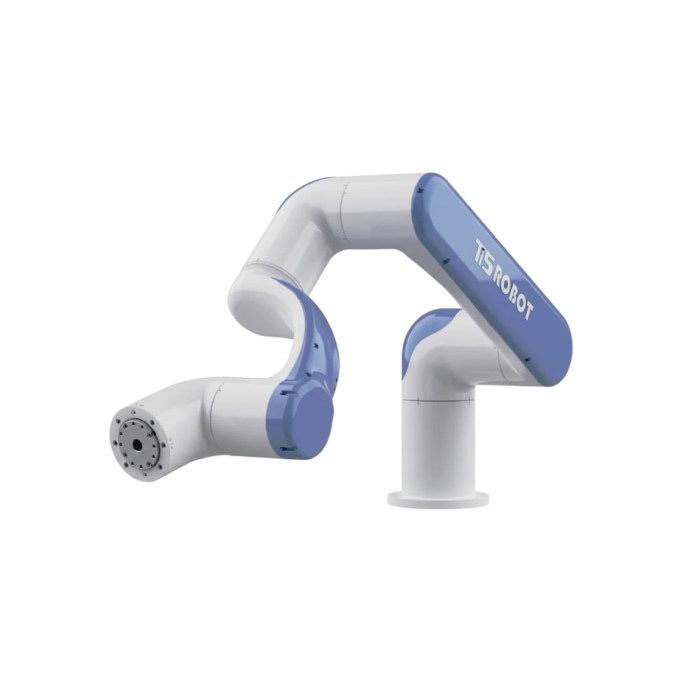
Ti5 Robotics EBLM/ARM Series Collaborative Robot Arms
In stock
- MARKA:
- TI5 ROBOTICS
- MODELKA:
- EBLM-ARM-Series
- ORIGIN:
- Chiny
- Warranty:
- 12 MIESIĘCY
- AVAILABILITY:
- SUBJECT TO AVAILABILITY
- SKU:
- Ti5-Robotics-EBLM-ARM-Series
Ti5 Robotics EBLM/ARM Series Collaborative Robot Arms
Ti5 Robotics EBLM/ARM Series Collaborative Robot Arms form a family of lightweight six-axis manipulators developed by Ti5 Robot for research, development, and light automation work. The series documented by the manufacturer spans several models with rated payloads from 1 kg to 3 kg and working radii from 380 mm to 600 mm, all sharing a common joint architecture, an aluminum alloy body, and open programming interfaces including ROS, Python, and C++. This page covers the model family as a single listing; the documented variants are described together below so the differences between them remain clear.
Background
The design philosophy behind the EBLM/ARM Series
Ti5 Robot states that its goal is to build high-performance, industry-standard robot products while lowering the threshold for customers to develop and use robots. The EBLM/ARM Series reflects that intent: rather than a closed, application-specific machine, each arm is a compact six-degree-of-freedom platform built around the company's joint module technology, with CAN and EtherCAT body communication and openly documented software interfaces. The arms use a consistent blue-and-white exterior and an aluminum alloy structure, which keeps the smaller models in the series light enough to move between benches and test rigs without lifting equipment.
A family of variants, not a single arm
The manufacturer's shared product page presents four models. Three of them carry complete parameter tables: the EBLM-1 (1 kg rated load, 2.6 kg weight, 380 mm reach), the EBLM-2 (2 kg rated load, 4.5 kg weight, 520 mm reach), and a third unit the source labels inconsistently — the page heading calls it "Ti5 Robot Arm-3" while its own parameter table is titled "Ti5 Robot Eblm-3" (3 kg rated load, 12 kg weight, 600 mm reach). Buyers should treat ARM-3 and EBLM-3 as references to the same documented unit until the manufacturer clarifies the naming. A fourth model, the ARM-5, appears on the page with a drawing heading but no published parameter values, so no specifications are listed for it here. Across the three fully documented variants, repeatability, joint ranges, joint speeds, communication options, and environmental figures are identical; payload, weight, reach, and power ratings are what separate them.
Technical Specifications
The following tables preserve the published configuration distinctions. Blank, malformed, or ambiguous source values are not confirmation of a capability; confirm the selected configuration during quotation.
Ti5 Robot Eblm-1
| Name | Unit | Ti5 Robot Eblm-1 |
| Rated load | kg | 1 |
| weight | kg | 2.6 |
| Working radius | mm | 380 |
| Repeatability | mm | ±0.05 |
| Degrees of freedom | - | 6 |
| Body material | - | aluminum alloy |
| Exterior Style | - | blue and white color scheme |
| Joint range of motion | 。 | J1(±180) J2(±90) J3(±135) J4(±180) J5(±150) J6(±180) |
| Joint speed | °/s | J1(180) J2(180) J3(180) J4(220) J5(220) J6(220) |
| Typical speed on the tool side | m/s | 1 |
| Ontology communication | - | Can/EtherCat |
| Temperature range | ℃ | -10~50 |
| IP Level | - | IP50 |
| Power supply voltage range | - | 28-48VDC |
| Rated power | W | 50 |
| Maximum power | W | 90 |
| Standard cable length | m | 1 |
| Interfaces and Openness | - | ROS、Python、C++ |
Ti5 Robot Eblm-2
| Name | Unit | Ti5 Robot Eblm-2 |
| Rated load | kg | 2 |
| weight | kg | 4.5 |
| Working radius | mm | 520 |
| Repeatability | mm | ±0.05 |
| Degrees of freedom | - | 6 |
| Body material | - | aluminum alloy |
| Exterior Style | - | blue and white color scheme |
| Joint range of motion | 。 | J1(±180) J2(±90) J3(±135) J4(±180) J5(±150) J6(±180) |
| Joint speed | °/s | J1(180) J2(180) J3(180) J4(220) J5(220) J6(220) |
| Typical speed on the tool side | m/s | 1 |
| Ontology communication | - | Can/EtherCat |
| Temperature range | ℃ | -10~50 |
| IP Level | - | IP50 |
| Power supply voltage range | - | 28-48VDC |
| Rated power | W | 80 |
| Maximum power | W | 110 |
| Standard cable length | m | 1 |
| Interfaces and Openness | - | ROS、Python、C++ |
Ti5 Robot Arm-3
| Name | Unit | Ti5 Robot Eblm-3 |
| Rated load | kg | 3 |
| weight | kg | 12 |
| Working radius | mm | 600 |
| Repeatability | mm | ±0.05 |
| Degrees of freedom | - | 6 |
| Body material | - | aluminum alloy |
| Exterior Style | - | blue and white color scheme |
| Joint range of motion | 。 | J1(±180) J2(±90) J3(±135) J4(±180) J5(±150) J6(±180) |
| Joint speed | °/s | J1(180) J2(180) J3(180) J4(220) J5(220) J6(220) |
| Typical speed on the tool side | m/s | 1 |
| Ontology communication | - | Can/EtherCat |
| Temperature range | ℃ | -10~50 |
| IP Level | - | IP50 |
| Power supply voltage range | - | 28-48VDC |
| Rated power | W | 280 |
| Maximum power | W | 350 |
| Standard cable length | m | 1 |
| Interfaces and Openness | - | ROS、Python、C++ |
How do the EBLM/ARM variants differ in practice?
Because the control architecture, repeatability, joint envelope, and software stack are shared, variant selection comes down to physical scale and power. The EBLM-1 is the most portable option: at 2.6 kg it can sit on a small desktop fixture and handle end effectors and workpieces up to 1 kg within a 380 mm radius. The EBLM-2 roughly doubles the payload to 2 kg and extends reach to 520 mm while remaining under 5 kg of arm weight. The ARM-3/EBLM-3 steps up to a 3 kg rated load and 600 mm reach, with a correspondingly heavier 12 kg body and a higher 280 W rated / 350 W maximum power draw, which should be factored into power supply sizing within the common 28–48 VDC input range. For the ARM-5, prospective buyers should request current documentation before specifying it into a project.
Who is the Ti5 Robotics EBLM/ARM Series for?
The series is aimed at robotics developers, university laboratories, vocational training programs, and integrators who need a compact six-axis arm with open interfaces rather than a locked vendor ecosystem. ROS, Python, and C++ support makes the arms suitable for teams writing their own motion planning, perception, or control software, while CAN and EtherCAT communication fits users integrating the arm into larger automation or humanoid robot development platforms. The low body weights of the smaller variants also suit mobile manipulation experiments where the arm is mounted on a wheeled or legged base.
What is the Ti5 Robotics EBLM/ARM Series used for?
- Scientific research and education, including robotics coursework, manipulation studies, and algorithm development on an open ROS-compatible platform.
- Light industrial production tasks within each variant's rated payload, such as small-part handling and machine tending prototypes.
- Software and control development in Python or C++, from kinematics testing to custom trajectory generation.
- Integration projects over CAN or EtherCAT, where the arm operates as one node in a larger automation or humanoid robot system.
- Laboratory automation experiments that benefit from ±0.05 mm repeatability in a compact footprint.
- Mobile manipulation research, pairing the lighter variants with mobile bases thanks to their low arm weight and 28–48 VDC supply range.
Pricing and Availability
The manufacturer does not publish pricing for the EBLM/ARM Series, and configuration details — variant choice, end effectors, communication options, cabling, and documentation for the ARM-5 — affect the final cost of a working cell. Pricing is therefore provided on a quotation basis. Use the quote request option on this page to specify the variant and intended application, and our team will confirm current availability, lead time, and a complete landed price for your location.
Frequently Asked Questions
How many models are in the EBLM/ARM Series?
The manufacturer's shared page presents four models. Three — EBLM-1, EBLM-2, and the unit labeled both ARM-3 and EBLM-3 — have full parameter tables; the ARM-5 is shown without published specifications.
Are ARM-3 and EBLM-3 different arms?
The source material uses both names for the same documented unit: the heading reads Arm-3 while the parameter table reads Eblm-3. Treat them as one model and confirm the current designation with a quote request.
What payloads and reaches are available?
Documented variants span 1 kg to 3 kg rated load and 380 mm to 600 mm working radius, with arm weights from 2.6 kg to 12 kg depending on the model.
What software and communication interfaces are supported?
All documented variants support ROS, Python, and C++ programming, with CAN and EtherCAT body communication and a 28–48 VDC power supply range.
Can these arms be used outdoors or in wet environments?
The documented variants are rated IP50 with a -10 to 50 °C temperature range, which suits indoor use; they are not specified for wet or washdown environments.
What is the repeatability of the EBLM/ARM Series?
All three fully documented variants are specified at ±0.05 mm repeatability with six degrees of freedom and identical joint motion ranges.
Where can I buy the Ti5 Robotics EBLM/ARM Series and what does it cost?
You can order it through this listing. Because pricing depends on the variant and configuration selected, submit a quote request from this page and we will provide a firm price, availability, and delivery timeline.
Summary
The Ti5 Robotics EBLM/ARM Series offers a scalable family of compact six-axis collaborative arms — 1 kg to 3 kg rated payloads, 380 mm to 600 mm reach, ±0.05 mm repeatability, and open ROS, Python, and C++ interfaces over CAN or EtherCAT. Whether you need a desktop research arm or the larger ARM-3/EBLM-3 platform, this page is the starting point.