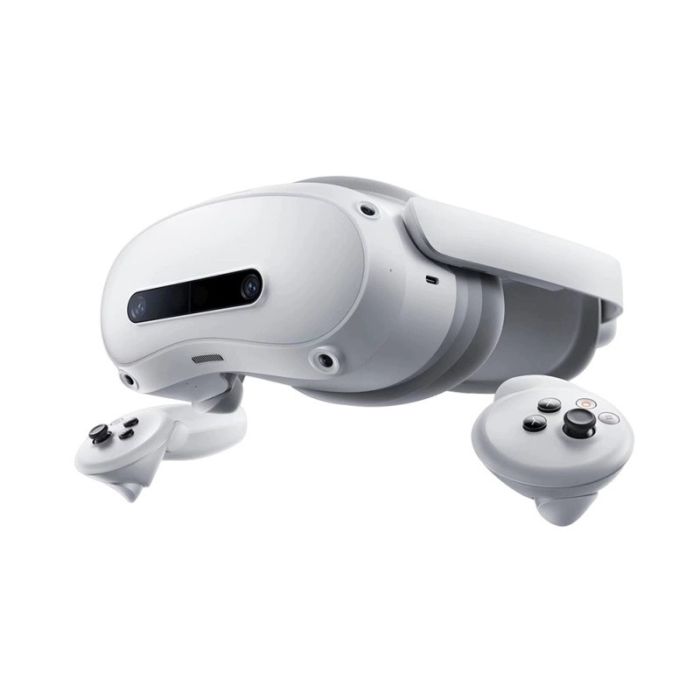
AgiBot A2 VR Teleoperation Kit
In stock
- BRAND:
- AGIBOT
- PART #:
- OmniHand 2025
- ORIGIN:
- China
- AVAILABILITY:
- USUALLY SHIPS IN 7-14 BUSINESS DAYS
- SKU:
- AgiBot-A2-VR
AgiBot A2 VR Teleoperation Kit: Complete Guide
The kit enables what AgiBot describes as "beyond-visual-range control with zero-delay audio/video sync," allowing an operator wearing a VR headset to control the robot and perceive its environment as if inhabiting it directly — a capability AgiBot positions as enabling "remote avatar applications." This positions the VR Teleoperation Kit at the intersection of two distinct and valuable use cases: human-controlled robotic presence in locations where the operator cannot physically be, and high-fidelity robot demonstration for training embodied AI models.
VR-based teleoperation of humanoid robots has grown in significance alongside the broader expansion of robot learning and embodied AI. As companies like AgiBot develop general-purpose robots capable of executing a wide range of manipulation tasks, the quality of training demonstrations becomes a critical factor in how capable those robots become. Teleoperation through VR provides a natural, intuitive interface for human demonstrators to show a robot how to perform complex manipulation tasks — generating high-quality training data in the process.
Key Features
The AgiBot official product page for the VR Teleoperation Kit identifies six core features:
Quick Operation Panel
The Quick Operation Panel allows operators to record and play back robot actions with a single click via AimMaster, AgiBot's operator software platform. This one-click recording capability significantly reduces the overhead of generating labeled robot demonstration trajectories. Instead of requiring a separate annotation workflow, the system captures arm movements and hand actions during teleoperation and stores them as replayable skill sequences that can be immediately reviewed, tested, and incorporated into training datasets or deployed as repeatable behaviors.
Real-Time Motion Mapping
The kit provides real-time motion mapping — the ability to control robot arms such that they follow the movements of the human operator's arms tracked through the VR system. The operator moves their arms naturally within the VR environment, and the robot's arms replicate those movements with minimal delay, providing an intuitive control interface that does not require joystick proficiency or familiarity with robotic coordinate systems.
This approach substantially lowers the barrier to effective robot teleoperation. Rather than learning a joystick or keyboard control scheme that abstracts arm movements into button presses or analog inputs, operators interact with the robot through natural arm and hand motions that the system translates into robot joint commands. Research in teleoperation consistently shows that this type of natural motion interface reduces operator error rates and produces higher-quality demonstrations for AI training compared to abstracted control schemes.
Multi-Gesture Rapid Switching
The kit provides three preset gestures that can be rapidly switched between to adapt to different task requirements. This multi-gesture rapid switching capability allows the operator to transition between grasping configurations — for example, switching from a power grasp to a precision pinch or a lateral key grip — without interrupting the teleoperation session or reaching for separate controls. The three preset options cover the most common grasping modalities encountered in manipulation tasks across manufacturing, logistics, and service scenarios.
Dexterous Hand Precision Control
The VR Teleoperation Kit enables finger motion synchronization for agile grasping through dexterous hand precision control. The operator's finger movements are tracked through the VR system and mapped to the robot's dexterous hand — the OmniHand or built-in SkillHand — allowing the operator to replicate fine-grained manipulation movements including pinch grasps of small objects, in-hand reorientation, and precise tool handling.
This capability is particularly important for generating the manipulation training data that enables robots to handle diverse objects reliably. Dexterous hand control through VR captures not just the arm trajectory but the complete grasp configuration — which fingers contact the object, with what force distribution, and at what orientation — providing the rich state information that embodied AI policies need to generalize across object variations.
Low-Latency Interaction
The kit provides smooth video feedback and real-time response through a low-latency interaction architecture. The video stream from the robot's onboard cameras is transmitted to the VR headset with minimal delay, ensuring that the operator sees the robot's environment as close to real-time as the communication link allows. High latency in teleoperation degrades both operational control quality and demonstration data quality — operators compensate for latency by making slower, more hesitant movements that do not reflect natural human manipulation behavior. The low-latency design of the AgiBot VR kit is intended to ensure that operator movements remain fluid and naturalistic.
Safety Protection Mechanism
The kit incorporates built-in joint limit and collision detection to prevent accidental movements. This safety layer operates during teleoperation to ensure that operator commands that would drive the robot's joints beyond their mechanical limits or into a configuration that causes self-collision are intercepted and prevented before causing hardware damage or unsafe robot behavior in a shared workspace.
Joint limit protection is particularly important in VR teleoperation because the human arm and the robot arm have different kinematic configurations — joint ranges, link lengths, and degrees of freedom differ between human and robot anatomy, meaning that movements that are natural for a human arm may not be achievable or safe for the robot arm. The safety protection mechanism handles these kinematic incompatibilities transparently, allowing the operator to focus on the manipulation task without needing to mentally model the robot's joint limits during operation.
Technology and Specifications
Compatibility
The AgiBot VR Teleoperation Kit is listed as compatible exclusively with:
- AGIBOT A2 Ultra — the certified commercial service humanoid
- AGIBOT A2 Lite — the performance-oriented humanoid for entertainment and commercial applications
The X2 Ultra is listed as a separate accessory option with its own "beyond-visual-range teleoperation" accessory. While specific VR headset hardware requirements are not publicly detailed on AgiBot's product listing, the kit's features suggest compatibility with modern consumer VR headsets capable of hand and controller tracking.
AimMaster Integration
The VR Teleoperation Kit integrates with AimMaster — AgiBot's operator-facing control platform — for action recording and playback. AimMaster provides the one-click recording interface that captures robot actions during VR teleoperation and stores them as playable skill sequences. This integration is central to the kit's utility for both operational use (deploying pre-recorded skills) and data collection (generating labeled trajectory datasets).
AimMaster is also the platform through which A2 Ultra operators configure knowledge bases, wake words, persona, voice, and greeting styles for the robot's autonomous interaction AI. The VR Teleoperation Kit adds a physical control layer to this same operator environment, giving users a unified management interface for both autonomous robot behavior and manually directed teleoperation.
Beyond-Visual-Range Connectivity
The zero-delay audio/video sync for beyond-visual-range operation requires a communication infrastructure between the operator's VR station and the robot's onboard sensors. While AgiBot does not publicly specify the communication protocol or bandwidth requirements, zero-delay operation at the practical level requires either a high-bandwidth local network or a low-latency wide-area network connection (such as 5G), depending on the distance between operator and robot. The A2 Ultra's 4G/5G connectivity module provides the radio communication link for remote operation scenarios.
Data Collection Integration
AgiBot's academic and technical publications describe VR headset teleoperation as one of two primary data collection methods used to generate the AgiBot World dataset. The system captures image observations and proprioceptive states — joint positions, end-effector positions — at a control frequency of 30 Hz during teleoperation sessions. This data, collected across hundreds of robots operating in AgiBot's Shanghai data acquisition center, has generated over one million robot action trajectories spanning 217 tasks across five application domains.
AgiBot's approach to data collection through VR teleoperation uses a "free-form" strategy, in which operators dynamically perform tasks based on real-time conditions rather than following scripted sequences. The company states that this approach produces more diverse demonstration episodes that generalize better across object categories, initial configurations, and execution sequences — producing AI training data that is more useful for developing robots capable of handling the variability of real-world environments.
AgiBot's Genie Sim 3.0 simulation platform, revealed at CES 2026, includes an intelligent data-collection toolkit that supports low-latency teleoperation alongside automated task programming, paired with auto-annotation and a recovery mechanism that resumes data collection after task failures, reducing the cost and time of producing large training datasets.
Applications and Use Cases
Remote Avatar and Telepresence
The most immediate commercial application of the VR Teleoperation Kit is enabling a human operator to be present and active through the robot at a location where the operator cannot physically go. This remote avatar capability is relevant in several scenarios:
Healthcare and Eldercare: A healthcare provider could operate an A2 Ultra robot in a patient's room or an eldercare facility, conducting visual assessments, monitoring, or light-touch assistance while physically located elsewhere.
Hazardous Environment Operations: An operator could direct a robot in an environment that is physically dangerous for human entry — a facility with elevated temperatures, toxic materials, or other hazards — while remaining safely remote.
Event and Brand Activation: A brand representative could inhabit a robot at an event venue in a different city, engaging with attendees through the robot's interactive interface under remote human direction, combining the engagement quality of a live human presence with the novelty and visibility of a humanoid robot.
Guided Tours and Specialized Interaction: For scenarios requiring specialized knowledge or personalized interaction quality — a premium museum tour, a VIP corporate reception — a remote human expert can operate the robot directly rather than relying on the robot's autonomous knowledge base.
Embodied AI Training Data Collection
The VR Teleoperation Kit's integration with AimMaster's one-click recording and AgiBot's data collection pipeline makes it a practical tool for generating high-quality robot manipulation demonstration data. Organizations that deploy AgiBot robots in manufacturing, logistics, or service settings can use the VR kit to demonstrate new tasks directly — generating training trajectories that teach the robot to perform those tasks autonomously over time.
AgiBot's documented approach uses first-person VR teleoperation to capture naturalistic human demonstration data because it aligns the operator's perception with the robot's: the operator sees what the robot sees, leading to demonstration choices that are more directly transferable to the robot's actual task execution context. This first-person alignment reduces the kinematic translation loss that occurs when operators control robots from an external observer perspective.
Skill Recording and Choreography for Entertainment
The A2 Lite's product page specifically notes that "in combination with AGIBOT software and supported VR kits, users can intuitively record, edit, and create custom actions and skills — no coding required." For entertainment operators deploying A2 Lite robots in live performance contexts — galas, shows, brand activations — the VR kit provides an intuitive tool for creating custom motion sequences by physically demonstrating them rather than programming them through code. The AimMaster recording interface captures these demonstrations and stores them as replayable action sequences that can be triggered on demand during events.
Research and Education
University robotics laboratories and research institutions studying teleoperation, imitation learning, human-robot interaction, and dexterous manipulation policies benefit from the VR Teleoperation Kit as a practical data collection interface for the A2 Ultra platform. The kit provides the finger-level dexterous hand tracking required to capture high-fidelity manipulation demonstrations, the low-latency video feedback needed for operator effectiveness, and the collision detection safety layer required for responsible operation in laboratory environments.
Advantages and Benefits
Intuitive Natural Motion Interface: By mapping operator arm and hand movements directly to robot movements rather than requiring joystick or keyboard proficiency, the VR kit enables a broader range of operators to effectively control the robot and generate quality demonstrations. This lowers the skill barrier for robot teleoperation.
First-Person Perception Alignment: Operating from the robot's visual perspective (rather than watching it from outside) enables operators to make more natural, human-like decisions about object handling and task execution, producing training demonstrations that are more transferable to the robot's autonomous operation context.
One-Click Skill Recording via AimMaster: The integration with AimMaster's recording panel allows skill sequences to be captured, reviewed, and stored without a separate annotation workflow, substantially reducing the overhead of building a robot task library through teleoperation.
Built-In Safety for Shared Environments: Joint limit protection and collision detection make VR teleoperation safer to deploy in shared human-robot workspaces, where an operator error during teleoperation could otherwise cause the robot to damage equipment or injure a nearby person.
Zero-Delay Audio/Video for Quality Remote Presence: Low-latency audio-visual feedback preserves the naturalism of operator responses during remote avatar deployments and maintains the demonstration quality during data collection sessions, both of which degrade significantly when latency is high.
No-Code Action Creation for Entertainment: The ability to record custom action sequences through VR demonstration without writing code makes the kit accessible to event operators, brand managers, and performance directors who need to create custom robot behaviors for specific shows or activations.
Frequently Asked Questions (FAQ)
What is the AgiBot A2 VR Teleoperation Kit? The AgiBot A2 VR Teleoperation Kit is an optional accessory that enables a human operator to remotely control an AgiBot humanoid robot using virtual reality equipment. Compatible exclusively with the AGIBOT A2 Ultra and AGIBOT A2 Lite, it provides real-time motion mapping of human arm and hand movements to robot movements, zero-delay audio/video feedback from the robot's perspective, dexterous finger motion synchronization for precise grasping, multi-gesture rapid switching between preset grasp configurations, one-click action recording through AimMaster, and built-in collision detection and joint limit safety protection.
How does the AgiBot VR Teleoperation Kit work? The operator wears a VR headset that tracks arm and hand movements and displays live video and audio from the robot's cameras and microphones. The motion tracking data is transmitted to the robot, which maps the operator's arm movements to its own arm joints in real time. The operator sees and hears what the robot perceives, creating a first-person remote presence experience. The dexterous hand tracking maps finger movements to the robot's hand for precise grasp control. Built-in safety software intercepts any commands that would exceed joint limits or cause collisions before they reach the hardware. Recorded teleoperation sessions can be saved as replayable skill sequences through the AimMaster quick panel.
Which AgiBot robots are compatible with the VR Teleoperation Kit? The VR Teleoperation Kit is explicitly listed as compatible only with the AGIBOT A2 Ultra and the AGIBOT A2 Lite. It is not listed as compatible with the standard A2, the A2-Max, the A2-W industrial robot, the G2, or the X2 series. The X2 Ultra has its own separate "beyond-visual-range teleoperation" accessory option. Buyers should confirm compatibility before purchasing, as the compatible robot models are specific and the kit is not a universal accessory.
Why is VR teleoperation important for humanoid robots? VR teleoperation serves two important functions for humanoid robots. First, it enables human-controlled remote presence — allowing an operator to physically direct a robot in environments where the operator cannot or should not be, including hazardous facilities, remote locations, and scenarios requiring specialized expertise. Second, it is a primary method for generating high-quality robot manipulation training data for embodied AI. By capturing naturalistic human demonstrations from the robot's first-person perspective, VR teleoperation produces training trajectories that generalize better to new objects and environments than demonstrations captured through external observation.
How does the VR Teleoperation Kit contribute to robot training data collection? AgiBot uses VR headset teleoperation as one of two primary methods for generating training data for the AgiBot World dataset. During data collection sessions, operators wear VR headsets and demonstrate manipulation tasks from the robot's first-person perspective, with the system recording image observations and proprioceptive state data at 30 Hz. AgiBot's approach uses free-form teleoperation — operators dynamically respond to real-time conditions rather than following scripted sequences — producing more diverse demonstrations that improve the generalization of AI policies trained on the resulting data. The one-click recording via AimMaster streamlines this data collection workflow for both research teams and commercial operators adding new skills to their robots.
Summary
The AgiBot A2 VR Teleoperation Kit represents a practically oriented solution to two of the most significant challenges in humanoid robotics: enabling effective remote human control of a robot in real-world environments, and generating the high-quality manipulation training data that makes robotic AI systems more capable over time. Its six core features — one-click action recording, real-time arm motion mapping, multi-gesture switching, dexterous finger tracking, low-latency video feedback, and built-in collision protection — address the specific requirements of both operational teleoperation and AI demonstration data collection. Compatibility with the A2 Ultra and A2 Lite, combined with integration into AgiBot's AimMaster operator platform, makes the kit a natural extension of the A2 service robot ecosystem for operators who want to extend their robots' capabilities through direct human demonstration, remote presence, or no-code skill creation.
Specifications
General
Physical
Mobility
Performance
Software
What's included
Related Products
Out of stock