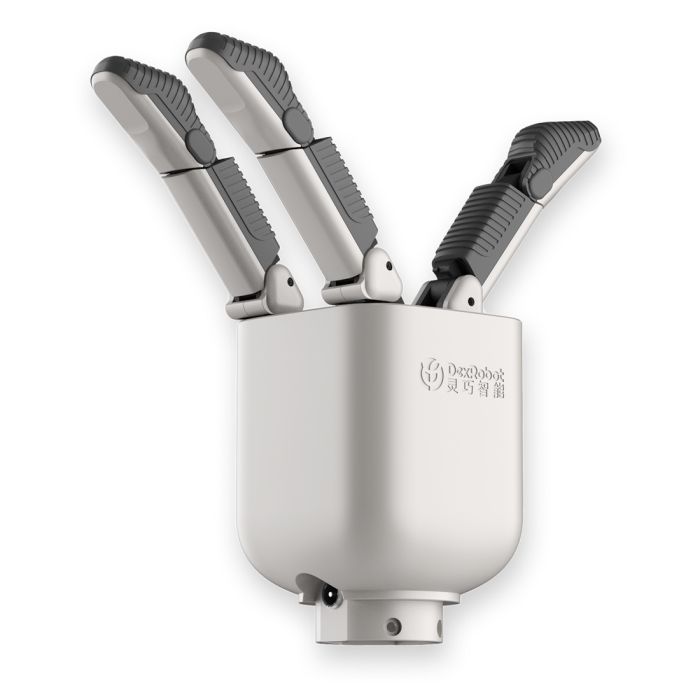
Dexrobot 021S High-Function Three-Fingered Dexterous Hand (021S)
In stock
- BRAND:
- DEXROBOT
- PART #:
- 021S
- ORIGIN:
- China
- AVAILABILITY:
- SUBJECT TO AVAILABILITY
- SKU:
- DexRobot-021S
021S High-Function Three-Fingered Dexterous Hand (021S)
DexRobot describes the 021S as targeting “80% of core hand manipulations” while remaining lightweight, open-source oriented, and mass-producible—attributes that align with current demand for affordable manipulation hardware in embodied AI, service robotics, and light industrial tasks.
Design and Features
Three-finger architecture for practical manipulation
Unlike five-finger humanoid hands optimized for anthropomorphic dexterity, the 021S focuses on a three-finger configuration intended to cover common grasp types efficiently. DexRobot positions this design as a pragmatic compromise: fewer fingers and mechanisms can reduce cost and complexity while still enabling stable pinches, tripod grasps, and many everyday pick-and-place actions.
Lightweight “bionic” exterior and durability focus
DexRobot highlights a bionic design with an elastic soft body and micro-textured surface, intended to provide a more skin-like contact feel and improved object interaction.
Durability is treated as a primary design goal: the 021S is presented as passing a 200,000-cycle loaded life certification, and the parameter sheet lists a service life of 200,000 cycles (with 500 g load).
Transmission concept and development ecosystem
A core selling point is its “three-mode intelligent transmission” combining gear + tendon + linkage, alongside a rigid-flexible coupling and a braided flexible rope approach mentioned in the technical highlights.
For integration, DexRobot emphasizes open-source SDK support and multi-protocol compatibility to speed secondary development and deployment.
Technology and Specifications
Key technical parameters (manufacturer-published)
The DexRobot 021S is specified with the following headline characteristics:
| Specification | DexRobot 021S (DexHand021 S) |
|---|---|
| Weight | 0.6 kg |
| Degrees of freedom (DOF) | 8 DOF |
| Drive type | Motor |
| Transmission | Gear + Tendon + Linkage |
| Grip force | 22 N → 44 N → 100 N (Peak) at fingertip/pad/base |
| Rated / max load | Rated 2.5 kg, Max 5 kg (3-finger cooperative lift) |
| Repeat positioning accuracy | ±0.5 mm (no load) |
| Max finger open/close speed | 150°/s (no load) |
| Max finger rotation speed | 130°/s (no load) |
| Operating voltage | DC 24 V |
| Static / max current | 0.1 A / 2 A |
| Control mode | Position control |
| Communication | CAN FD / RS485 |
| Sensors | Angle + Vision (standard); Tactile (optional) |
| Operating environment | 0–40°C (indoor); ≤80% RH |
Sensing and control implications
The published sensor configuration indicates a baseline focus on joint/angle feedback plus vision-based perception (standard), with optional tactile sensing for applications that require contact-rich manipulation (e.g., slip detection, force-limited grasping, or more robust in-hand control).
On control, the 021S lists position control explicitly, suggesting a straightforward integration path for developers who want deterministic grasp postures, scripted trajectories, and repeatable pick-and-place routines.
Applications and Use Cases
Industrial automation and light assembly
DexRobot’s examples include electronic component assembly, conveyor sorting, and automotive wire harness plug-in tasks—use cases where a compact dexterous end-effector can outperform simple parallel grippers in handling irregular parts, cables, and mixed-object bins.
Research and embodied AI development
The 021S is positioned for bionics research and AI training, supported by its open development framing (open SDK / rapid secondary development) and hardware claims around repeatability and durability. This pairing is often attractive for university and lab teams that need a robust platform for learning-based grasp policies without committing to higher-cost humanoid hands.
Medical and laboratory handling (tool/object delivery)
DexRobot also lists syringe grasping, test tube dispensing, and surgical instrument delivery as illustrative medical scenarios. In practice, deployments in regulated clinical contexts typically require additional safety engineering, validation, and workflow integration; nonetheless, the cited examples reflect the broader suitability of dexterous hands for delicate object handling when combined with appropriate sensing and control.
Advantages / Benefits
Low mass for easier arm integration
At 0.6 kg, the 021S can reduce payload burden and inertia at the robot wrist, which can improve dynamic performance and lower energy consumption compared with heavier multi-finger hands.
Practical capability with simplified complexity
With 8 DOF and a three-finger grasp geometry, the 021S aims at a “useful middle ground” between simple grippers and full humanoid hands—especially for tripod grasps, pinches, and many pick-and-place tasks.
Integration-friendly electrical and communications stack
Support for DC 24 V power and CAN FD / RS485 communications aligns with common industrial and research robot integration patterns, potentially simplifying deployment in labs, mobile manipulators, and cobot-adjacent setups.
Durability-oriented claims
A stated 200,000-cycle service life (with load) is a notable positioning point for labs and integrators who need repeatable testing cycles and longer maintenance intervals.
FAQ Section
What is the DexRobot 021S (021S)?
The DexRobot 021S is an ultra-lightweight, industrial-grade three-finger dexterous robotic hand designed for robot-arm integration, offering 8 DOF, 0.6 kg weight, and CAN FD/RS485 communications.
How does the DexRobot 021S work?
The 021S uses motor-driven actuation with a combined gear + tendon + linkage transmission architecture to move its three fingers through coordinated grasp postures, controlled primarily through position control.
Why is the DexRobot 021S important?
It targets a common robotics gap: providing dexterous grasping beyond simple grippers while remaining lightweight and positioned for lower-cost adoption, which can accelerate research, prototyping, and practical automation pilots.
What are the benefits of the DexRobot 021S?
Key benefits include 0.6 kg low mass, 8 DOF dexterity, published grip-force staging up to 100 N peak (by contact region), and CAN FD/RS485 integration options—plus durability claims of 200,000 cycles under load.
Summary
The DexRobot 021S (DexHand021 S) is a three-finger, 8-DOF dexterous robotic hand designed to deliver broadly useful grasping performance in a 0.6 kg, integration-friendly package with DC 24 V power and CAN FD/RS485 communications. Positioned as an entry-cost dexterous hand and backed by durability and ecosystem claims, the 021S is aimed at teams that need a practical bridge between simple grippers and high-end humanoid hands for industrial pilots, logistics handling, and robotics research.