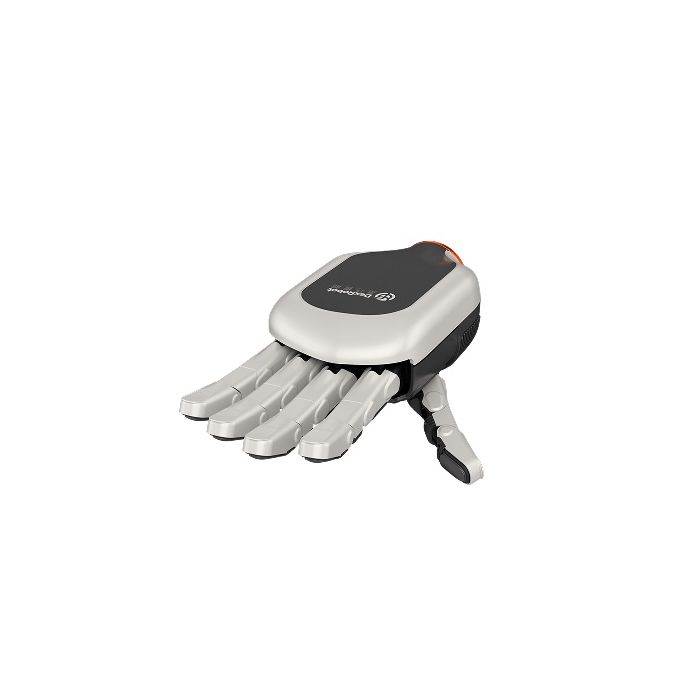
Dexrobot 021MP High-DOF,Multi-Modal,Perceptive Intelligent General-Purpose Dexterous Hand (021MP)
In stock
- BRAND:
- DEXROBOT
- PART #:
- 021MP
- ORIGIN:
- China
- AVAILABILITY:
- SUBJECT TO AVAILABILITY
- SKU:
- DexRobot-021MP
021MP High-DOF,Multi-modal,Perceptive Intelligent General-Purpose Dexterous Hand (021MP)
DexRobot’s official product materials describe its mass-produced DexHand as “the first mass-produced, high-DOF, multi-modal intelligent general-purpose dexterous hand,” emphasizing reliability, low-power posture holding, modular finger maintenance, and broad integration support.
Because distributor naming conventions vary, 021MP is most usefully understood as a market label for DexRobot’s mass-produced DexHand021-class hardware, with published specifications and platform capabilities provided on DexRobot’s official “production” DexHand page.
Design and Features
Five-finger architecture with high dexterity
DexRobot’s production DexHand platform is specified at 19 degrees of freedom (DOF), consisting of 12 active and 7 passive DOF, a configuration intended to balance fine motion with mechanical robustness and controllability in real-world deployments.
Tendon-driven transmission and motor actuation
The production DexHand uses motor drive with tendon transmission, a design approach frequently used in dexterous hands to achieve compact finger routing and compliant interaction with objects.
DexRobot also highlights independent maintainability: each of the five fingers is independently replaceable, supporting faster service and reduced downtime in lab or pilot environments.
Low-power posture holding
A core design claim of DexRobot’s production hand is posture holding without power drain, targeting scenarios where a robot must maintain a grasp or hand pose for extended periods without continuous high current draw.
Multi-modal perception for manipulation
DexRobot describes the hand as multi-modal with “perceivable modalities” that include Position, Force, Slip, and Proximity, enabling richer closed-loop control than position-only grippers.
In its specification table, the platform lists sensors including Position, Tactile, and Force, consistent with manipulation workflows such as grip stabilization, contact detection, and force-limited interactions.
Technology and Specifications
DexRobot’s official “production” DexHand specifications include:
-
Weight: 1.0 kg
-
Degrees of Freedom: 19 (12 active + 7 passive)
-
Drive type: motor; Transmission: tendon
-
Operating voltage: DC 24V
-
Static current: 0.2 A; Maximum current: 7.4 A
-
Load capacity: 5 kg (system-level)
-
Single-finger fingertip strength: 1,000 g load capacity (per finger, as presented)
-
Communication: CAN FD
-
Cycle time: < 1.0 s
-
Lifespan: >150,000 cycles
-
Control modes: Position, Trajectory, Force
-
Software/OS integration: ROS1, ROS2, micro-ROS
-
Tactile sensor figures (published): Normal force 20 N; Proximity > 1 cm
DexRobot also describes an “AI capabilities” ecosystem that includes simulation assets, a toolkit for motion mapping/teleoperation and learning methods (reinforcement and imitation learning), and integrations such as motion capture, VR, and gesture recognition, reflecting the hand’s positioning for embodied AI and learning-based manipulation pipelines.
Applications and Use Cases
Humanoid robot end-effector for general manipulation
A high-DOF dexterous hand like the 021MP is typically used as a humanoid robot end-effector for tasks where multi-finger contact matters: stabilizing irregular objects, pinching, rotating items in-hand, and performing humanlike grasp families. DexRobot’s production page explicitly states the hand supports 15+ human hand operations such as cylindrical grasp, spherical grasp, and multi-finger pinching.
Robotics research and education
With published support for ROS1/ROS2/micro-ROS, CAN FD, and multi-modal sensing, the platform aligns with common lab stacks for perception-to-control experimentation, grasp planning research, and manipulation benchmarks.
Education programs can use such a hand to teach grasp taxonomy, tactile feedback concepts, and closed-loop force control beyond what parallel grippers typically allow.
Industrial prototyping and light automation
Although dexterous hands are not always the simplest choice for high-throughput factory automation, they can be valuable in prototyping cells where product variation is high, tooling changes are frequent, or the goal is to emulate human handling of parts and tools. The published 5 kg load capacity and force-capable control modes support exploratory automation and demonstration deployments.
Embodied AI, teleoperation, and learning-based control
DexRobot’s stated ecosystem—simulation, teleoperation/motion mapping, and learning toolkits—targets teams building data-driven manipulation systems, including imitation learning pipelines that learn grasp behaviors from human demonstrations and reinforcement learning approaches tuned in simulation before transfer.
Advantages / Benefits
High dexterity with practical integration
The combination of 19 DOF, CAN FD, and ROS compatibility provides a pragmatic route for system integrators to mount the hand on a robot arm and connect it to common robotics middleware without building a custom stack from scratch.
Multi-modal sensing for stable grasps
Published modalities—position, force, slip, and proximity—support a more robust grasp loop than position-only actuation, helping reduce drops and improving delicate handling when tuned appropriately.
Reliability and maintainability for repeated use
DexRobot highlights >150,000 cycles and modular maintenance (independently replaceable fingers), which are key practical requirements for labs, classrooms, and pilot deployments where uptime and serviceability often determine whether a platform is usable day-to-day.
Low-power posture holding
“Posture holding without power drain” is a meaningful advantage for mobile robots and long-duration demos because it can reduce heat, noise, and energy consumption while maintaining stable hand poses.
FAQ Section
What is the Dexrobot 021MP dexterous hand?
The Dexrobot 021MP is a high-DOF, multi-modal, general-purpose dexterous robotic hand (five-finger end-effector) commonly used for humanoid manipulation, robotics research, and advanced grasping demonstrations.
How does the Dexrobot 021MP work?
DexRobot’s production hand uses motor actuation with tendon transmission and combines position/tactile/force sensing with control modes such as position, trajectory, and force, enabling closed-loop grasping behaviors.
Why is the Dexrobot 021MP important?
High-DOF dexterous hands are important because they enable humanlike grasp families (pinch, spherical, cylindrical, in-hand rotation) and can support embodied AI research where tactile feedback and multi-finger contact improve manipulation performance and robustness.
What are the benefits of the Dexrobot 021MP?
Published benefits include 19 DOF (12 active + 7 passive), multi-modal perception (including force/slip/proximity), CAN FD + ROS compatibility, posture holding without power drain, 1.0 kg hand weight, and >150,000-cycle durability claims.
Summary
The Dexrobot 021MP is best understood as a commercial, mass-produced DexRobot dexterous hand positioned for humanoid manipulation, R&D, and advanced grasping demonstrations. With published specs including 19 DOF (12 active + 7 passive), tendon-driven transmission, CAN FD communications, ROS1/ROS2/micro-ROS support, multi-modal sensing (including force/slip/proximity), and durability claims beyond 150,000 cycles, it targets teams that need a practical, maintainable path to high-fidelity robotic hand manipulation and embodied AI development.