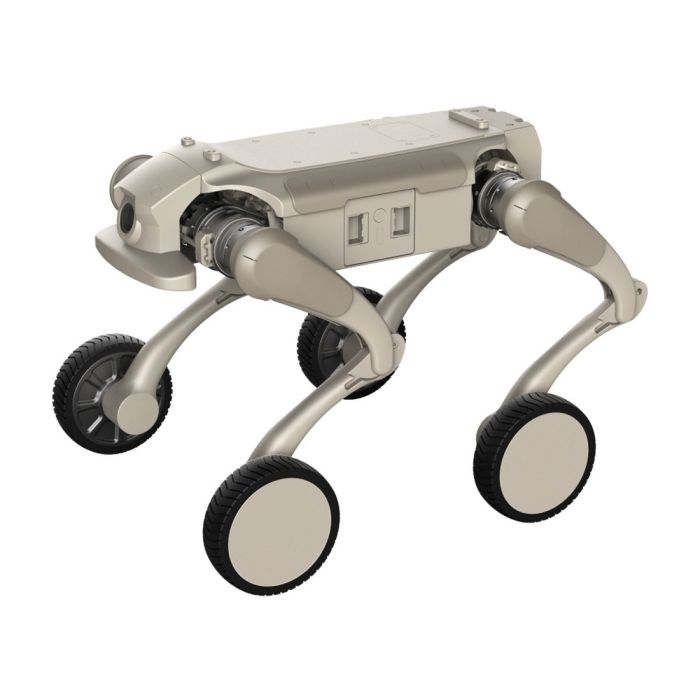
Genisom L1-W Ultra Compact Industrial Grade Wheeled Quadruped Robot Dog
In stock
- BRAND:
- GENISOM
- PART #:
- L1-W
- ORIGIN:
- China
- AVAILABILITY:
- SUBJECT TO AVAILABILITY
- SKU:
- Genisom-L1-W
Genisom L1-W Ultra Compact Industrial Grade Wheeled Quadruped Robot Dog
n practice, wheeled-quadruped designs aim to blend two locomotion modes: wheel efficiency on smooth surfaces and legged adaptability on uneven terrain or obstacles. The L1-W is commonly presented alongside the closely related Genisom L1 platform; where detailed specifications for the L1-W are not publicly itemized, many sources describe the L1 family’s sensors, compute, ruggedization, and payload class as the baseline for the wheeled variant.
Design and Features
Wheeled-quadruped chassis
The defining feature of the L1-W is its wheeled quadruped configuration—listed explicitly as its robot type—enabling faster, lower-energy travel on flat floors while retaining leg articulation for maneuvering.
Rugged compact platform
Listings for the L1 platform emphasize industrial ruggedization (including an IP66 rating for dust/water ingress protection), indicating suitability for harsh indoor/outdoor use cases such as industrial plants, construction sites, and outdoor patrol routes.
Note: Public retail pages explicitly state IP66 for Genisom L1; the L1-W is marketed as an industrial wheeled quadruped, but not all pages repeat every environmental rating for the L1-W.
Payload interface and modularity
The L1 platform is commonly described with a light payload capacity (listed as 1.5 kg payload) and a modular sensor stack (LiDAR, cameras, etc.), consistent with use as a carrier for inspection sensors, mapping payloads, or small tools.
Technology and Specifications
Mobility and physical characteristics
Retail specifications for the Genisom L1 (often used as the baseline reference for the L1 family) include:
-
Weight: 11 kg
-
Payload: 1.5 kg
-
Operating time: 1.5–2 hours
-
Maximum speed: 6 m/s
These figures are typically cited for the L1 platform; the L1-W’s wheeled configuration may change real-world endurance and speed depending on terrain and duty cycle, but public listings consistently frame the L1-W as part of the same compact industrial class.
Onboard compute and autonomy
The L1 platform is listed with 28 TOPS of AI compute, reflecting onboard inference capability for navigation, perception, and autonomy functions (e.g., obstacle avoidance, target tracking, or mapping pipelines).
Sensors and perception stack
Public specifications for the L1 platform list a multi-sensor configuration including:
-
LiDAR: 360° LiDAR
-
Cameras: binocular front camera plus additional camera(s) (listed as “binocular camera / front and rear camera”)
-
Optional thermal imaging camera
This sensor stack supports common robotics workloads such as SLAM (simultaneous localization and mapping), teleoperation with situational awareness, and perception-driven navigation.
Communications and control
The L1 platform listing includes Wi-Fi and Bluetooth, which are typical for teleoperation, mission upload, and local device pairing in controlled environments.
Applications and Use Cases
Industrial inspection and patrol
The L1-W’s wheeled quadruped form is well suited for routine inspection routes in warehouses, factories, campuses, and utility corridors—especially where a robot must cover distance efficiently but still handle ramps, thresholds, or rough patches.
Research and education
Compact quadrupeds are widely used in labs for testing autonomy stacks (navigation, mapping, perception) because they provide real-world dynamics without the cost and complexity of full-size industrial platforms. The L1 family’s listed sensor suite (LiDAR + cameras) and onboard compute support these workflows.
Security, situational awareness, and remote sensing
With multi-camera support and optional thermal imaging on the L1 platform, the L1-W class is often positioned for remote monitoring, perimeter checks, and low-light or heat-signature assessment (depending on payload configuration).
Payload carriage for specialized tools
A 1.5 kg payload class is typically aligned with inspection sensors (gas detectors, compact thermal modules, small RF scanners) rather than heavy manipulation.
Advantages / Benefits
-
Efficiency on smooth surfaces: Wheels reduce energy use and increase throughput on floors, long corridors, and paved paths compared with purely legged motion.
-
Adaptability vs. wheeled-only robots: Leg articulation can help with obstacles that stop standard delivery AMRs (thresholds, uneven ground, debris).
-
Sensor-ready autonomy platform: The L1 family’s published LiDAR/camera stack and onboard compute are consistent with modern navigation and inspection workloads.
-
Rugged positioning: IP66 on the L1 platform indicates a design goal of environmental robustness.
FAQ Section
What is the Genisom L1-W?
The Genisom L1-W is an industrial wheeled quadruped robot (“wheeled robot dog”) designed as a compact mobile platform for inspection, research, and sensor payload missions.
How does the Genisom L1-W work?
It combines wheel-based travel (efficient movement on smooth surfaces) with leg articulation that improves maneuverability around obstacles. Like the broader L1 family, it is typically paired with perception sensors (e.g., LiDAR/cameras) and onboard compute for autonomy and teleoperation.
Why is the Genisom L1-W important?
Wheeled quadrupeds fill a niche between standard wheeled AMRs and fully legged robots: they aim to deliver faster, more power-efficient routing than leg-only systems while maintaining better obstacle tolerance than many wheeled-only platforms.
What are the benefits of the Genisom L1-W?
Key benefits include efficient movement on smooth routes (via wheels), improved obstacle handling compared with many AMRs (via leg articulation), and a sensor-ready autonomy platform aligned with the L1 family’s published LiDAR/camera stack and onboard compute.
Summary
The Genisom L1-W is positioned as a compact industrial wheeled quadruped robot aimed at inspection, research, and sensing missions where efficient movement on smooth routes must be balanced with the ability to handle obstacles and mixed terrain. Public listings emphasize its industrial role and wheeled-quadruped identity, while widely circulated L1 family specifications highlight a modern autonomy stack (LiDAR/cameras, onboard compute) and light-payload capability suited to inspection-class deployments.