Inspire RH56E2 Dexterous Robot Hand (RH56E2)
In stock
- BRAND:
- INSPIRE ROBOTS
- PART #:
- RH56E2
- ORIGIN:
- China
- AVAILABILITY:
- SUBJECT TO AVAILABILITY
- SKU:
- Inspire-RH56E2
Inspire RH56E2 Dexterous Robot Hand (RH56E2)
RH56E2 Dexterous Robot Hand (RH56E2)
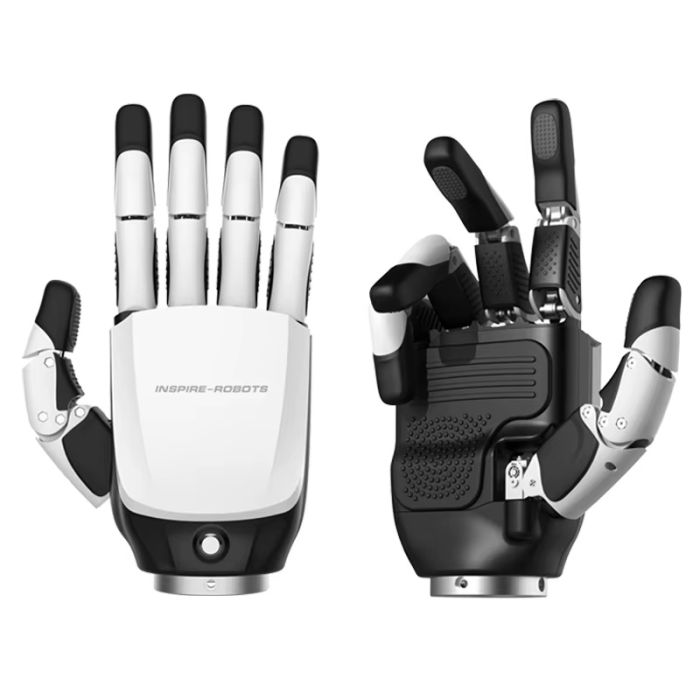
Marketed as a “humanoid five-finger dexterous hand,” the RH56E2 is positioned for research and applied robotics use cases such as service robotics, manipulation R&D, teleoperation experiments, and humanlike grasp studies.
A defining characteristic of the RH56E2 family is its emphasis on tactile perception and closed-loop gripping. The manufacturer describes a configuration with up to 17 tactile sensor modules in a single hand, intended to support real-time acquisition of tactile information across multiple contact areas.
Design and Features
Humanoid five-finger layout
The RH56E2 uses a five-finger form factor intended to approximate common human grasp patterns (pinch, power grasp, tripod, etc.) while keeping control complexity manageable through a limited set of actuated degrees of freedom (DOF). The series is listed with 6 DOF and 12 joints, reflecting a design where multiple joints may be mechanically coupled or underactuated relative to a fully actuated anthropomorphic hand.
Integrated sensing for manipulation
The RH56E2 series is specified with:
-
Force sensors: 6 (with a listed 0.5 N force sensor resolution in the RH56-series manual).
-
Tactile sensors: a configurable range described as 5–17, and marketing claims of 17 tactile sensor modules per hand in certain configurations.
This combination supports manipulation workflows where the controller can adjust grip thresholds depending on object hardness or slip risk. The RH56-series user manual describes a built-in pressure/force-sensing approach intended to enable threshold-based grasping behaviors.
Power-off self-lock (anti-backdrive behavior)
The RH56E2 series is marketed with a “power-off self-lock” feature, described as stable and reliable and intended to hold position without requiring re-homing at power-up.
(Implementation details—mechanical self-locking, braking, or actuator characteristics—are not fully described in the public snippets, but the feature is presented as a core selling point.)
Technology and Specifications
Degrees of freedom, joints, and actuation
Public manufacturer specs list 6 DOF and 12 joints for the RH56E2 series.
The RH56-series manual describes the hand as integrating six linear servo actuators, emphasizing small size and high torque density for finger motion.
Force output and accuracy
The RH56E2 series lists:
-
Maximum fingertip output force: 30 N (series spec).
-
Repeated fingertip positioning accuracy: ±0.2 mm (series spec).
The RH56-series manual also provides example gripping-force values (e.g., differentiated “DF” and “BF” force figures for fingers and thumb), which may vary by configuration; it nonetheless indicates the hand is designed for controlled gripping rather than purely kinematic demonstration.
Electrical and communication interfaces
Key interface details include:
-
Operating voltage: DC 24 V (±10%) (series spec)
-
RS485 / Modbus-style control: The RH56-series manual lists RS485 as the communication interface and describes register-based control and configuration.
-
Modbus TCP + CAN (RS485 optional): The RH56E2 series page (Chinese) lists Modbus TCP + CAN, with RS485 optional, indicating variants exist depending on integration needs.
The RH56-series manual further notes that RS485 bus connection can be expanded to many devices on a shared bus (with appropriate conversion circuitry), and that RS232/CAN may be available on customized versions.
Physical characteristics and motion range
The RH56E2 series lists:
-
Weight: 790 ± 10 g (series spec).
-
Thumb lateral rotation range: >85° (series spec).
-
Thumb angular speed: >130°/s; four-finger angular speed: >200°/s (series spec).
Applications and Use Cases
Robotics research and dexterous manipulation
The RH56E2’s combination of five-finger geometry, force sensing, and tactile sensing is commonly aligned with:
-
Dexterous grasp research (grasp planning, in-hand manipulation experiments)
-
Learning-based manipulation (reinforcement learning and imitation learning using tactile/force feedback)
-
Benchmarking object interaction across textures, compliance, and shapes
Service robots and mobile manipulators
The RH56-series manual explicitly lists suitability for service robots and similar systems, where robust grasping and object handling can benefit from threshold-based force control.
Education, training, and prototyping
Because the interface is described as register-based and supports parameter configuration and motion control from a PC or embedded controller, the RH56E2 can be used in lab environments for robotics courses, demonstration rigs, and prototyping of grippers/end-effectors.
Advantages / Benefits
Tactile-enabled grasp refinement
Configurations with up to 17 tactile sensors are intended to improve real-time perception of contact, enabling finer control strategies than position-only grasping—particularly for uncertain or delicate objects.
Closed-loop force threshold control
The RH56-series manual describes using sensing and configurable thresholds to grip objects of different hardness, which is useful for repeatable grasping without excessive squeeze force.
Integration-friendly control interfaces
Support for common industrial/robotics communication approaches (RS485/Modbus-style control, and variants listing Modbus TCP + CAN) can simplify integration into robot controllers and lab testbeds.
FAQ Section
What is the Inspire RH56E2 Dexterous Robot Hand?
The RH56E2 is a five-finger dexterous robotic hand with 6 degrees of freedom, integrated force sensing, and optional tactile sensing (up to 17 tactile sensors) for real-time contact feedback during grasping and manipulation.
How does the RH56E2 work?
The RH56-series design integrates six linear servo actuators to move the fingers and uses sensor feedback (force/pressure and tactile modules) so a controller can set grip thresholds and adjust grasp behavior. Control and configuration are described through a register-based interface over supported communications (e.g., RS485/Modbus-style control and variants listing Modbus TCP + CAN).
Why is the RH56E2 important for dexterous manipulation?
Dexterous manipulation often depends on knowing not only finger position but also how and where an object is contacted. The RH56E2’s tactile-sensing configurations are intended to provide richer contact information than position-only grippers, which can improve grasp stability and help reduce slip or excessive force.
What are the benefits of the RH56E2 compared to simpler robot grippers?
Compared with two-finger or suction end-effectors, the RH56E2 provides a five-finger grasp envelope, repeatable fingertip positioning (±0.2 mm), and integrated sensing (force and tactile options) for more humanlike grasp strategies and contact-aware control—useful for research, service robotics, and manipulation prototyping.
Summary
The Inspire RH56E2 dexterous robot hand is a five-finger, 6-DOF end-effector designed for tactile- and force-informed grasping, combining configurable tactile sensing (up to 17 sensors), repeatable fingertip positioning, and integration-oriented control interfaces.